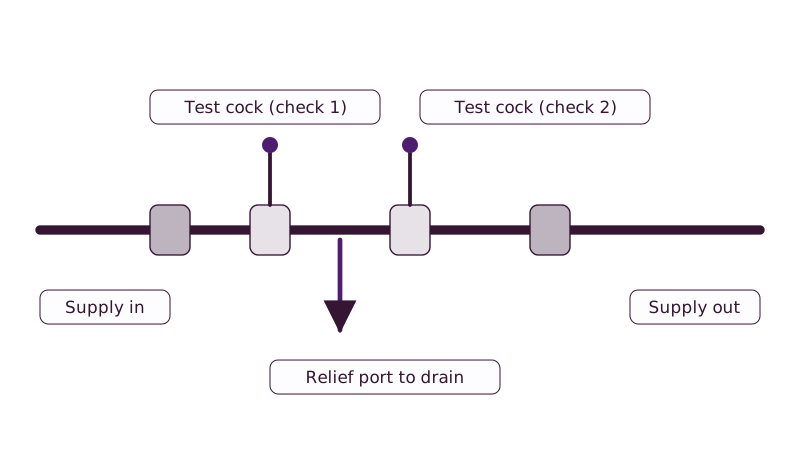
A backflow assembly works like a one-way gate in the plumbing: it stops used or contaminated water inside a building from seeping back into the street main. Many businesses have one at the main, or on a sprinkler feed, irrigation line or boiler. A tester holding the right credential checks each device, and the paperwork goes to the water supplier. The page is written for owners and property managers who need that test done. Broader commercial work, after-hours calls included, is on the commercial plumbing page, and the request form is on our home page.
What happens during commercial backflow testing?
For a few minutes the tester cuts the supply to the device, connects a differential gauge to the small test ports, and watches whether the internal checks and the relief port keep the pressures they were built for. The readings are recorded on a form. A failure is repaired or flagged, and the form goes to the water supplier. Expect a short visit with the water off while the gauges run.
Schedule around that shutoff. A restaurant should choose a slow hour, a salon should avoid appointments, and a building with a sprinkler assembly must tell the fire monitoring company if the system will be out of service. A failed assembly can often get new parts during the same visit, but a larger device may need parts ordered, so ask when you book. The test walkthrough covers it step by step.
Who sets the testing frequency for a commercial property?
Your water supplier sets it. California public water systems run cross-connection control programs, notifying customers when a device comes due and naming the credential they accept. Many suppliers require a yearly test, and some may ask for shorter intervals at riskier sites. Confirm the schedule with the agency on your water bill.
The rules behind this have been shifting. A state water board staff report describes a policy handbook in which each water system drafts a cross-connection control plan relying on credentialed testers, and the older Title 17 section 7605 on testing and upkeep has been repealed. Testing did not end with it. Suppliers continue to enforce schedules through their own programs, so follow the notice in your mailbox.
Whom to call depends on your address. Riverside Public Utilities takes customer questions at (951) 782-0330, and Western Water, which covers areas such as Orangecrest, at (951) 571-7104. Most Moreno Valley addresses are served by EMWD, with a small western area served by Box Springs Mutual, (951) 653-6419. Loma Linda operates its own city water utility. We cannot confirm a neighborhood-level map, so read the bill.
What follows when a backflow assembly fails the test?
A failure means an internal part leaks or fails to seal. The tester may clean or replace the worn piece, such as a check disc, spring or relief seat, and then retest. The supplier wants a passing report, and many set a deadline. Some systems limit service when a failed assembly is left alone, so a notice deserves an answer.
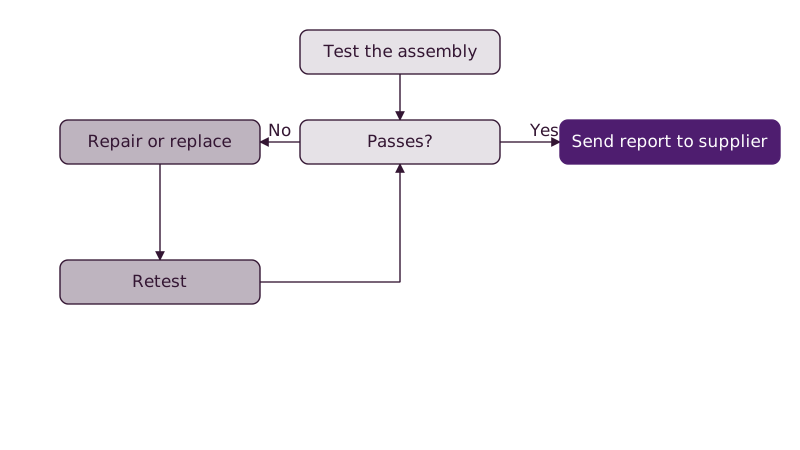
Replacing an old, corroded assembly outright may be the better path, which is plumbing work with its own requirements; ask whether a permit applies. California requires a contractor for any job reaching $1,000 in labor and materials and for anything driven by a permit, and the licensing board's website verifies a number. Keep every test report on file, because inspectors and suppliers can ask for the history.
What other work do commercial plumbers take on?
Commercial plumbers work on larger, busier systems than a residential crew: multi-stall restrooms, grease interceptors, floor drains, heaters sized for a kitchen or salon, sewer laterals, gas lines to equipment and sprinkler feeds. They also repair under time pressure, since a business cannot always close during a pipe fix. How their time is billed is explained in the commercial plumber hourly guide.
A backflow visit is a good chance to have someone look over the rest of the water room: shutoff valves that do not fully close, a regulator that has crept above 80 psi, or a leaking union. These are easier to fix on a planned visit than in an emergency. The home-property angle on the same topic is in the guide to backflow prevention testing.
How does pricing work for a commercial backflow test?
Start by describing the property: how many assemblies, their size in inches if the tag is legible, the type of business and where the devices are. The local plumber then writes a price down. No dollar range appears here, because we could not verify any published guide figure for backflow testing, and the total depends on how many devices there are and how large.
Send the request through the quote form and attach the supplier's notice if you have it. Ask the plumber to confirm the tester holds a credential your supplier recognizes, who files the report, and whether a repair price is given before parts are swapped. Each point belongs in the written quote.
Common questions
Does every business need backflow testing?
How much time does a commercial backflow test take?
Is any plumber able to test a backflow assembly?
What should a business owner have on hand?
Does residential backflow testing differ?
Sources used
- Cross-Connection Control Policy Handbook staff report, California State Water Resources Control Board
- 17 CCR 7605, Testing and Maintenance of Backflow Preventers (repealed), Cornell Legal Information Institute
- Riverside Public Utilities, contact us
- Western Municipal Water District, about us
- Box Springs Mutual Water Company
- Contractors State License Board
Page updated