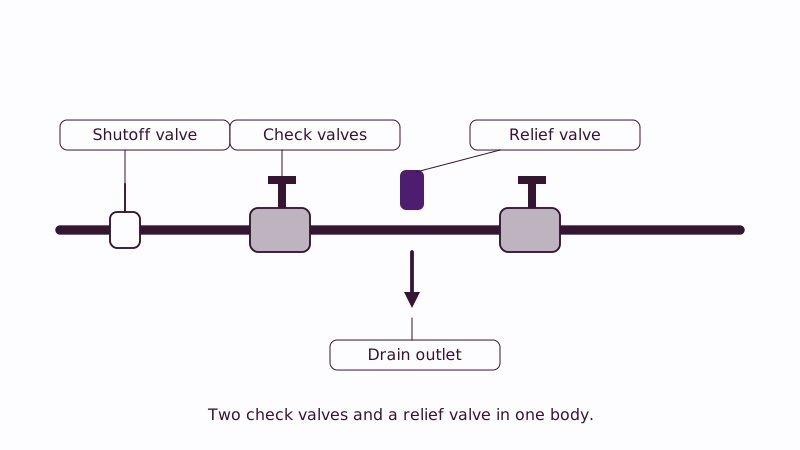
Plumbing depends on one-way travel, from the street main to your taps. A backflow device, made of spring-loaded check valves, holds that line when pressure drops, so sprinkler runoff, pool water or any other downstream liquid cannot get pulled backward into the public supply. It protects people only while it still seals, which is why the supplier wants a test on file. This is one of the rule-driven jobs covered under permits, codes and inspections, and what follows is the home-and-small-property version.
Where would a homeowner encounter a backflow device?
Mostly on the lawn sprinkler system, where a vacuum breaker or a larger assembly sits beside the zone valves. Other places include a pool or spa fill line, a fire-protection sprinkler feed, a boiler, or a main-line device the supplier required. Many houses have only the small anti-siphon fittings on hose bibs, and those are not tested.
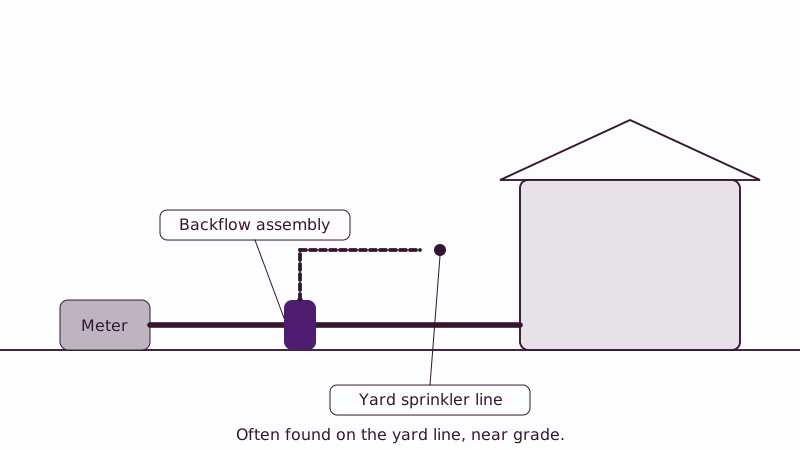
Unsure? Look for a bronze or steel assembly with two shutoff handles and small test ports on top, usually in a yard box or on the wall by the irrigation line. Then go through your water bill and any mailed notices. The supplier tells you which devices it tracks. In Riverside that may be Riverside Public Utilities, (951) 782-0330, or, for some addresses, Western Water, (951) 571-7104. Most Moreno Valley addresses are on EMWD, and Loma Linda addresses use the city's utility. The name on your bill settles it.
What does a backflow prevention test measure?
The tester closes the handles in order, attaches a gauge to the ports and reads how each internal check responds, plus the relief valve. A device passes when it resists reverse flow and its relief port opens at the right pressure difference. The readings go onto a form sent to the supplier.
None of this shows from the outside, since a device can drip or look fine and still fail. Expect a short visit and a few minutes without water. Step-by-step detail is in the testing walkthrough. Shop or office owners should read commercial backflow testing, where planning the shutoff matters more.
Who is allowed to run the test?
The supplier decides which tester credential counts, and many keep a list or ask for proof on the report form. A cross-connection staff report from the state water board describes a policy handbook under which water systems rely on credentialed testers, and says the older Title 17 testing language is repealed. Follow your supplier's latest notice.
A tester credential and a contractor license are different things. Under state rules, work reaching $1,000 in labor and materials, or anything driven by a permit, goes to a contractor, and the licensing board's lookup verifies a number. Repairs after a failed test can cross that line. Ask for both when booking and keep a copy of the report.
Is it possible to earn backflow testing credentials online?
Many sites sell online backflow courses. None of them were checked by us, and a course alone may not meet what a supplier accepts. Programs usually combine approved training, a hands-on exam and a gauge kit. With rules shifting, anyone hoping to become a tester should ask the supplier or the state drinking water program which program it recognizes before paying anything.
An owner's question is simpler: you do not need the credential yourself, only a tester who holds it. Request proof before the visit, and confirm the report uses your supplier's form. A pitch that mentions online credentials without naming a program calls for follow-up questions.
Is it part of a plumbing inspection for a mobile home or older house?
Not automatically. An inspection looks over supply lines, drains, the water heater, shutoffs and visible leaks, while a backflow test examines only the protective device. Mobile and manufactured homes may have an irrigation or park-supply connection that park management tracks, so ask whether the park or you handles devices.
A wider survey is described in the inspection cost guide, which lists what one includes. In your request, name the device, its location and which notice arrived. A plumber can pair the test with a look at the shutoffs and house pressure.
What if the device fails?
A failure means a check or relief valve leaks. The typical repair is swapping the worn internals, or the whole assembly if it is corroded or discontinued, then retesting. A supplier may set a deadline, and some restrict service when a failed device goes unfixed, so a notice should not sit in a drawer.
Replacing an assembly can involve cutting pipe and may trigger a permit, so have the plumber's answer in writing. Riverside Building and Safety, at (951) 826-5800, handles city permit questions. The written quote should show the test price, any repair parts and who files the paperwork. Begin with the quote form.
Common questions
How frequently must a backflow device be tested?
How much time does it take?
Which questions come first when hiring a tester?
Does someone need to be present during the test?
Is a backflow device the same as a pressure regulator?
For the wider picture, start with Rubidoux Ridge Plumbing.
Sources used
- Cross-Connection Control Policy Handbook staff report, California State Water Resources Control Board
- 17 CCR 7605, Testing and Maintenance of Backflow Preventers (repealed), Cornell Legal Information Institute
- Riverside Public Utilities, contact us
- Western Municipal Water District, about us
- Contractors State License Board
Page updated