A leak is water going somewhere it should not, and the plumber begins by tracing the origin, which often sits a few feet away from the stain. Close the main valve, keep power away from wet areas, and call. Through us, a local plumbing business can visit your home in Riverside, Moreno Valley or Loma Linda, locate the source and write up the repair first. Start on the quote page and the business that takes the request calls you back.
This page covers what plumbers use to stop leaks, what happens when the pipe is under the house, who pays when the leak is outside, and how to find one you cannot see.
Which clamps work to stop a leaking pipe?
A repair clamp is a stainless steel band with a rubber sleeve that wraps around a tiny hole or short crack in a pipe and squeezes it closed. A hardware store sells them by pipe size. They buy time on a supply line, they do not replace the damaged section, and a plumber will usually remove the worn length and fit new pipe or fittings.
Match the clamp to the pipe. Copper, PEX and galvanized steel all have different outside diameters, and a clamp that is a size too big will weep. Tighten it evenly, turn the supply back on gradually, and check for drips over the next hour. A clamp on a pipe that has been corroding for years often fails next to the clamp, because the pipe wall around the hole has thinned as well.
What do plumbers use to stop a leak?
A plumber starts by closing a valve, then repairs the pipe itself. That means cutting out the damaged length and soldering in new copper, crimping PEX, or replacing a threaded fitting. Clamps and compression couplers handle the quick fixes. For a joint that weeps, the cure is a clean, dry, correctly made connection rather than more tape or sealant stacked on a bad one.
The tools show the job. A press tool makes copper joints without flame, a PEX crimper handles plastic lines, and a pipe cutter gives a clean square edge. When the leak is behind drywall, the plumber cuts a small access opening, fixes the pipe, and leaves the wall for a patch. Larger pipe sections, like a failed galvanized run, are better handled as part of a repipe than one repair after another.
Does flex seal really stop water leaks?
Spray and brush-on sealants can slow a drip, and the maker markets them for many repairs. Plumbers treat them as a stopgap, not a fix. A coating does not restore a failing pipe wall, it rarely holds on a wet surface under steady pressure, and it hides the damage until it fails again. Use one, if at all, to get through the night, then have the pipe repaired.
If a coating is on a pipe when the plumber arrives, say so. The plumber has to clean it off to see the metal and to make a proper joint, and knowing what was applied saves time. Never apply a sealant to a gas pipe, and never cover a leak at a water heater relief valve, because that valve is there to let pressure out.
What happens if a pipe leaks under a house?
Water under a house can sit against the foundation, rot wood framing in a raised-foundation home, and feed mold. In a home built on a concrete slab, a leaking line under the floor is called a slab leak. Early signs include a floor that feels warm underfoot, running water you can hear with every fixture shut, a climbing water bill, or carpet that is damp along a wall.
To pinpoint the leak, the plumber relies on acoustic listening gear and pressure tests, then chooses the least costly sound fix: a local repair cut through the slab, a new route for the line overhead or in the walls, or a repipe. A This Old House guide, updated April 7, 2026, gives $150 to $600 for finding the leak, and slab leak repair ranges from $630 to $4,400, with an average near $2,300. These are national guide figures, not Riverside rates or what we charge. The written quote sets the price.
Older homes in Downtown Riverside, the Wood Streets, Arlington and the Eastside often have galvanized or older copper lines that are worn from the inside. Tract homes put up between the 1970s and the 1990s in Moreno Valley and La Sierra raise a different question, because the original copper is now 30 to 50 years old. Newer areas such as Orangecrest were built later, so the plumbing is more likely to be PEX or newer plastic pipe, and a plumber looks hard at the fittings there. For more depth, read the comparison of slab leak repair or repipe and the slab leak repair cost breakdown.
Who pays for repair if a water leak is in an underground pipe?
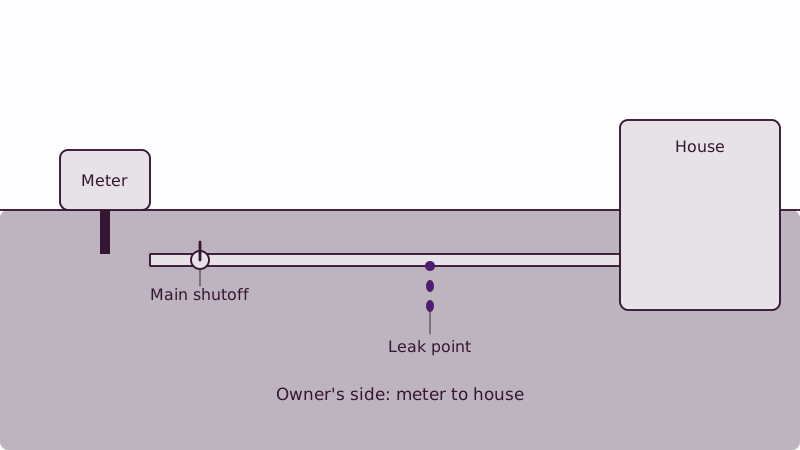
In general, the property owner pays for the private line running from the meter to the house, while the water utility handles the main and the meter side. In most systems the owner is responsible for the stretch between meter and house. Confirm with your own utility, because boundaries differ by agency and by address.
Which agency that is depends on where you live. Riverside Public Utilities serves most of the city, and its customer service line, (951) 782-0330, is also its water emergency line. Western Municipal Water District serves some Riverside addresses, so confirm on your bill. Eastern Municipal Water District serves most of Moreno Valley, and the City of Loma Linda runs its own water. Your bill shows which one serves you. A sewer lateral leak is a separate pipe: for Riverside sewer questions the city lists Public Works at (951) 826-5311.
Homeowners insurance may cover resulting damage from a sudden burst, but policies differ on paying to fix a worn pipe. Read the policy, take photos, and ask the insurer before you start repairs.
How can I locate a concealed water leak at home?
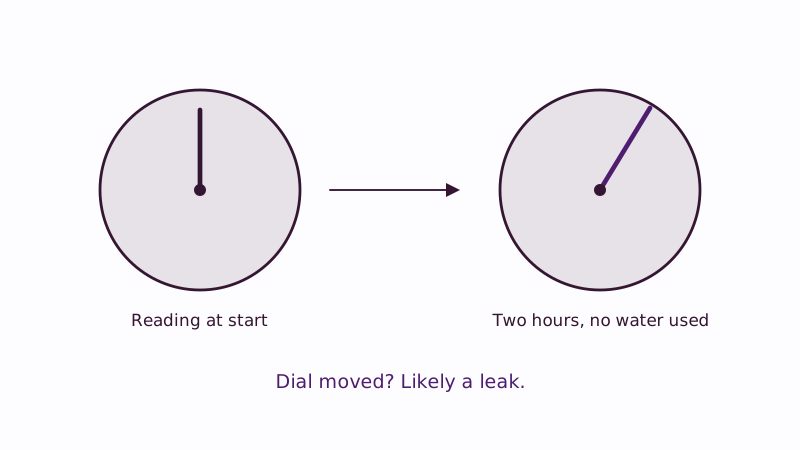
Start with the water meter. Shut every tap and appliance, note the reading, leave the water unused for two hours, then read it a second time. According to EPA, any change in the meter means a leak is probable. If the dial moves but the house is dry, the leak is likely underground, under the slab or behind a wall.
Two other checks cost nothing. First, compare your winter water use: EPA says a family of four above 12,000 gallons a month could have serious leaks. Second, put several drops of food coloring into each toilet tank and give it ten minutes. Color appearing in the bowl means the flapper is leaking, which is the most common hidden leak. EPA adds that leaks in a typical household can waste over 9,300 gallons yearly.
If the bill is high but nothing is visibly wrong, the page on a high water bill with no visible leak lists the checks in order. For stains overhead, start with ceiling water leaks and the signs of a leak in the ceiling.
Can I get an emergency plumber when water is leaking?
Yes. A burst pipe, or any leak the main valve cannot slow, counts as an emergency, and the emergency plumber page covers what to do until help comes. Close the main, drain the lines through a low faucet, move valuables, and cut power to wet areas only if the panel is safely reachable.
We answer requests Monday to Friday, 9am to 5pm. If water is pouring in overnight or on a weekend, close the main and call the utility number printed on your bill. We make no promise about how fast a plumber arrives. The plumber business that takes your request tells you its own availability when it calls. The same shutoff steps appear in how to know if a pipe burst.
Common questions
Does house insurance cover a pipe leak?
What happens if you have a burst pipe?
Does a burst pipe cost a lot to repair?
Which water leak do houses get most often?
Can I repair a pipe leak without turning off the water?
Guides in this section
- Burst pipe prevention
How to keep a pipe from bursting in the Inland Empire: pressure limits, corrosion, cold snaps, water hammer and the shutoff valve to find…
- Burst water pipe
A burst water pipe in Riverside needs quick action.
- Ceiling water leak
Water coming through your ceiling? Shut off the water, stay clear of electricity, contain it, then find the source.
- Leaks and burst pipes
Does homeowners insurance cover a burst pipe?
- Leaks and burst pipes
Burst pipe in Riverside? Shut the water off first, then see what an emergency visit involves and what guide figures say it costs.
- High water bill no
A high water bill with no wet spots usually means a hidden leak.
- How to know if a pipe burst
Warning signs of a burst pipe in a Riverside home, where to look first, how to stop the water and what to do about damage and insurance.
- Pinhole leak repair
Stop a pinhole leak in copper pipe for now, fix it for good, dry a wet ceiling and learn what repeated pinholes say about the rest of the…
- Burst pipe underground
Soggy ground, a dropping pressure gauge and a meter that keeps turning are the main clues to an underground pipe burst.
- Pipe leak repair
Stop a leaking water pipe fast, find where it starts, learn which fixes hold and which need a plumber, and see how pipe age in Riverside…
- Plumber leak detection cost
Guide prices for finding and fixing a water leak: detection, pipe repair, main line and slab leaks.
- Ceiling leak signs
Brown stains, sagging drywall, drips and musty smells all point to a ceiling leak.
- Slab leak detection and repair
How a slab leak is found and fixed in a Riverside home: warning signs, detection methods, repair or reroute options and guide prices with…
- Costs
A 2026 guide puts slab leak repair at $630 to $4,400, with detection $150 to $600.
- Leaks and burst pipes
Choosing between spot repair and repiping after a slab leak.
- Burst pipe water damage
What a burst pipe does to floors, walls and wiring, the first 48 hours that decide mold risk, and how to document the loss and get the…
- Water leaking from a ceiling light
Water dripping from a ceiling light fixture is an electrical and plumbing hazard.
- Water spots on ceiling
A ceiling stain with no obvious leak can come from condensation, a slow pipe drip, a roof or a duct.
- Leaks and burst pipes
Pressure, age, corrosion, cold snaps and heat can all split a pipe.
Sources used
Page updated