Nobody does their own backflow test. Riverside's water utility expects an approved tester to perform it and send in the paperwork, and permit-level plumbing follows a similar logic. Inspection, gas and code topics sit together under permits, codes and inspections.
Below: the annual test step by step, the owner's part, how a plumbing permit gets requested, and the moment a local plumber should take over.
How is a backflow test actually done?
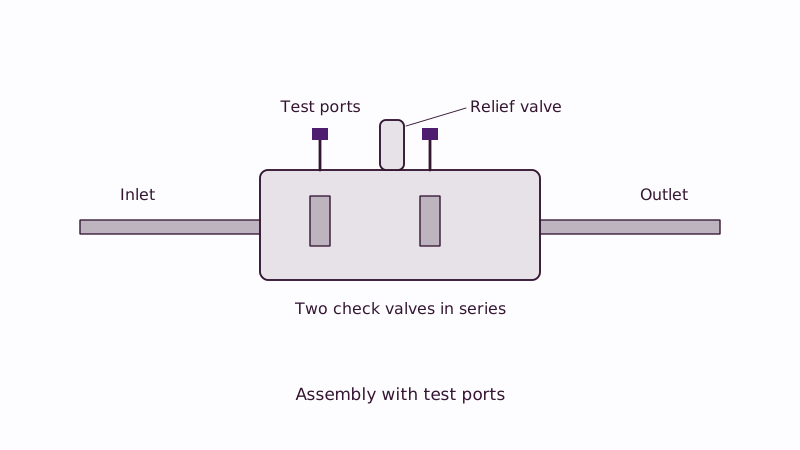
In general, the tester hooks a calibrated gauge set up to the small ports built into the assembly, closes valves in a set order, checks how the valves hold pressure and records pass or fail on a form. A passing assembly stays in service, and the utility receives the report. A failure means repair first, then another test.
These assemblies sit on lines such as irrigation, fire protection or commercial service, and their job is to stop water flowing in reverse back into the public supply. Riverside Public Utilities describes six approved assembly types, including double check valve, reduced pressure principle and pressure vacuum breaker.
The visit is generally brief, yet that line may have no water while the test runs, so sprinklers or a shop's service can pause. Warn anyone using the line ahead of time.
At what point should a plumber take over?
Bring in a plumber for an assembly repair, a retest following a failed result, gas piping, a heater swap, a repipe or anything inside a wall. The state licensing board sets the bar: a contractor license is needed once labor and materials reach $1,000, and for any job that requires a permit.
We do not do the work ourselves. Use the written quote request and a local plumbing business will be arranged to review your case. Say whether it is a utility test notice, a permit question or both, so a suitable business gets it. Other services are on the Rubidoux Ridge Plumbing home page.
Smell gas? Leave the building at once, then call SoCalGas at 1-800-427-2200 once you are outside, or dial 911 if you are in danger. Permits never come into that.
What is the testing schedule?
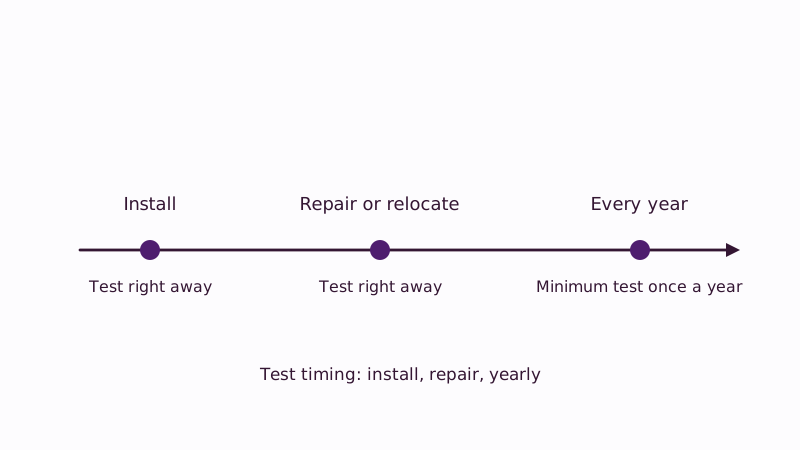
RPU's backflow page says every device needs a test no less than yearly. Ask RPU or your tester whether a new, moved or repaired assembly needs its own test, and what deadline applies after a failed result, because we could not read the utility's rule text. The tester completes the report form and it goes to the utility.
Book the fix as soon as a test fails. The repair is plumbing work a plumber can take on, and the retest comes after it.
Note for homeowners: a plain house usually does not have a testable assembly. They appear mostly where an irrigation system, a pool fill, a fire line or a commercial service ties into the water supply. Your utility notice tells you whether you have one. Business properties are covered separately in commercial backflow testing and testing services.
What are the steps to get a plumbing permit here?
Inside the City of Riverside, the city says a permit may be issued to the property owner, an authorized agent or a contractor. Applications can be made through the city's Public Permit Portal or at the Permit Services counter, 3900 Main Street, 3rd Floor. Questions go to Building and Safety, (951) 826-5800.
The city publishes a trade permit application tutorial, but it is an older document, so follow the steps shown on the live portal. Expect to describe the kind of work, attach supporting documents, state the job cost and list any equipment such as a water heater.
Before applying, confirm that your job needs a permit. The city lists some small repairs as exempt, such as faucet or toilet repair or replacement, while replacing piping behind the wall face or below the floor requires one. A water heater replacement usually needs a permit here, though Building and Safety has the final word.
What goes on the form, and do I need drawings?
Give the property address, the job cost, a short plain-language description of the work, who will do it and any equipment going in. For simple replacements a written description may be enough. Whether your job needs drawings is a question for Building and Safety.
If drawings are asked for, a scaled sketch of existing and new fixtures with pipe sizes and routes is the usual start, and a plumber who pulls permits often will know what the city accepts. Moreno Valley permits run through its Building and Safety Division, (951) 413-3350. Unincorporated areas deal with County of Riverside Building and Safety, (951) 955-1800.
Do not start work and plan to apply afterward. Inspections are tied to the permit, and work covered up before an inspection may have to be opened again.
Which testers may work on Riverside assemblies?
RPU's backflow page says only backflow prevention testers approved by the City of Riverside may test the equipment. You cannot swap in your own gauge and fill out the form yourself, so ask the testing company to confirm its approval with the city before you book the visit and pay for it.
The customer carries the responsibility for follow-up. RPU says it is ultimately the customer's responsibility to follow up with the tester they hire and confirm the reports reach RPU by the due date.
For questions about the program, RPU lists (951) 351-6386 and (951) 351-6167 on its backflow page. Confirm which testers are currently on the approved list before you hire one, since a list can change.
Common questions
Is the test a long visit?
What should I ask a tester before booking?
Must someone be on site for the test?
Sources used
Page updated