A repipe swaps out the supply lines that carry water from the meter to each faucet, toilet and appliance in the house. It is worth considering once the old pipe is failing from the inside, with repeated leaks, brown water and weak flow at every fixture. We pass your request to a local plumbing business that inspects the pipe and writes a quote for a full or partial job. The home page lists the other jobs we handle, or you can ask for a quote directly.
Below you will find the meaning of the term, the lifespan of new pipe, the do-it-yourself question, the steps of a typical job, and the guide prices.
What does "repiping" mean?
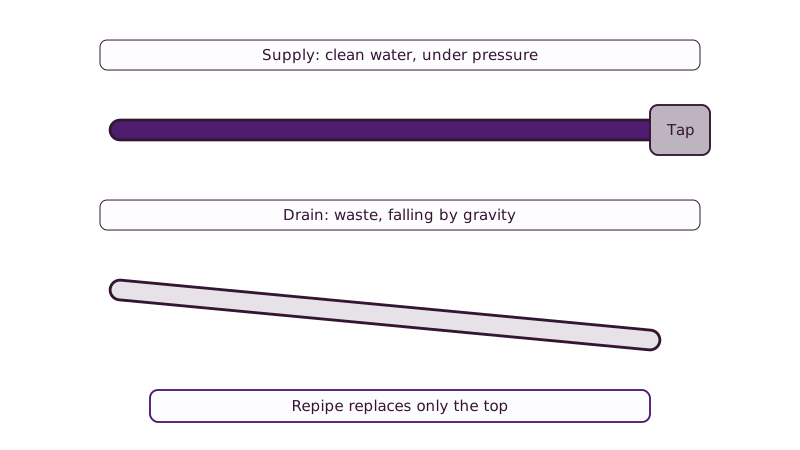
Repiping is the replacement of a home's potable water lines, the pressurized pipes that feed your taps, with new tubing, usually PEX or copper. It does not touch the drain pipes that carry waste out. A full repipe covers all of the supply piping throughout the home. A partial repipe replaces one zone, such as a bathroom group or a single failing run.
Crews open small access holes in drywall, route or pull the new lines, connect them to the fixtures and the shutoff, test under pressure, then you or a contractor patch the walls. Newer homes built with copper or modern plastic lines are less likely candidates. Older homes with galvanized steel, or with polybutylene, which was sold in some homes from roughly the late 1970s through the 1990s, are the usual candidates.
How long does repiping a house last?
New PEX or copper supply lines are expected to last for decades, though published guides differ on the exact number and we cite none here. Any lifespan is a general expectation, not a promise for any one house. Water chemistry, pressure, installation quality and fittings all change the answer.
Local water matters. In 2025 Riverside Public Utilities reported average hardness of 197 mg/L, around 12 grains per gallon, within a range of 180 to 210. Eastern Municipal Water District's 2025 table for the Mills service area lists averages from 5.1 to 7.5 grains per gallon depending on source. Hard water leaves scale inside pipe and on heating elements, so a water heater feels it before the pipes do. Use a regulator if needed to hold pressure below the 80 psi cap set by section 608.2 of the California Plumbing Code.
Is it hard to plumb your own house?
Yes, it is hard. A whole-house repipe is demanding for anyone who is not a plumber, and Riverside's permit handout says a permit is required to replace piping inside the wall face or beneath the floor. Cutting into walls, running dozens of connections, keeping the water on for the family, and passing inspection add up to a large job that most owners do not want.
Smaller repairs are different. The same city handout lists faucet or toilet repair or replacement as exempt from permits. Phone the Building and Safety counter ahead of time: City of Riverside, (951) 826-5800; City of Moreno Valley, (951) 413-3350; Loma Linda permit questions, (909) 799-2836. Gas lines and anything the code reserves for contractors should not be touched. A contractor license is required in California for jobs reaching $1,000 in labor and materials and for any job that needs a permit, so hiring a plumber with a CSLB license is the safe route for a whole-house job.
How do you repipe your house?
First comes an inspection that settles what to replace and how the new lines will be routed. Next the water is shut off, access holes are cut, new PEX or copper is run from the main to each fixture, connections are made and pressure-tested, the city inspector signs off if a permit was pulled, and the walls are patched or left for a drywall contractor.
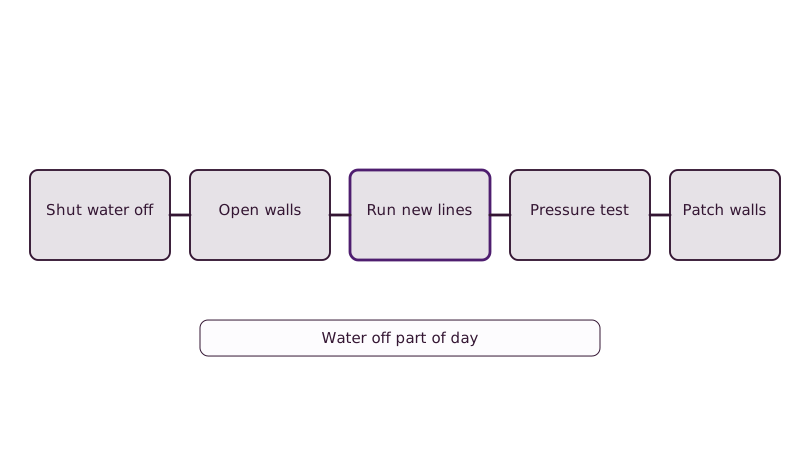
On some jobs the work is staged so water is off only part of each day instead of throughout. Raise that when you review the quote. The plumber also decides whether to route lines through the attic, through the crawl space or through walls, which changes both the cost and the number of holes. Two-story homes may allow attic runs, while single-story slab homes may need new lines through walls and ceilings instead of under the floor.
Is it possible to clamp a copper pipe?
Yes, briefly. A rubber-sleeved clamp over a copper pinhole can hold back a drip until a plumber arrives. Treat it as a temporary patch only. If the pipe has one pinhole it probably has others, because corrosion tends to run the length of the line. Repeated pinholes are one of the clearest signs that a repipe is worth pricing.
Pitting inside the pipe often comes from aggressive water or from the pipe's age, and a clamp does nothing about either. If you have clamped the same run more than once, that is the point to get a quote. For small, single leaks the leaking pipe repair page explains the quicker options, and pinhole leaks in copper explains the clamp approach step by step.
How many days does a house repipe take?
A typical single-family home often needs a few days from first cut to final patch, and larger or harder-to-reach homes take longer. That is a general expectation, not a schedule, and the plumber business that takes your request will tell you its own timeline in the written quote. Weather is rarely a factor, because most of the work is indoors.
Delays come from permit and inspection timing, from surprises inside the walls, and from drywall repair. Find out if the quote includes patching and paint or stops at the access holes. A partial repipe of one bathroom group can be a day or two.
Does a repipe pay off?
Get a price when leaks keep coming back, when the pipe is a known problem material, or when a remodel already has the walls open. Spending money on one repair after another on a failing system often costs more than one planned job, and a burst line in a wall causes damage that dwarfs the pipe itself.
Know the guide figures. Bob Vila's PEX vs. copper guide, updated July 23, 2025, gives an example for an average two-bath, 1,500 square foot home: PEX at about $4,000 to $6,000 and copper at about $8,000 to $10,000. Those are national guide figures for one example house, not Riverside rates and not what we charge. Larger homes cost more. The written quote sets the price, and getting two is fair. Our repipe cost page goes through what moves the number.
Which repipe method costs the least?
In the guide above, PEX is the lower-cost option, about half the copper figure for the same example house. A partial repipe of just the failed section costs even less, provided the remaining pipe is sound. Choosing a plumber who explains what each line is made of is better than choosing the lowest number on a quote.
Avoid the cut-rate route of patching a bad pipe with coatings or repeated clamps. To compare the trade-offs, read the PEX or copper comparison and the page on what PEX repiping costs. If your home has polybutylene, see polybutylene pipe replacement; for older steel pipe, galvanized pipe replacement.
Is my house due for a repipe?
Watch for these signs: brown or rusty water at first use, pressure that keeps dropping, pinhole leaks showing up at several spots, green corrosion on the pipe joints, or a known problem material such as galvanized steel or polybutylene. A house that has none of these probably does not need it.
Timing matters as well. A plumber can identify the pipe material and say whether it is close to done. For timing and expectations read how frequently a house needs repiping and why repipe a house. Sizing up leaks first? Start with slab leak repair or repipe.
Common questions
Which three systems make up plumbing?
What is the replacement schedule for house water pipes?
What would a 2000 sq ft house repipe cost?
What is the 135 rule for plumbing?
What is the repipe price for a $1200 square foot house?
Guides in this section
- Galvanized pipe replacement
Galvanized pipes rust from the inside and choke flow.
- How often to repipe
There is no fixed interval for repiping a house.
- Repiping and pipe replacement
How a whole-house repipe works, from shutting the water off to patching walls, how slab homes are handled, and what a Riverside owner…
- PEX repipe cost
PEX repipe cost from national guides: about $4,000 to $6,000 for a two-bath home versus $8,000 to $10,000 for copper.
- Repiping and pipe replacement
PEX or copper for a Riverside repipe: guide prices, flow, lifespan, cold weather and what an older home or mobile home changes.
- Polybutylene pipe replacement
Homes built from about 1978 to 1997 may have polybutylene pipe.
- Costs
What a whole-house repipe costs according to national guides, what moves the price in Riverside homes, and how to compare written quotes…
- Repiping and pipe replacement
Why homeowners in Riverside repipe: failing galvanized or polybutylene lines, pinhole leaks, low pressure and rusty water.
Sources used
Page updated