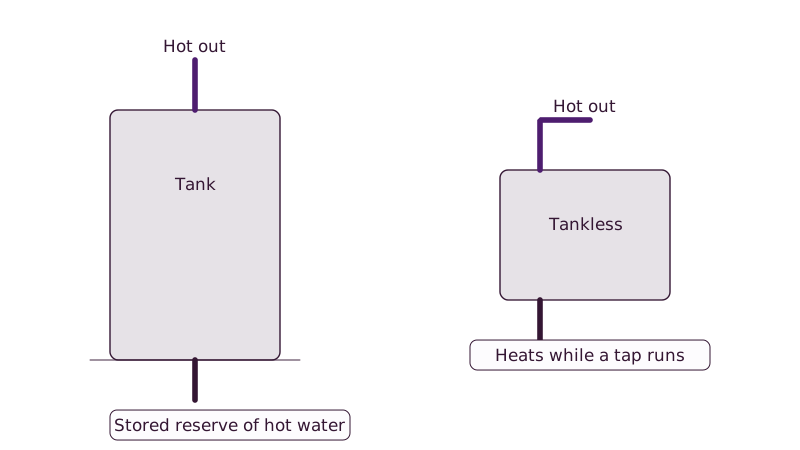
A storage heater keeps a full tank of water hot around the clock and tops itself off after each use. A tankless heater does nothing until you open a faucet. The tank costs less to buy and set in place; the tankless model frees up wall space and keeps producing hot water as long as its burner or element can keep pace. If yours is acting up today, read what a repair visit covers first, then return here before you commit to a replacement.
Which suits my house, a tank or tankless?
Neither wins everywhere. Pick a tank when the lowest installed price matters most and you want a like-for-like swap without new gas or electrical work. Pick tankless when showers stack up, floor space is tight, or you expect to stay long enough to earn back the higher purchase price. Your fuel type and existing pipes usually settle it.
One way to frame it: tally what runs at once on your busiest morning, say a shower, the dishwasher and the laundry. A tank copes with the overlap until the hot water is spent. A tankless unit copes while its rated flow exceeds the combined draw. An undersized tankless unit can leave a shower lukewarm, so have the plumber size from fixtures instead of bedroom count.
What do tank and tankless heaters cost installed?
Across national guides, installed tank heaters land near $800 to $2,700 depending on fuel and size, and tankless units near $2,100 to $4,500. This Old House (updated June 17, 2026) puts tank jobs at $1,200 to $2,300 and tankless at $2,100 to $4,000. Fixr shows gas tanks at $1,000 to $2,700 (January 30, 2026) and electric tanks at $800 to $1,500 (January 27, 2026).
On tankless, Fixr's guide from January 31, 2025 calls $2,500 to $4,500 typical. All of this is national guide data, neither a local rate nor our charge. The written quote sets the price, and it ought to spell out the model, venting, any gas line upgrade and the permit.
| Heater type | Installed range from guides | Guide source |
|---|---|---|
| Gas tank | $1,000 to $2,700 | Fixr, Jan 30, 2026 |
| Electric tank | $800 to $1,500 | Fixr, Jan 27, 2026 |
| Any tank | $1,200 to $2,300 | This Old House, Jun 17, 2026 |
| Tankless | $2,100 to $4,000 | This Old House, Jun 17, 2026 |
| Tankless, typical | $2,500 to $4,500 | Fixr, Jan 31, 2025 |
Deeper numbers sit in replacement pricing and the tankless price guide.
What changes between gas and electric versions?
Gas models burn fuel and so need venting and a supply line, while electric ones need no vent yet draw a lot of power. SoCalGas serves Riverside, Moreno Valley and Loma Linda, so natural gas is the usual choice in these cities. Propane heaters exist, but they only come up in places without a gas main, and we have not verified supply options for any specific street.
Going from a tank to gas tankless often means a larger gas pipe, since the burner draws more fuel at once, along with a different vent. Going electric tankless can mean heavy-gauge wiring and spare panel capacity. Such add-ons explain why two quotes on one model may differ by hundreds. Gas line work needs a permit and falls under rules we cover in gas line work. For the gas version, see gas tankless installation.
What does local hard water do to each type?
Heating water drops scale out of it. Riverside's utility reported average hardness of 197 mg/L (about 12 grains per gallon, range 180 to 210) across its 2025 testing. In a tank, sediment settles on the bottom and the element or burner labors. In a tankless unit, scale lines the heat exchanger, which is why makers typically specify routine descaling.
Moreno Valley's supplier, EMWD, reports Mills-area hardness of about 5.1 to 7.5 grains per gallon for 2025, depending on source. Western Water's Riverside service area report lists groundwater averaging 155 mg/L. Check which utility is on your bill. If you own a tankless unit in an area at the harder end, ask the installer about a flush valve kit on the unit and read scale prevention.
What wears out first on each type?
Tanks tend to give out from interior corrosion, and the anode rod is the part designed to be sacrificed so the steel lasts longer. Tankless units have more parts that can fail, such as igniters, sensors and flow valves, but the unit is usually repairable piece by piece. Lifespan figures vary by brand and water quality, so we do not print a number here; read the manufacturer's warranty terms.
Puddles at the base are the classic end-of-life sign. Seepage through the shell calls for a new tank, while a weeping fitting or relief valve can be repaired. The replacement timing guide lists the signs, and tankless repair covers the other type.
What permit and strapping rules apply?
In Riverside a water heater swap generally counts as permitted work, and the city's handout on work exempt from permits leaves water heaters off the exempt list. Confirm with Building and Safety at (951) 826-5800. Moreno Valley and Loma Linda have not published a clear rule that we could verify, so call their building offices, (951) 413-3350 and (909) 799-2836.
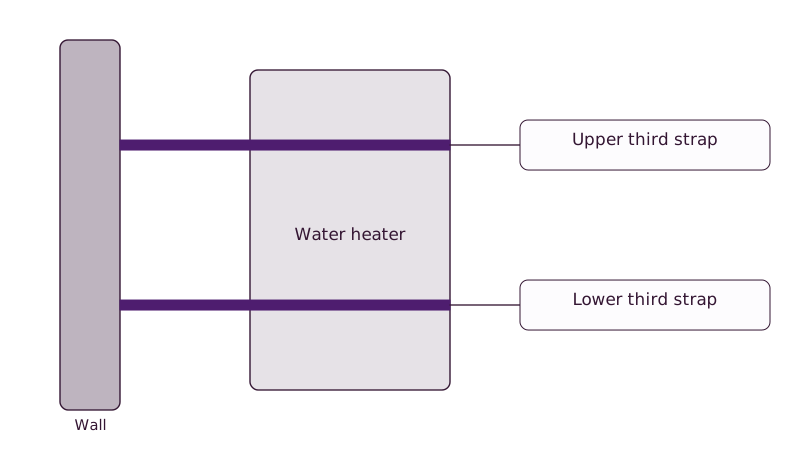
California law calls for bracing or strapping water heaters so that a quake cannot topple them. A tank heater is the bigger concern because of its weight, and tankless units are lighter but still get anchored. Separately, the regional air board decided in June 2025 against changing its water heater emission rules, which means no zero-NOx mandate is arriving from that process. Gas and permit jobs go to a contractor. In California that line starts at $1,000 for labor plus materials.
Which one for a small house, a condo or a large family?
A condo or one-bath house often does well with a modest tank, and a closet tank is simple to swap. A large family with three bathrooms sees real benefit from tankless, as long as the gas line and vent can handle it. A home with a recirculating loop needs a plumber to check that the unit supports it.
Older homes, such as the orange-grove-era houses in Downtown Riverside, the Wood Streets and Arlington, can have tight utility closets and older gas piping, so a tankless swap may open up other work. Newer tracts in Orangecrest and east Moreno Valley may be easier, since they were built later, though the plumber has to check each home. Once a plumber sees the space, the answer takes minutes.
Common questions
Does tankless pay for itself?
What happens during a tankless install?
Can a tankless unit be repaired?
Is a 2016 tank vs tankless comparison still accurate?
How do I size a heater?
See Rubidoux Ridge Plumbing plumber for the other services and what they cost.
Sources used
- How Much Does Water Heater Installation Cost (2026), This Old House, updated June 17, 2026
- How Much Does a Gas Water Heater Cost in 2026, Fixr, updated January 30, 2026
- Electric Water Heater Installation Cost in 2026, Fixr, updated January 27, 2026
- Tankless Water Heater Installation Cost, Fixr, updated January 31, 2025
- Riverside Public Utilities 2025 Water Quality Report
- SoCalGas, cities served
- City of Riverside Building and Safety
- Western Water, 2025 Annual Water Quality Report
- EMWD, 2025 Water Quality Report
- California Contractors State License Board
Page updated