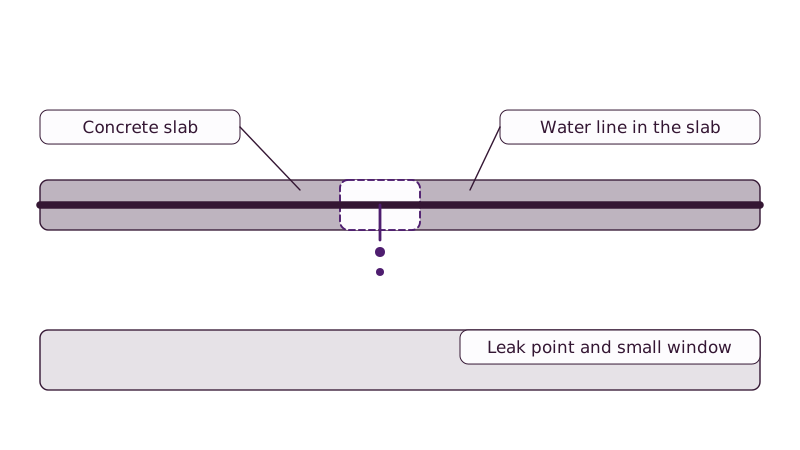
When a water line beneath a concrete floor leaks, you face two real options: open the slab and repair the one spot, or retire the buried line and install new pipe along an easier path. The right pick turns on the pipe, how many leaks there have been and how long you intend to remain in the house. Start with the overview of leaks and burst pipes, then use the questions below.
How can I tell the leak is under the slab?
Telltale signs include a floor patch that feels warm, running-water noise even though every fixture is shut, a bill that climbed while your routine stayed the same, weak pressure, and damp carpet or lifted flooring along one wall. A warm spot with no heater nearby points to a hot-water line. Check the meter with all taps off: a moving dial confirms a leak somewhere.
Do not assume the slab is the culprit. A dripping pipe in the attic or a wall can run down and look like a floor problem. Leak detection, with sound and pressure tests, narrows it down before anyone cuts concrete. This Old House's slab leak guide, updated April 7, 2026, puts detection at $150 to $600, a fraction of what opening a floor costs. Pay for that first.
Gas needs a different rule. A gas smell near the floor means going outside and phoning SoCalGas on 1-800-427-2200 before anyone else.
When does a spot repair make sense?
A spot repair suits a single leak on a line that is otherwise healthy, especially in a newer home whose pipe is still in good shape and where the leak sits in an open area of floor. The plumber locates the leak precisely, cuts a small window in the slab, replaces the section and patches the concrete. Cost and disruption stay low.
It also fits when you are selling soon or the rest of the plumbing was updated earlier. Ask the plumber to photograph the pipe around the failure. If the copper looks thin, pitted or green for a long stretch, that single patch is a warning that more leaks will follow.
When is repiping the better answer?
Repiping makes sense when a line has failed more than once, when the pipe is old galvanized or thin copper that is wearing from the inside, or when the leak is under a spot nobody wants to jackhammer, such as tile through the whole kitchen. Each new spot repair also resets the clock on the same weak pipe.
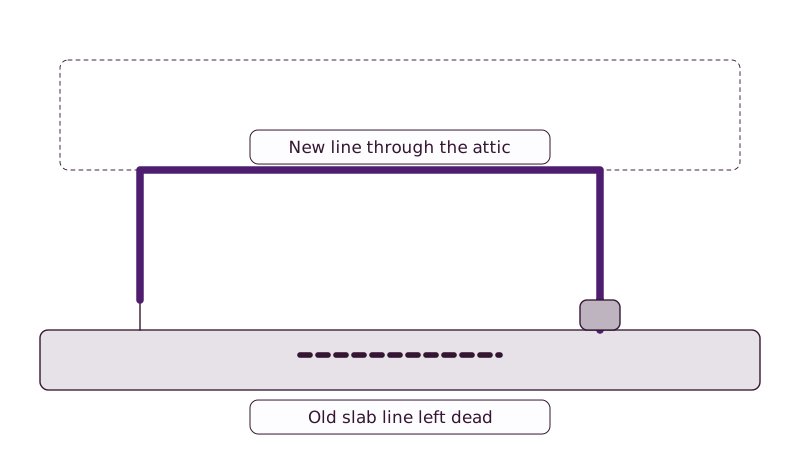
A common approach on a slab house is to leave the buried line dead and route new pipe along the attic and walls, which avoids concrete work altogether. PEX is a frequent choice here, since it turns corners easily and requires fewer cuts. The route is chosen on site, so the quote should say exactly where each line will run and where drywall will be opened and patched.
Older Riverside neighborhoods such as Downtown, the Wood Streets and the Eastside may have older pipe, and 1970s to 1990s tract homes in Moreno Valley and La Sierra have pipe that is aging too. Ask the plumber what material your lines are and how they look, because once a second or third leak turns up, owners usually start weighing patching against repiping. For more detail see our guides on whole-house repiping and comparing PEX and copper.
What does each choice cost?
This Old House, updated April 7, 2026, gives a $2,300 average for slab leak repair, with prices spanning $630 to $4,400. For repiping, Bob Vila's PEX versus copper guide, updated July 23, 2025, lists $4,000 to $6,000 with PEX and $8,000 to $10,000 with copper, for a typical two-bath, 1,500 square foot house.
| Job | Guide range | Source and date |
|---|---|---|
| Leak detection | $150 to $600 | This Old House, April 7, 2026 |
| Slab leak spot repair | $630 to $4,400, average $2,300 | This Old House, April 7, 2026 |
| Whole-house repipe in PEX | $4,000 to $6,000 | Bob Vila, July 23, 2025 |
| Whole-house repipe in copper | $8,000 to $10,000 | Bob Vila, July 23, 2025 |
These are national guide figures for the sizes named, not local rates or what we charge. The written quote sets the price, and for repiping it should also list drywall patching, painting and permit costs, which guides often leave out. Detailed breakdowns live on the slab leak cost page and the repipe cost page.
What does the city require?
The City of Riverside's list of work exempt from permits says replacing piping behind the face of a wall or below the floor requires a permit. That covers both a slab repair and a repipe, so a plumber should plan for one. Confirm with Riverside Building and Safety at (951) 826-5800, or with Moreno Valley Building and Safety at (951) 413-3350.
Any job worth $1,000 or more including labor and materials, and any job needing a permit, requires a California contractor license. Before you sign, check the license number at cslb.ca.gov. Insurance is a separate question, and our page on burst pipe coverage explains why the answer depends on your policy.
What else is worth knowing about slab leaks?
Some searches add terms such as concrete roof slab, epoxy lining or leaks beneath the slab. A roof slab leak is a waterproofing problem on a flat concrete roof, a different matter from a buried supply line. Epoxy lining coats the inside of old pipe and is not right for every house, so ask what it will do about future leaks and how it is permitted.
Whichever route leaves the slab alone and puts a clear scope in writing is the best approach to repiping a slab house. The EPA estimates household leaks waste over 9,300 gallons annually, and a slab leak can lose far more before anyone notices, so act when a bill rises rather than waiting for damage.
Common questions
What is the expected duration of the work?
What should I raise with a plumber first?
Must someone be home?
Can I keep using water until the plumber comes?
More services are listed on the plumber guide for Riverside.
Sources used
Page updated