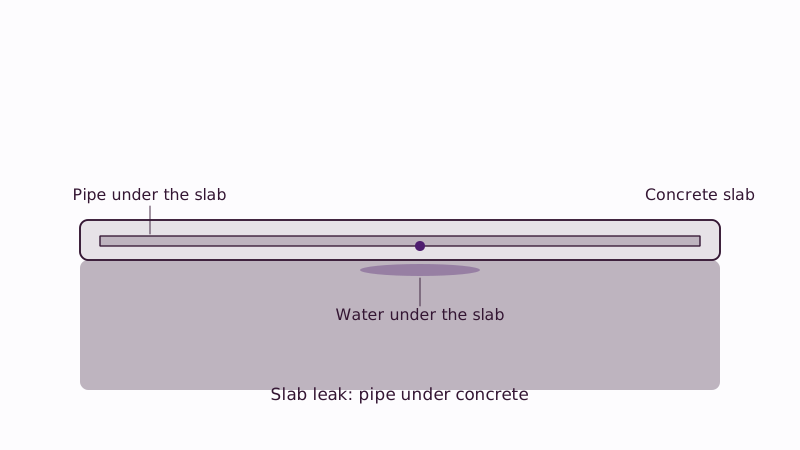
A 2026 guide from This Old House puts most slab leak repairs between $630 and $4,400, averaging $2,300, with $150 to $600 extra for locating the leak first. National guide figures like these differ from Riverside rates and from our own fees. The broader topic has its own page on leaks and burst pipes in Riverside, and details of your own leak can go to us on the quote page.
What does the guide say a slab leak costs?
This Old House's slab leak guide, updated April 7, 2026, gives $2,300 as the average and $630 to $4,400 as the spread for repairing a slab leak, while leak detection is priced separately at $150 to $600. Since these are national averages, a home in Riverside, Moreno Valley or Loma Linda may fall outside them.
| Item | Guide range | Source and date |
|---|---|---|
| Leak detection | $150 to $600 | This Old House, April 7, 2026 |
| Slab leak repair, whole job | $630 to $4,400 | This Old House, April 7, 2026 |
| Slab leak repair, average | $2,300 | This Old House, April 7, 2026 |
The written quote sets the price. A plumber who has located the leak and seen the access route can say what the real number is, and a quote that is firm in writing beats any averaged range.
Which factors push the price up or down?
Depth, access and method drive the price. A leak under a bare concrete floor with a clear route costs less than one beneath tile, cabinets or a finished bathroom. Tunneling under the slab, rerouting through the attic and repiping the whole house each bring different labor and materials, and any of them can move the total from the bottom of the range to the top.
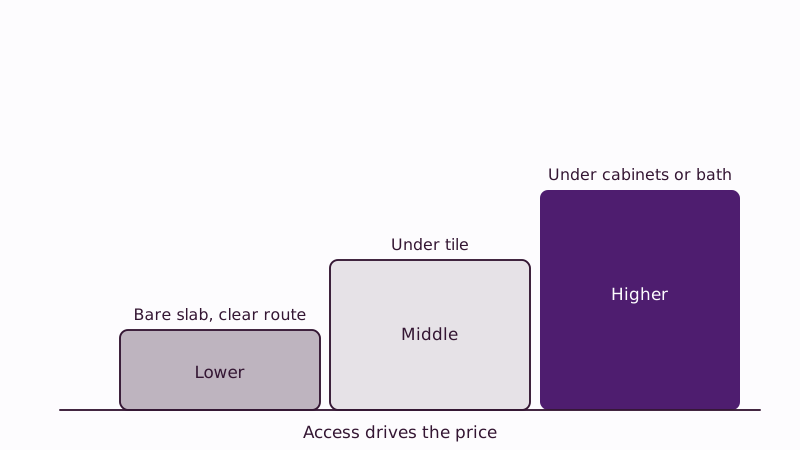
Other things add up too: how many leaks the pipe has, whether the line is copper, galvanized or plastic, floor repair afterward and any permit. Old copper that has pinholes in several places often tips the choice toward a reroute or a repipe instead of patching one spot. The decision is laid out in slab leak repair versus repipe.
Permit rules matter. The city's list of permit-exempt work leaves out slab and in-wall pipe replacement, which means a permit applies, so check with Building and Safety at (951) 826-5800 before any digging.
Which clamps work for stopping a pipe leak?
A repair clamp is a metal band with a rubber gasket that tightens around a split or pinhole in a straight pipe. Stainless sleeve clamps suit copper, steel and plastic of the right diameter. They are a temporary stop, not a permanent repair, and they work only on pipe that is round, clean and accessible.
Match the clamp to the pipe's outside diameter, clean the area, center the gasket over the hole and tighten evenly. Epoxy putty, self-fusing tape and push-fit couplings are other stopgaps. Clamps do nothing for leaks beneath a slab, in a joint or at a fitting, and one that still drips once tightened shows the pipe is worn through at that spot. A plumber's follow-up still has to replace the damaged section.
When copper has a tiny hole, the options appear in repairing a pinhole leak in copper pipe.
Who covers the bill for a leak in a buried pipe?
In most cases the property owner pays for pipe beyond the meter, while the water utility looks after the line leading to it. The leak's location, the pipe's owner and your policy wording all change the answer, so ask the supplier listed on your bill, and your insurer, before work begins.
Home insurance often pays for sudden damage from a burst pipe yet not for opening up and repairing the pipe itself, and wear and tear is commonly excluded. Wording varies, so read your policy or put the question to the insurer. Whether insurance covers a burst pipe describes the usual dividing line.
A renter should notify the landlord in writing and keep photographs. Tenants of a building with several units may find the line is shared and belongs to the owner. In Riverside most addresses are served by Riverside Public Utilities, (951) 782-0330, but Western Municipal Water District serves some Riverside addresses, so confirm on the bill.
What is the price to fix a leaking wall pipe or a burst pipe?
The sourced guide above covers slab leaks, so we do not have a trusted guide range for burst pipes or wall leaks to print here. The cost depends on the pipe type, the length of damaged section, the wall access needed and the drywall, paint and flooring work that follows the plumbing.
A simple accessible section replaced under a sink costs less than a split in a wall that needs opening, patching and repainting. The larger bill is often the water damage that follows, so closing the main valve fast matters. The EPA's household figure of over 9,300 gallons yearly from an ordinary leak is one more reason not to ignore a wet floor.
With a burst pipe, read the advice on a burst water pipe and the page on urgent burst pipe help, then ask for a written quote.
Is it possible to fix a pipe leak while the water stays on?
For a few minutes, with a clamp or putty on an accessible pipe, a drip can be slowed while the water is on, but a proper repair needs the water off and the line drained. Cutting out a damaged section, soldering or fitting a coupling with pressure present fails and risks a flood.
Begin by closing the main valve. For a hard leak, drain the line through the lowest faucet and let air in through the highest. A rubber patch with a clamp, a repair sleeve or wrapped putty can serve as a temporary stop until the plumber comes. Do not use tape alone on a pressurized line and expect it to last.
A leak close to a radiator or hydronic line, as in some older buildings, may mean draining the loop too, and that job belongs with a plumber.
How can I budget for my own slab leak?
A quick worksheet uses the guide's three figures. Start with detection at $150 to $600, add the repair range of $630 to $4,400, then add floor or finish repair and a permit. Lean toward the high end when the leak lies under tile or cabinets, and the low end where access is clear. Finally, compare the total with written quotes.
Treat any online calculator as rough, because none can see the slab. Several leaks can push past the guide's range, and a repipe could be the better value. Keep a record of the meter reading with all fixtures off, which helps the plumber confirm that water is escaping.
Common questions
How many days does a slab leak fix need?
What questions go to a bidder on a slab leak job?
Does someone have to be there for the work?
How do I know the leak is under the slab?
Prices are one part of the job: the plumber guide for Riverside covers the rest.
Sources used
Page updated