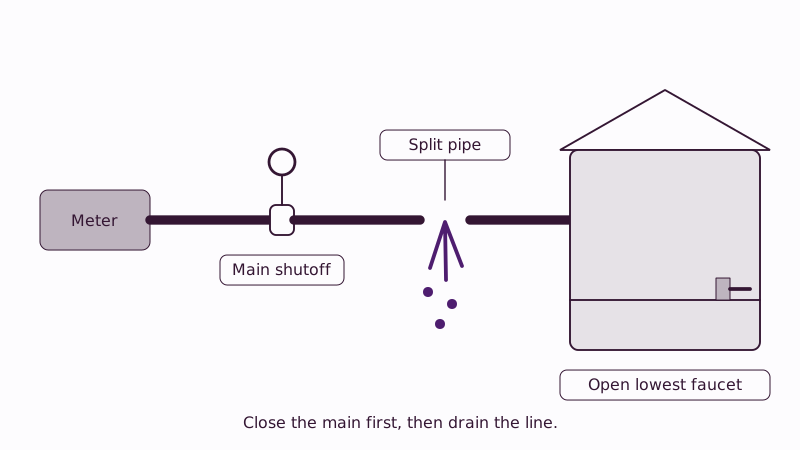
When a pipe bursts, close the main shutoff, run a faucet low in the house to empty the line, cut power to any wet area, and call a plumber. After that, move belongings out of the water's way. The damage you face later is largely set in those first minutes. This page covers the shutoff, the visit, the cost and the insurance paperwork. The wider picture on leaks starts at leaks and burst pipes.
What happens if you have a burst pipe?
Under pressure, water escapes through a split, a joint that has failed or a corroded section, and it keeps flowing until someone closes the supply. Within hours a burst can send a great deal of water into walls, ceilings and floors. The damage comes in two waves: soaked drywall, flooring and insulation first, then mold if the area stays damp. Fast shutoff is the whole game.
Here is the order that works in most homes:
- Find the main shutoff valve, often at the front of the house near the hose bib, at the meter, or in the garage by the water heater. A wheel handle turns clockwise until it will not go further. A lever valve is closed once the handle lies across the pipe.
- Run the lowest faucet or hose bib so whatever remains in the pipes drains out.
- When water has reached outlets, appliances or the panel, turn off that area's circuit at the breaker box, provided the panel can be reached from dry floor. If it cannot, stay out and call 911.
- Shut down the water heater. Set a gas unit's control to pilot or off. With electric, trip its breaker to keep the elements from running dry.
- Move rugs, electronics and furniture, and photograph everything before cleanup. You will want those pictures later.
When the main valve is missing or will not close, call Riverside Public Utilities at (951) 782-0330. RPU lists that number as customer service and its water emergency line, but your water account may belong to another utility, so check the bill first. Some areas, such as parts of Orangecrest and the March Air Reserve Base area, may be served by Western Municipal Water District, and per the city's general plan environmental report most Moreno Valley homes get water from Eastern Municipal Water District.
What does repairing a burst pipe cost?
The cost varies with the pipe's location and the amount of opening-up required. Published guide figures put plumber labor at $75 to $150 an hour for typical work, with an emergency call-out of roughly $200 to $300 flat, or $150 an hour plus $50 to $200 for transportation. These are national guide figures, with no link to local rates or our charges.
Fixr's "Cost to Hire a Plumber" guide, updated January 30, 2025, lists the typical hourly range and service call fees of $50 to $300. The written quote sets the price, so ask for it before work begins, and ask whether the number covers wall repair or only the pipe.
| What drives the bill | Why it matters |
|---|---|
| Time of day | A call-out fee is often added for after-hours visits |
| Pipe location | A pipe in an open crawlspace costs less to reach than one behind tile |
| Pipe material | Copper and PEX repairs differ from galvanized or old clay-era lines |
| Size of the break | A pinhole split is quick to fix, while a long split may mean replacing a section |
| Drywall and flooring | Opening and closing walls is often separate from plumbing labor |
Plumbing labor and building repair are different trades. Many plumbers stop at the pipe, and you hire drywall, paint and flooring work separately.
What does an emergency plumber do when they arrive?
The plumber confirms the water is off, finds the break, and decides between a patch and a replacement. A small split in copper may get a repair coupling. A section of PEX can be cut out and joined with fittings. For galvanized or very old pipe, a longer run may be recommended for replacement because neighboring sections tend to be just as worn.
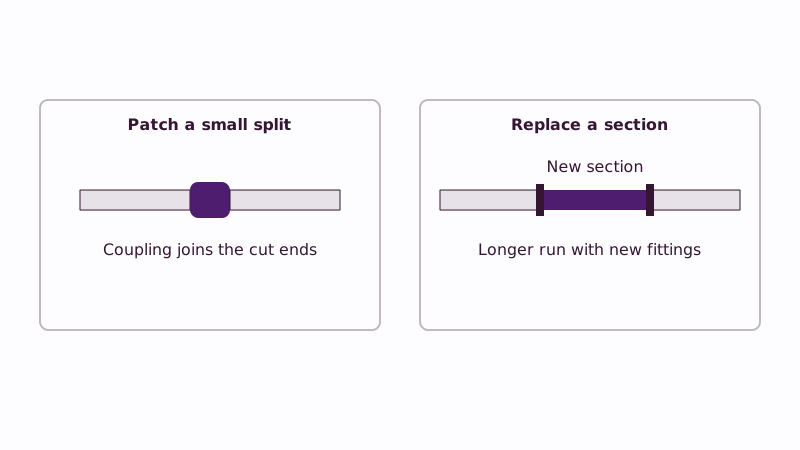
Expect these steps:
- An inspection of the shutoff and the supply pressure.
- A moisture check to see how far the water traveled. Some plumbers bring a thermal camera or moisture meter, and others pass that to a water damage company.
- The repair itself, then turning the water back on slowly and watching for drips.
- Notes on what else looks worn, so you know whether more breaks are likely.
Older homes around the Wood Streets, Downtown and Arlington may still have galvanized or copper lines in places. Homes built in the 1970s through the 1990s in Moreno Valley and La Sierra often have copper, and newer builds commonly use PEX. A plumber looking at the exposed pipe will tell you which you have. If a run is aging, ask whether a repipe makes more sense than patching again.
At what temperature does a pipe burst, and does Riverside get that cold?
Freezing is the usual cause of splits, because water expands as it turns to ice, which generally needs temperatures at or below freezing for several hours. Riverside winters are mild, so a frozen burst is rare, but a cold snap in the foothills can do it, and pipes in unheated garages or exposed outdoor runs are the ones at risk.
Most burst pipes here come from other causes. Corrosion in older metal lines, pressure that runs too high, a failed fitting, a nail through a line during a remodel, or roots and shifting soil on buried lines are all more common. Household water pressure is capped at 80 psi by the California Plumbing Code, and a regulator that has drifted above that wears on fittings over time. See why pipes burst and prevention steps.
How can I tell that a pipe burst inside a wall, basement or slab?
Warning signs include a sudden drop in water pressure, running water audible with everything off, a meter that keeps turning with all taps closed, warm spots on the floor, damp drywall, a musty smell, and a water bill that jumped. A line outside, such as a sprinkler pipe, shows up as soggy ground or a spreading puddle.
Walk through the home and check ceilings, baseboards and cabinet floors. Then run the meter test: with every tap closed, note the meter, wait fifteen minutes and check it again. Any movement means a leak somewhere. For underground or under-slab lines, read detecting an underground pipe burst and burst pipe warning signs. Locating a hidden leak is a plumber's job, and leak detection costs are a separate line from the repair.
Should I call the plumber or my insurance company first?
Call the plumber first to stop the damage, then call the insurer. Reasonable steps to limit further loss are expected under many policies, and photographs and receipts help a claim. What a policy pays for sudden bursts versus slow leaks is written in your own documents, so read them. What to ask is listed in our guide to insurance cover for a burst pipe.
Keep the damaged section of pipe if the plumber removes it, ask for an invoice that describes the cause and the repair, and save every receipt for drying equipment and temporary repairs.
Does a burst pipe repair need a permit?
A like-for-like repair of a small section generally does not, but replacing piping behind walls or below the floor can. According to the City of Riverside's exempt-work handout, replacing piping inside the wall face or under the floor requires a permit. Confirm with Riverside Building and Safety at (951) 826-5800 before work starts. Unincorporated addresses use the county office, and Moreno Valley and Loma Linda have their own divisions. The plumber should tell you which applies.
A job of $1,000 or more in labor and materials, or one needing a permit, calls for a California contractor license. Before you sign, verify the license at cslb.ca.gov.
Common questions
How fast can a plumber get there for a burst pipe?
Is a burst pipe a do-it-yourself repair?
Does turning the water off at the street help?
How much water does a leak waste?
What should I ask the plumber before they start?
Back to Rubidoux Ridge Plumbing for every service we arrange across Riverside, Moreno Valley and Loma Linda.
Sources used
Page updated