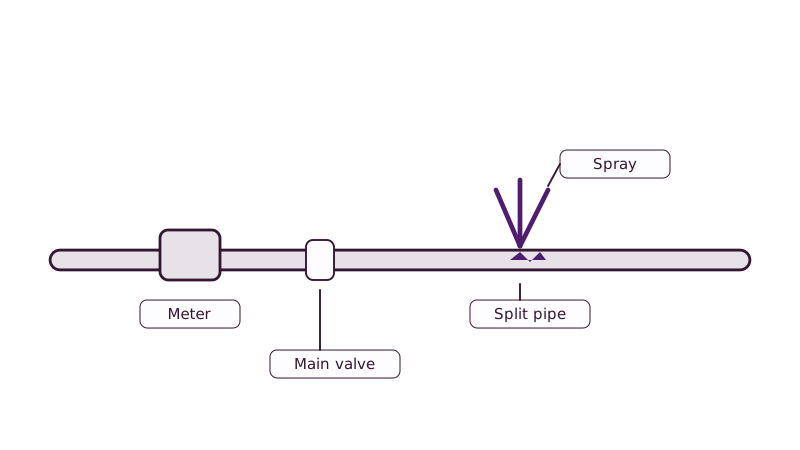
Water pouring from a ceiling, a wall or the floor means a pipe has split or a joint has failed. Stop the flow first, then limit the damage, then call for repair. The sections below put those steps in order. For the wider picture of leaks, leaks and burst pipes covers detection and repair routes, and the fast-response angle is in urgent burst pipe service.
Do not try to be heroic with towels while the water is still running. Find the shutoff.
Which step comes first once a pipe splits?
Find the main valve, usually beside the point where the supply pipe meets the house or inside the curbside meter box. A gate-style valve shuts by turning clockwise until it stops firmly. Next, run the lowest tap in the home, hot side included, so the lines drain. Keep away from standing water near outlets, and switch off the breaker for a soaked room only when you can reach the panel with dry hands and feet.
Move valuables and light furniture out of the wet zone, and photograph everything before cleanup in case an insurer asks. Mop up, set fans going and open windows. If you cannot find the shutoff, Riverside Public Utilities lists (951) 782-0330 as its customer service and water emergency line, Monday to Friday 7:00 am to 6:00 pm; confirm your water supplier on your bill.
Notice gas as well as water? Step outside and phone SoCalGas at 1-800-427-2200.
Who handles the repair, and what do I tell them?
Phone immediately once the water is off. A plumber locates the break, fixes the pipe and checks neighboring runs. Nobody can promise an arrival time through us, though a written quote request puts a local plumbing business on the case.
Leak detection, meaning acoustic or thermal tools, finds a break hidden in a wall or slab. In your request, say where the water shows up, how long it has run and whether the main is shut, so a suitable business picks it up.
Repairs that open walls often involve a permit. The City of Riverside's exempt-work handout says piping replaced behind the wall face or below the floor needs one, and Building and Safety at (951) 826-5800 can confirm. For other jobs we arrange, visit the Rubidoux Ridge Plumbing home page.
How can I distinguish a burst from a slow drip?
A burst announces itself: spraying or running water, pressure that suddenly sags, a ceiling that bulges or drips, rushing sounds with every tap closed, or a meter dial spinning while nothing is on. Slow leaks are quiet, showing up as a stain or a climbing bill.
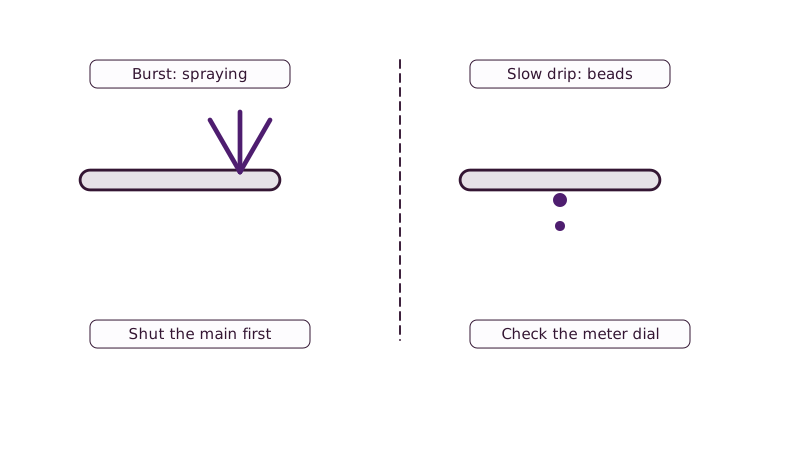
Treat the meter as a witness: seal up the house, note the number and check it again a few minutes later. Any change means water is getting out somewhere. EPA WaterSense puts ordinary household leaks above 9,300 gallons per year, and a split pipe can discharge that volume far faster. Breaks underground or beneath a slab hide well. Signs of an underground burst include a boggy spot in the yard or a warm area on the floor.
Not certain what you are seeing? Telling whether a pipe burst goes through more clues.
How do I keep the damage from spreading?
Get rid of standing water first, then set up fans and a dehumidifier. Pull up soaked carpet and padding. Leave drywall cutting to a professional or your insurer's advice. Quick drying helps protect against mold, so ask your insurer or a restoration company how soon to start.
Keep receipts and photos, and jot down when the leak began and whom you rang. Insurance deserves its own read, in burst pipe and insurance. Policies vary, so check your own or ask your agent.
Water inside walls can lurk unseen for days. What usually happens next is covered in after the water: what a burst pipe damages.
Why do pipes burst around here?
Freezing is the textbook cause in colder places, but in the Inland Empire corrosion, aging materials, high pressure, a failed joint, shifting ground and roots can matter as much. Older galvanized and copper lines in orange-grove-era neighborhoods can wear from the inside until pinholes turn into splits.
Pressure counts. Section 608.2 of the California Plumbing Code caps pressure at 80 psi, and any house running higher strains all of its pipes and fittings. A failed regulator lets raw street pressure in, so regulator adjustment is a worthwhile check before another burst happens.
Water chemistry contributes. The utility's 2025 report gives an average hardness of 197 mg/L, around 12 grains per gallon; scale from minerals narrows pipes and wears fittings. More on causes in why pipes burst, and early warning signs are in burst pipe prevention.
Repair means removing the damaged length and fitting new pipe, or in worse cases re-running a section. Several failures close together suggest a tired system, which leaking water pipe repair discusses.
Is a temporary patch possible?
A temporary patch can buy time, but it is not a repair. With the water off and the pipe dry, a rubber-lined clamp, a self-fusing silicone wrap or epoxy putty may hold a small split long enough to restore water to the other rooms. None of them should be trusted behind a wall, and none replace cutting out the damaged section.
Think of any patch as a bridge to the plumber's visit. Keep the main closed overnight if you leave the house, and check the spot often when you reopen it. A patch that sweats or drips needs the water turned off again. Never wrap a gas line or put tape on a pipe that is still pressurized, since that hides the leak without stopping it.
Common questions
How long does the repair job itself run?
What should I put to the plumber first?
Do I have to stay for the repair?
Sources used
Page updated