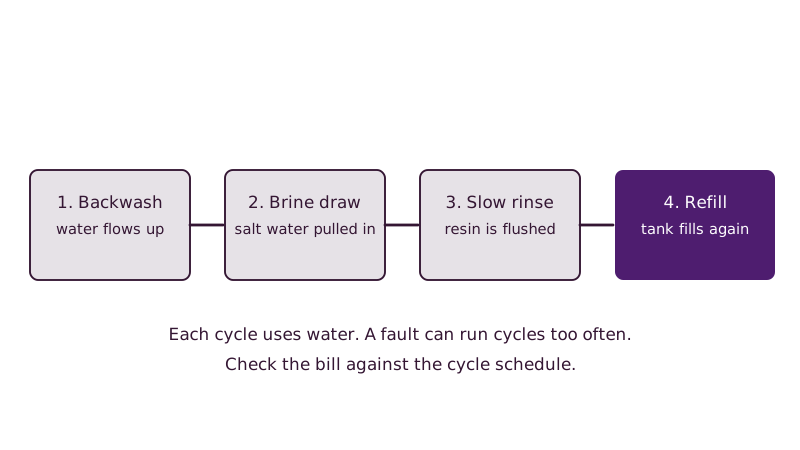
Yes, a softener can raise a water bill, though only modestly when it works properly. During regeneration the tank sends brine and rinse water down the drain, and the meter counts it. A sharp jump in your bill points to a fault. The water softener page explains how we pass your request to a local plumbing business that can inspect the system.
How much water does a softener use?
Water goes through a softener only during regeneration, the cycle that rinses and recharges the resin with brine. The volume depends on the model, tank size and settings, and the manual states it. In most homes the extra water is a small part of the monthly total, not the cause of a big jump.
Newer demand-initiated units regenerate once the resin is spent instead of on a fixed schedule, so they usually waste less than old timer-driven models. A timer that regenerates nightly, or a unit far larger than the household needs, cycles more often than necessary and adds extra rinse water.
Each softener carries a nameplate and a manual listing gallons per regeneration. Find that number and multiply it by how often the unit cycles. A missing manual is usually available as a PDF on the maker's website using the model number.
How can I stop a softener from wasting water?
Match the regeneration to real use, replace worn seals and valves, monitor the salt level and brine tank, and have the unit inspected yearly. A well-sized, demand-initiated softener on proper settings keeps the extra rinse water small. Have the plumber go over the settings at installation.
When weighing a new unit, the steps are in the installation guide and guide prices are on the softener cost page. Certain California communities restrict salt-based softeners because of what reaches the sewer system. Rules for the cities we serve were not verified, so ask your sewer agency before buying.
Requests we pass along cover Riverside, Moreno Valley and Loma Linda. Request a quote with the symptoms and bill history, or begin from the home page.
Which softener faults push the bill up?
A stuck control valve can keep the drain line running, sending water to the drain around the clock. A failed seal or piston, a broken timer, or a drain line that never closes can do the same. An overfilling brine tank and a bypass left open cost less but also show in the bill.
Listening often reveals a stuck valve. Running water at the softener while nobody uses any, or a drain hose that is warm and wet, means you should close the supply and call a plumber. The repair is on the control head, not a job for a wrench.
Salt bridging, a crust forming in the brine tank, stops the unit from making brine. It does not raise the bill, but the water stays hard, so people sometimes regenerate more often to compensate, which adds water use for no gain. A plumber or the maker's manual shows how to break a bridge.
How do I find out if the softener or a leak is responsible?
Turn to the meter. Shut every tap and appliance, record the reading, leave it two hours and read again. EPA recommends this test, and any change means water is moving somewhere. Next, put the softener on bypass and repeat. A meter that stops identifies the softener as the source.
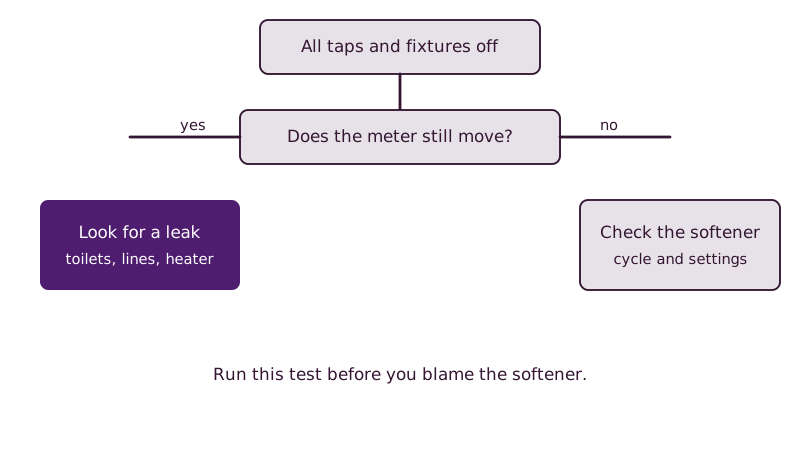
A meter that keeps moving with the softener bypassed places the cause elsewhere, and the usual suspects are a running toilet, a dripping faucet, an irrigation valve or an underground line. A dye test in the toilet tank catches silent flapper leaks, because color in the bowl within ten minutes marks a leak.
The wider hunt is covered in why your water bill is so high, a high bill with no visible leak and whether a leaky faucet can raise the bill. EPA reports that leaks in a typical household waste over 9,300 gallons of water per year.
Does Riverside's hard water justify buying a softener?
The water here is hard, and the figures are public. The 2025 Riverside Public Utilities report gives average hardness of 197 mg/L (about 12 grains per gallon), in a range of 180 to 210. The 2025 EMWD report gives Mills-area hardness averaging 5.1 to 7.5 grains per gallon (roughly 87 to 128 ppm), depending on the source, and which source feeds your street we could not confirm.
Whether it does is your call. Scale collects in water heaters, kettles, shower heads and fixtures, and some households choose a softener over constant descaling. Others pick a different treatment or simply maintain fixtures. The options are covered in hard water scale prevention and removing hard water scale.
Loma Linda's water comes mainly from the city's own wells, according to its 2015 report. That report, the only one we could read, listed average hardness of 93.4 ppm within a range of 6.3 to 220, so look at the current report for your address before deciding.
Why did my water bill rise after the softener was installed?
Three causes often overlap: the softener's regeneration water, a setting that has it regenerating too often, and a hidden fault the installation exposed. A plumber who disturbs old valves or supply lines may also reveal a weakness. Set the bills from before and after side by side, and check the meter.
Begin with timing. A bill that jumped in the first cycle after installation makes the new equipment the first suspect. One that crept up across months suggests a failing valve or a leak. Bills also swing with the seasons, since irrigation use rises in summer, so compare the same month from year to year.
Look at the account for any rate change or different billing period. Riverside Public Utilities, Western Municipal Water District, Eastern Municipal Water District and the City of Loma Linda each bill their own customers, and the bill names the agency you pay. A rate change can pass for a usage change.
Common questions
What volume of water does one softener cycle use?
Can a broken softener flood my house?
Should I turn the softener off to test my bill?
Who inspects a softener in Moreno Valley or Loma Linda?
Sources used
Page updated