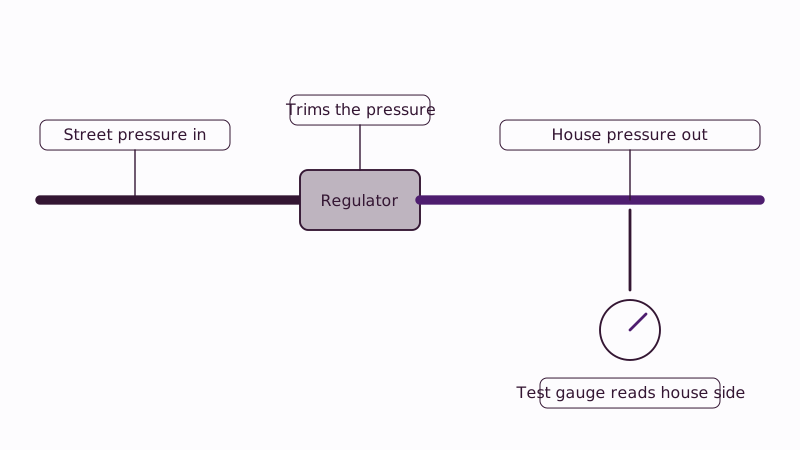
Thin flow at a shower or sink usually traces to one of a handful of culprits, and you can eliminate several with no tools at all: a stop valve left partway shut, a gritty aerator, a tired regulator, pipe narrowed by corrosion, or trouble out in the public main. Begin by noting if one tap or every tap is affected, then jump to the matching section below. When the fix outgrows DIY, the form on our home page sets a local plumber's visit in motion.
What can I do if my house has low water pressure?
Work through the cheap checks. Open the house shutoff and the meter valve all the way, because a valve left partly closed after past work is a frequent cause. Unscrew aerators and showerheads and soak off mineral crust. Then compare hot against cold. If hot water alone is feeble, the heater or its valve is the suspect. If every tap is feeble, you need a gauge.
A threaded gauge from a hardware store screws onto an outdoor spigot and shows what the house truly receives. Many guides treat 40 to 80 psi as a normal household range, and 80 psi is the ceiling set in California Plumbing Code 608.2. Readings far below 40 confirm a real problem; readings above 80 mean the regulator needs attention. Jot the numbers down for the plumber. A longer walk through each cause is in why pressure falls.
What if it dropped overnight?
An abrupt change means something changed. Candidates: a valve nudged shut during recent work, a regulator that quit, a break in your own line past the meter, or utility work on the main. Heavy neighborhood demand can also sag pressure at busy hours. Look for soggy soil, a dial at the meter still spinning while every fixture is shut, and a bill that jumped.
If the dip is house-wide and shows up at the same hour each day, call your water provider, because it may be the street. In Riverside, Riverside Public Utilities answers at (951) 782-0330 on weekdays. Some Riverside areas, such as Orangecrest, may be served by Western Water, (951) 571-7104. In Moreno Valley, EMWD supplies most of the city, and Box Springs Mutual is at (951) 653-6419 for its small service area. Check the utility on your bill. Details live in sudden low pressure.
Which valves control pressure in a house?
Homes deal with three kinds. Pressure-reducing valves trim incoming pressure to a safe level. Pressure-relief valves pop open to vent excess pressure from a heater or tank. Pressure-sustaining valves keep upstream pressure from sagging. Most houses carry the reducing kind, called the regulator, beside the main shutoff, plus a relief valve on the heater.
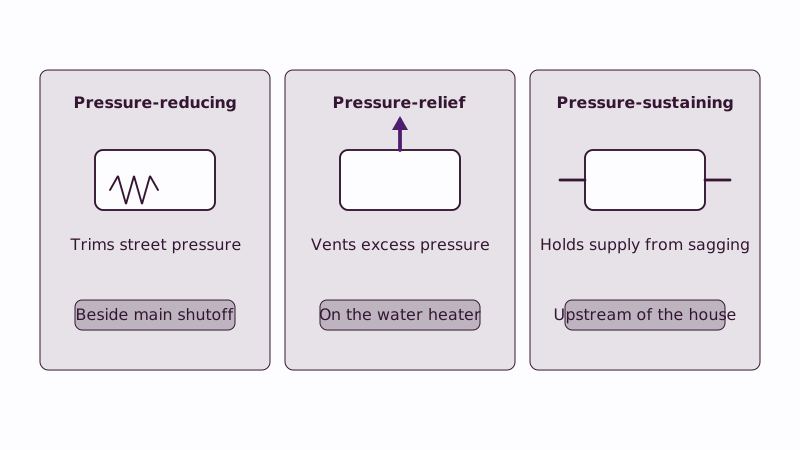
If your problem is low pressure, the regulator is the one to examine. It can wear until it passes too little water, or it can be set too low. Plumbers test it by gauge on both sides. The location guide shows where to look, and the 3/4 inch valve page covers the common household size.
How long do water pressure regulators last?
No firm number applies, since lifespan swings with water quality, street pressure and brand. Wear happens inside, so the warning signs arrive slowly: pressure creeping upward, a thump in the walls, or swings after a tap closes. A gauge test by a plumber separates a worn unit from one that simply needs adjusting.
Local mineral content plays a part. Riverside's 2025 utility report shows average hardness of 197 mg/L, near 12 grains per gallon, and as years pass, mineral buildup can foul small internal parts. If a unit is old and misbehaving, replacement is more reliable than repeated tuning. Read adjusting a regulator for what you can safely try and regulator replacement for the job itself.
What does a pressure regulator run?
Fixr's water main repair guide, dated January 31, 2025, states that a pressure regulator replacement runs $250 to $1,000, labor included. This is national guide data rather than a local rate or our charge. A unit sitting out in the open lands low; one that is buried, awkward to reach, or needs a fresh shutoff or pipe fix lands high.
Expect the written quote to set the price, and have it name the regulator model, the pressure setting, any expansion tank the plumber recommends, and who deals with a permit if one applies. For a fuller breakdown see regulator installation cost. For context, Fixr's general plumber guide lists a $90 hourly national average and a trip fee that can run $50 to $300.
Does low pressure harm anything?
Weak flow by itself will not hurt anyone, but it can signal trouble underneath. A concealed leak, a faltering regulator or rusted pipe could be behind it, and appliances such as a washer or dishwasher may fail to fill properly. Sprinkler zones also suffer. If pressure slipped while your bill rose, suspect a leak.
A different kind of caution applies to high pressure. Above 80 psi, fixtures and appliance hoses wear out faster and can burst. If you hear banging after a faucet shuts, read about water hammer. This page only covers household plumbing, and health questions about blood pressure belong with a doctor.
What causes low pressure at one shower or faucet?
If a single outlet is weak, the cause lives at that outlet or on its own supply line. A scaled-up showerhead or aerator tops the list, with a half-closed angle stop under the cabinet next. For a shower with a mixing valve, a worn cartridge can restrict flow. Scale from hard water collects on fixtures, which makes a vinegar soak a sensible first move.
Cleaning did nothing? The line feeding that fixture may have narrowed. Old galvanized steel closes down from within, and older homes may still contain some. See shower pressure, kitchen sink pressure and low hot water pressure for fixture-specific steps. When the lines are the problem, a galvanized pipe replacement restores flow.
Should a homeowner swap a water heater alone?
For most households, hire it out. A replacement touches gas or high-voltage wiring, venting, a relief valve and seismic strapping, and in California a contractor is needed for work that requires a permit or totals $1,000 with materials. Riverside generally issues permits for water heater swaps, so verify with Building and Safety, (951) 826-5800.
If your hot water pressure is the only issue, a heater swap may not fix it, so diagnose first. The replacement visit page lists what is included, and the pressure regulator note for hot water explains why a regulator can affect the heater side.
What is the title of a person who fixes water pipes?
A plumber. The person who fits and mends pipes, fixtures and water-using appliances is a plumber, while someone focused on large industrial piping might be called a pipefitter. California reserves work past $1,000 for a contractor-license holder, and the licensing board offers a web lookup for checking credentials first.
Before you book, ask who will arrive, which license class they hold, and whether pressure gets measured before and after the repair. A good result is a stable reading in the normal range, not just stronger flow at one tap.
Common questions
What holds a leaking pipe in check until a plumber arrives?
Which household leak is most common?
Can a leak be fixed with the water still on?
What does a home pressure regulator cost?
How does a house water pressure regulator work?
Guides in this section
- 3/4 water pressure regulator
Choosing or replacing a 3/4 inch water pressure regulator valve?
- Adjust a regulator
Test your home water pressure with a gauge, adjust a pressure regulator in small turns, and learn when the valve is worn out and a plumber…
- Sudden low water pressure
Water pressure fell overnight? Check the main valve, the supplier, the regulator and signs of a leak first, with who to call by area in…
- Costs
Guide figures for replacing a home water pressure regulator, what moves the price up or down, and what to ask for in a written quote in…
- Regulator replacement
Read your house pressure with a gauge, spot a failing regulator by its symptoms and see how replacement works, from shutoff to the 80 psi…
- Water pressure and valves
Not sure where your water pressure regulator sits?
- Why water pressure is low
Low water pressure in a Riverside home can come from one valve, a clogged aerator, a failing regulator or a leak.
Sources used
- Water Main Repair Cost, Fixr, updated January 31, 2025
- Cost to Hire a Plumber, Fixr, updated January 30, 2025
- California Plumbing Code section 608.2, water pressure limit of 80 psi
- Riverside Public Utilities, contact us
- Western Municipal Water District, about us
- Box Springs Mutual Water Company
- Contractors State License Board
- EPA WaterSense, Fix a Leak Week
Page updated