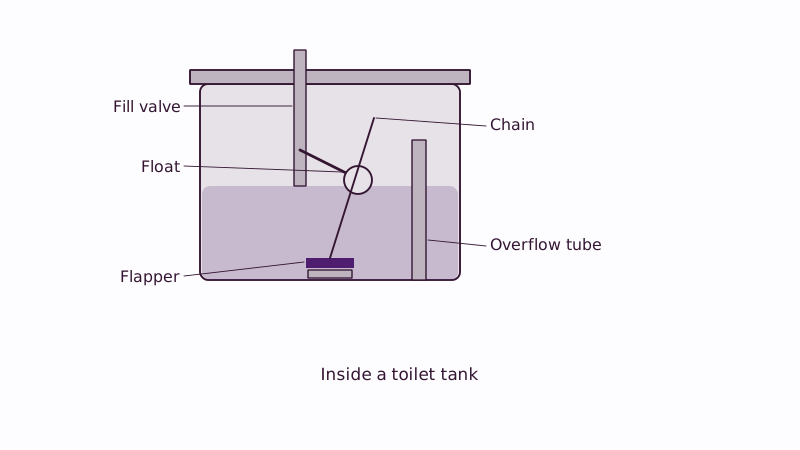
Lift the tank lid and all the working parts are visible: flapper, fill valve, float and overflow tube. Once one of those tires out, the toilet hisses, keeps cycling, flushes feebly or drips, and one plumbing visit normally replaces the culprit. Riverside, Moreno Valley and Loma Linda homes can all request a written quote through us whenever the job outgrows a screwdriver.
You will find the typical faults, who to ring, price ranges from published guides, and the line past which repairing loses to replacing. If your toilet is blocked rather than broken, head to the clogged toilet page instead.
Which parts inside the tank usually fail?
Three parts account for most call-outs. Flappers are rubber stoppers that cover the tank outlet. Fill valves refill the tank, then close once water hits a set level. The handle and chain connect your lever to the flapper. A tired flapper or a snagged chain lets water trickle away after a flush.
The tall overflow tube in the middle is a clue as well: water lapping over its rim means the fill valve never closes, and the surplus runs down into the bowl all day. Hairline porcelain cracks, a wobbling seat and a spent wax ring below the bowl finish the list.
A few drops of food dye in the tank will expose a flapper leak. Colored water in the bowl within fifteen minutes, with no flush in between, means the seal is leaking. Each part has its own page: flapper repair and fill valve repair.
Do plumbers repair toilets?
Absolutely. Toilet work is routine for a plumber: new flappers and fill valves, float resets, fresh wax rings, tightened closet bolts, swapped supply lines. Many jobs are quick part swaps, and a plumber can usually tell you on arrival which part has failed and whether fixing it or replacing it is the better call.
A trained eye also catches what a quick swap misses, such as a stop valve that will not fully close, a flange that has come loose, or a braided supply line past its prime. Describe the symptoms on the request, and we set a local plumbing business to visit. Bigger work falls under California contractor rules, which the CSLB website lays out.
Who handles a badly broken toilet?
Book a plumber for puddles at the base, a cracked bowl or tank, a toilet that rocks, a seized stop valve, or any job that involves lifting the bowl. A handyman can handle small swaps. Keep in mind the state licensing board's contractor license rule, which kicks in at $1,000 in labor and materials or whenever a permit is involved.
Moving a drain or touching gas piping is a different category of job altogether. A fill valve alone is a kit-and-twenty-minutes job for many owners. Unsure where yours falls? Request a quote and weigh the plumber's opinion before you commit.
Is a cracked or weeping toilet fixable?
Sometimes, and the location of the crack decides. A split tank may be cured with a replacement tank. A cracked bowl or trapway ends the toilet's life, because water reaching the floor proves the porcelain has failed. Moisture at the base normally points to a dead wax ring, replaced by lifting the toilet.
Leaking tank bolts or a bad gasket between tank and bowl need a different repair. Find the source by wiping everything dry and then pressing a dry tissue to each joint in turn. The article on toilet leaks takes the checks further and says what the plumber does next.
What fix do plumbers perform most?
Flapper replacement leads the list, with a fill valve that will not shut off in second place. Both are rubber and plastic that wear over time, and hard water can speed that up. The 2025 Riverside Public Utilities report lists hardness averaging 197 mg/L (about 12 grains per gallon), so mineral crust on parts is plausible.
The telltale sign is a toilet that hisses, runs or tops itself up while no one is near. A running toilet explained and the toilet that will not stop cover each variation, including a chain cut either too short or too long.
How do I repair a toilet myself first?
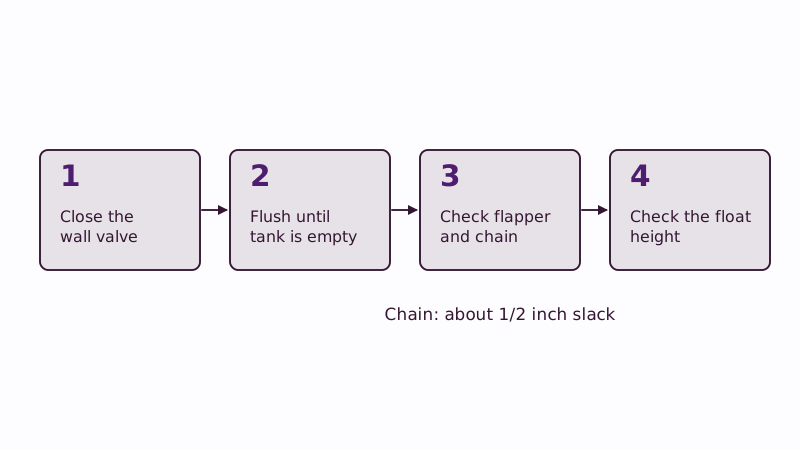
Begin with moves that cost nothing and undo easily. Close the wall valve, then flush until the tank drains, and inspect the flapper for warping or grit. Leave the chain roughly half an inch loose. Compare the float with the waterline mark in the tank, then raise the float arm and see whether the inflow stops.
If a part is clearly worn, buy a universal fill valve or flapper kit and swap it. A wax ring replacement means lifting the toilet, which is awkward for one person and needs a new seal each time. A wobbly seat is a separate easy job, explained in tightening a loose toilet seat.
If the stop valve itself leaks or sticks, leave it to a plumber, who will replace it correctly; see the shut-off valve page.
What does a toilet repair run?
This Old House's plumbing cost guide, updated 06/06/2026, lists toilet repair at $100 to $300 and installing a new toilet at $300 to $800. Fixr's installation guide, updated January 28, 2026, shows $250 to $800 with a $450 average, and $150 to $440 for labor alone. These are national guide figures. They are not Riverside rates and not our prices.
The written quote sets the price, not the guides. A bare fill valve or flapper swap stays at the low end, while a corroded stop valve, a flange repair or a bowl that has to be lifted moves it upward. Check if parts and the visit fee are bundled. For a full swap, see replacement pricing for toilets.
Repair or replace the toilet?
Mend it when bowl and tank are sound and one cheap part has failed. Replace it when the porcelain has cracked, when parts for an ancient model are scarce, or when it is an old high-flow design that wastes water. A new unit costs well above the parts, yet it ends the repeat visits.
Older houses can still hold toilets from an earlier generation, where matching parts takes more effort. Ask the plumber to put both a repair figure and a replacement figure in a single quote for easy comparison.
Common questions
Will a plumber come and fix my toilet?
Can a handyman fix a toilet?
What should a toilet repair cost?
Why does one toilet visit cost more than another?
Does fixing a toilet beat replacing it on cost?
Guides in this section
- Loose seat and flush fixes
Tighten a loose toilet seat, then fix the other common flush problems from the same tank: handle, flush button, flapper, slow flush and…
- Plumber for toilet leak
Toilet leaking at the base, tank or supply line in Riverside?
- Costs
What it costs to have a plumber replace a toilet, from guide figures updated 2025 and 2026, plus what pushes a bill up and how to compare…
- Repair a toilet fill
Replace or adjust a toilet fill valve step by step, spot a bad flapper, and learn when a hissing, running toilet means a call to a…
- Repair toilet overflow tube
Toilet overflow tube too high, cracked or draining constantly?
- Toilet bowl tank repair
Fix a toilet tank that runs, leaks or will not fill, find cracks and bowl leaks, and learn which repairs are DIY and which need a local…
- Toilet commode repair
Commode problems from weak flushes to base leaks and cracked bowls: which ones you can fix, which need a plumber, and the guide costs for…
- Flapper repair
A toilet that runs, hisses or refills by itself usually has a worn flapper.
- Toilet flush repair
Toilet not flushing right or running after a flush?
- Why a toilet keeps running
A toilet that will not stop running is usually a worn flapper, fill valve or float.
- Toilets
A toilet that keeps running usually needs a flapper, fill valve or float adjusted.
- Toilet repair shut off
Toilet shut off valve stuck, dripping or not closing?
- Toilet won't stop running
Toilet won't stop running? Check the flapper, chain, float and fill valve in order, see how a leak can raise your water bill, and know…
Sources used
Page updated