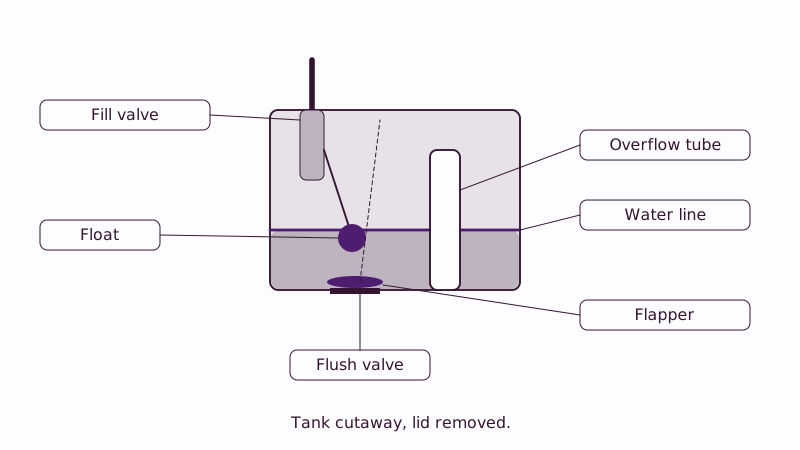
When a toilet keeps running, the cause is nearly always a small part in one of three places. The flapper seals the tank, the fill valve refills it, and the float tells the valve when to shut off. With the lid off you can inspect all three in a single sitting. This is part of our wider toilet repair service, and if the checks below do not settle it, a local plumber can take over.
Which part is making my toilet run?
Take off the tank lid and check where the water sits. Water pouring into the overflow tube means the float or fill valve is adjusted too high. A normal level paired with a hiss or trickle every few minutes means water is slipping past the flapper into the bowl. A few drops of food coloring settle it: if the bowl turns colored within fifteen minutes, the flapper seal is bad.
The three parts behave differently, so the symptom points to the culprit. A flapper that has gone soft or warped lets water seep out slowly, and the tank refills in brief bursts that sound like a ghost flushing. A worn fill valve keeps hissing after the tank is full. If the chain is short it props the flapper slightly open, and if it is long it can get trapped under the flapper.
When the water reaches the very top of the overflow tube, press the float arm down, or on a cup-style float turn the adjustment screw in small steps. Flush, wait and watch. Expect to adjust in quarter turns, never big swings.
What stops the running immediately?
Behind the toilet, on the wall or the floor, sits an oval valve. Turn it clockwise as far as it goes. The supply stops, and the tank empties at the next flush so nothing overflows. You can then repair the part at your own pace. Shutting off a toilet that runs all day is worthwhile, because the EPA reports that household leaks waste over 9,300 gallons a year.
Keep the shutoff closed while you work. Replace the flapper first, because it is cheap and fits many toilets with a universal model, and the old one tells you whether the rubber is warped, gritty or cracked. If the new flapper does not fix it, replace the fill valve next. Both are standard hardware-aisle parts.
What about a toilet running on and off, or at random?
Intermittent running, sometimes called phantom flushing, means the tank is losing water so slowly that the fill valve only wakes up every few minutes. The usual cause is a flapper or flush valve seat with a film of mineral buildup, a nick or a tiny gap. Wipe the seat with a cloth, look at how much slack the chain has, and swap the flapper if the rubber feels sticky or swollen.
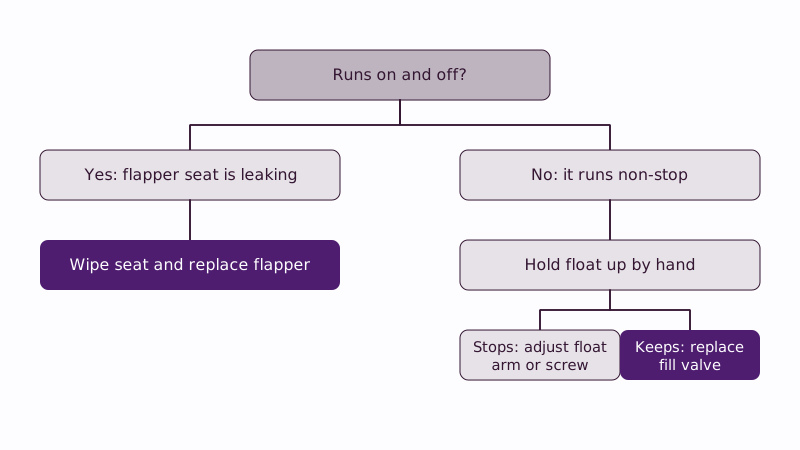
Continuous running is the opposite problem. Water keeps entering either because the fill valve cannot close or because the float is wedged against the tank wall or the lid. Open the tank, hold the float up by hand, and watch the water stop. If it stops, the float is simply misadjusted. If it does not, the valve itself has failed and needs replacing.
Hard water speeds all of this up. Riverside Public Utilities' 2025 water quality report lists hardness averaging 197 mg/L, roughly 12 grains per gallon. Mineral scale on a flapper seat is a classic cause of a toilet running again a few months after a repair. Rinsing the seat during a repair helps.
What if my Kohler or other brand toilet is running?
Parts vary with brand and age, yet the underlying fault repeats: a flapper or flush valve that fails to seal, or a fill valve that never closes. Many Kohler and other branded tanks take a model-specific flapper or canister, so find the model number molded inside the tank and buy the matching part instead of a generic one.
If the model is a mystery, snap a photo of the tank interior and show it at a hardware store, or have the plumber bring a few options. A mismatched flapper is the reason many first repairs fail. When a one-piece toilet or an older tank has hairline cracks in the porcelain, no kit will cure it, and the answer is toilet replacement.
What should I do about a wobbling toilet base?
A toilet that moves on the floor is not the same problem as one that runs, though people often confuse them. Snug the closet bolt nuts at the base gradually, switching sides, and stop once the toilet feels firm. Overtightening cracks porcelain. If it keeps rocking, the wax seal or the flooring under it needs work.
Water around the base after flushing means the wax ring has failed or the flange is damaged. That one is worth a plumber, because a failed seal lets sewer gas into the bathroom and water into the subfloor. Our page on toilet leaks covers what that visit involves.
How much does a running toilet repair or replacement run?
A flapper or a fill valve is a small hardware-store purchase, and we found no reliable published guide that prices a plumber's visit for a simple flapper swap. When a tank or bowl is cracked, replacement is the sourced figure. Fixr's toilet installation guide, updated January 28, 2026, lists $250 to $800 installed, averaging $450, with labor alone at $150 to $440. This Old House puts toilet installation at $300 to $800 in its June 6, 2026 guide.
These are national guide figures, not Riverside rates or what we charge. The written quote sets the price, and it should list the toilet model, the labor and removal of the old unit. Compare quotes on those lines.
A replacement can come with a bonus. Riverside Public Utilities lists rebates for premium high-efficiency toilets that start at $140 per eligible model, though funds are limited and the page says to confirm at socalwatersmart.com or (888) 376-3314 before buying.
For more detail on the numbers, see the toilet replacement cost page; the two parts that fail most each have a guide, one on the flapper and one on the fill valve.
At what point should a plumber handle a running toilet?
Bring in a plumber if fresh parts for the flapper and fill valve failed to cure it, if there is water on the floor, if the tank or bowl has a crack, or if the toilet sits upstairs where a leak would reach the ceiling below. Riverside needs no permit for faucet and toilet repair, but it does for pipe replaced inside the wall or under the floor.
California requires a contractor license for work of $1,000 or more in labor and materials, which covers most whole-bathroom jobs but rarely a flapper swap. If a plumber quotes a large price for a part you can identify at a hardware store, ask for the parts and labor split in writing.
Common questions
How long is the visit?
Which questions belong in the conversation before a running toilet repair?
Must someone be home for the visit?
Is a running toilet wasting money?
Every service and price guide is on the plumber guide for Riverside.
Sources used
Page updated