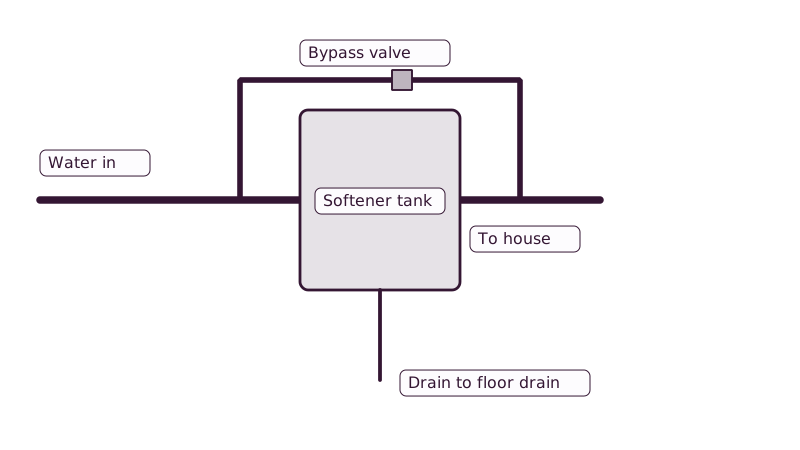
Scale on faucets, shower glass and the water heater usually points to a softener, and connecting one is plumber work. We pass your request to a local plumbing business, which checks where the unit will sit, puts the quote in writing and installs it in a few hours. Browse everything we cover on the home page, or go straight to the quote form.
What does a plumber do when installing a water softener?
The plumber taps into the main water line, fits a bypass valve with inlet and outlet connections, routes a drain line to carry off the regeneration discharge, places the brine tank, adds salt and programs the control head. After that the system is flushed and checked for leaks. A basic install can be done in a few hours.
The location matters. The softener normally goes just after the main shutoff and pressure regulator, so every hot and cold line inside the house gets treated water. Outdoor hose bibs are often teed off before the unit so irrigation and car washing do not use softened water. A good plumber asks you which taps should stay hard, and puts that in the quote.
You need three things near the spot: an electrical outlet, a floor drain or standpipe for the discharge, and enough floor area for the tanks. A garage or utility closet near the main is a common choice. Older houses may need extra pipe work if the main enters in an awkward place.
Why would a home in this area want a softener?
Hardness is a measurement of dissolved calcium and magnesium. Local utilities publish it, and the figures vary by source. Riverside Public Utilities' 2025 report gives hardness averaging 197 mg/L, around 12 grains per gallon, and a spread from 180 to 210. Western Water lists local groundwater at 155 mg/L average.
In Moreno Valley, EMWD's 2025 report lists hardness in its Mills area averaging 5.1 to 7.5 grains per gallon, about 87 to 128 ppm, depending on the source. Loma Linda's city report from 2015 listed 93.4 ppm on average, with a wide range; we could not read a newer one. Check your own utility's latest report, since which source feeds your home can differ.
Hardness leaves scale on heating elements, can shorten the life of a water heater, and spots glass. Alone it poses no health risk, yet it is a nuisance and a cost. More is available on preventing hard water scale and on getting rid of existing scale.
What drives the cost of installing a softener?
The unit itself is the largest piece, then labor, then any pipe or electrical work. Guides put the installed total at $1,100 to $3,000, with a national average near $2,500 (Fixr, updated January 31, 2025), and labor alone at roughly $150 to $1,000. Bob Vila's April 2024 guide gives a wider $200 to $6,000.
| Item | Guide figure | Source and date |
|---|---|---|
| Installed, typical | $1,100 to $3,000 (average $2,500) | Fixr, January 31, 2025 |
| Labor only | $150 to $1,000 | Fixr, January 31, 2025 |
| Installed, wide spread | $200 to $6,000 (average $1,500) | Bob Vila, April 22, 2024 |
| Single ion exchanger unit | $500 to $3,000 | Bob Vila, April 22, 2024 |
These are national guide figures, not local rates or what we charge. The written quote sets the price. For the breakdown, see water softener installation cost and the whole-house softener cost page.
Things that move the number up: a larger household and a bigger tank, a long run from the main to the garage, a new electrical outlet, a drain that must be extended, copper pipe in place of flexible connectors, and permits where a city requires one.
How can I tell a softener would help?
Look for chalky crust around faucets and showerheads, cloudy film on dishes and glass, soap that will not lather, dry skin after showering, and a heater tank that makes rumbling sounds or wastes energy. A test kit measures hardness in grains per gallon. Compare the result with your utility's published figures.
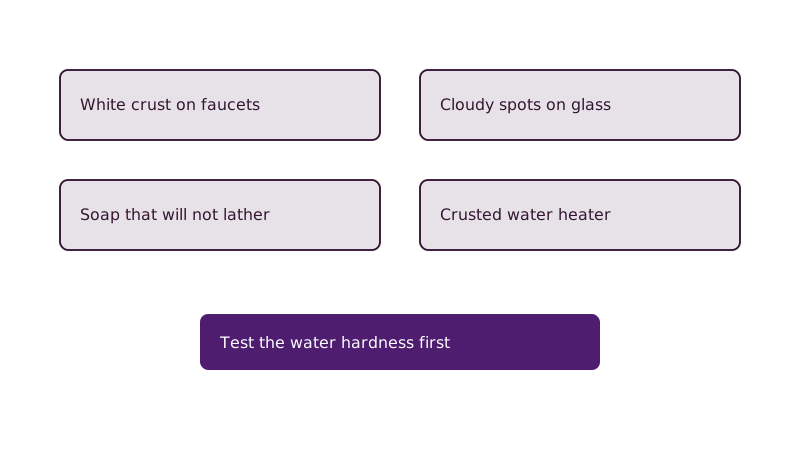
Scale also shows inside appliances you cannot see. A dishwasher or washing machine may last less time in hard water. If your last water heater failed with a thick crust on its heating surfaces, that is a strong sign. A softener is not the only fix: a whole-house filter does not reduce hardness, and salt-free conditioners reduce scale buildup differently, so decide what outcome you want.
If the real complaint is a high bill, find out whether the softener or something else is behind it on the page about softeners and water bills.
What about brands, manuals and where to buy?
Whether the unit is a Culligan, Kinetico, Whirlpool, Aquasana or another make, the plumbing steps are close to the same: inlet and outlet ports, a bypass, a drain with an air gap and a salt tank. Each brand has its own installation manual, and the plumber follows the one for your model.
You can buy the unit yourself or have the plumber supply it. Buying separately can save money, but check that the model matches your water use and that the plumber is willing to install a customer-supplied unit. Ask whether a customer-supplied unit changes the warranty, because the manufacturer sets those terms.
Details on loop piping, shower head filters and the brine tank are in the softener installation guide and the page about installation service options.
Does a city rule or permit apply?
A softener install generally involves plumbing changes. Per the state's Contractors State License Board in California, a contractor license is needed for work that calls for a permit or reaches $1,000 in labor and materials. Whether the city asks for a permit depends on the scope, so confirm with City Building and Safety before work starts.
In Riverside the number is (951) 826-5800. In Moreno Valley it is (951) 413-3350, and in Loma Linda it is (909) 799-2836 for permit questions. Also ask your water utility if any local rule affects how softener brine is discharged to the sewer. We did not confirm a specific rule, so ask rather than assume.
Common questions
How much time should a softener installation take?
Which questions should I put to a softener installer first?
Must an adult be home on installation day?
Will the softener make my water taste salty?
Guides in this section
- Softener and bill
A working softener adds a little water use each cycle, but a big jump in the bill points to a fault or a leak.
- Hard water scale prevention
Read your utility's hardness number, learn why scale forms and which fixes work: flushing, softeners, descaling.
- Water softener installation, step by step
How a water softener goes in, what a do-it-yourself install involves, how to deal with hard water scale, and when a Riverside plumber is…
- Remove scale
Remove hard water scale from faucets, shower heads, glass, kettles and water heaters with safe household methods, and see what the local…
- Costs
What guides say a water softener installation costs in 2026, what moves the price, and how to compare written quotes for Riverside, Moreno…
- Water softener installation service
How to pick a water softener installation service in Riverside: plumber or dealer, DIY versus hired install, manuals, well water, and the…
- Whole house water softener
What a whole house water softener installation includes, the guide price ranges, the extras that raise the bill and how to size one for a…
Sources used
- Fixr, Water Softener Installation Cost, updated January 31, 2025
- Bob Vila, Water Softener System Cost Guide, updated April 22, 2024
- Riverside Public Utilities 2025 Water Quality Report
- EMWD 2025 Water Quality Report
- Western Municipal Water District 2025 Consumer Confidence Report
- California Contractors State License Board
Page updated