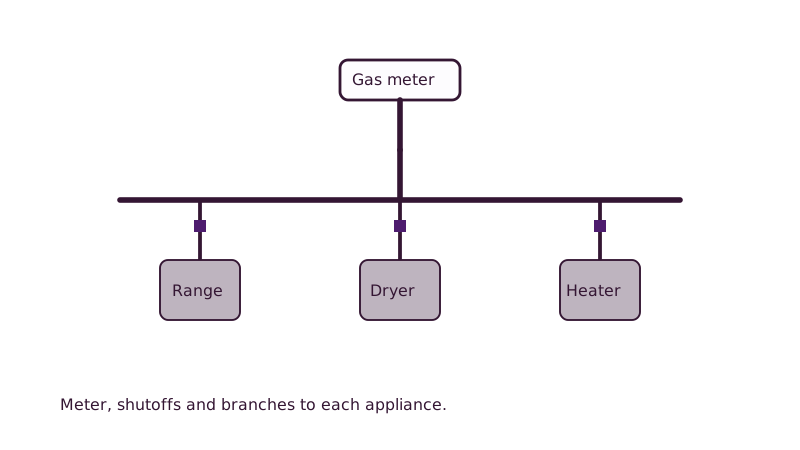
The California Plumbing Code governs home gas piping, and the building division of the city or county where the house sits enforces it. Put simply, the code deals with pipe materials, sizing for the appliances served, shutoff valves, supports, protection of the line, leak testing and inspection. New or altered gas piping generally needs a permit, and the work belongs with a contractor. The gas plumber page covers the service.
What do residential gas piping codes cover?
They cover which pipe and fittings are allowed, how the line is sized for the appliances it feeds, where shutoffs must go, how pipe is supported and protected, how appliances are connected, how the system is checked for leaks and how it is vented where required. Appliance venting rules sit alongside piping rules.
Sizing depends on the combined demand of the appliances plus the distance the line runs, so a tankless heater or a new range can require a bigger line. Shutoff valves are expected at each appliance, and flexible connectors have limits on length and location. Pipe through walls, floors and slabs needs protection from damage, and some materials need bonding. The exact tables come from the code version your city has adopted.
Which code version applies in Riverside, Moreno Valley and Loma Linda?
California adopts a plumbing code on a cycle, and cities enforce it with local amendments. The City of Moreno Valley's 2025 submittal bulletin says the 2025 California codes took effect January 1, 2026, and that applications submitted on or after that date follow them. For Riverside and Loma Linda, check with the building division.
Do not rely on a website or a neighbor for which edition applies, because it changes on a schedule and local amendments exist. Building and Safety offices answer this in a quick call: City of Riverside, (951) 826-5800; City of Moreno Valley Building and Safety Division, (951) 413-3350; City of Loma Linda Building and Safety, (909) 799-2836 for permit questions.
Is a permit needed before altering gas piping?
Generally yes. A job that needs a permit requires a California contractor license, and gas line work, from adding a line for a range or barbecue to rerouting existing pipe, is usually permit work, so confirm with the office. Unincorporated addresses use County of Riverside Building and Safety, (951) 955-1800.
The permit leads to an inspection, which protects you. Skipping it can create trouble at resale and with insurance, and an unpermitted gas line may never have been tested. The City of Riverside's exempt-work handout lists faucet and toilet repair as exempt and does not list water heaters or gas piping. Confirm your case with the office before work starts.
Who may do gas piping work?
California's contractor license rule kicks in at $1,000 or more in labor and materials, or whenever a permit is required, and gas piping counts as permit work. An owner can sometimes take out a permit on their own house, but gas work carries real risk and many building divisions expect a contractor. Ask the office about owner-builder rules for your address.
We pass the job to a local plumbing business that looks it over, quotes it and does the work. Request the business's CSLB license number and look it up on the CSLB website. SoCalGas serves Riverside, Moreno Valley and Loma Linda, and its responsibility generally ends at the meter, so the piping on the house side is usually the owner's. Ask SoCalGas to confirm for your address.
How is a new gas line tested and inspected?
After installation and before the line is covered or the appliance is lit, the inspector generally expects a pressure test, where the line is filled with air or an inert gas to a set pressure and held to show it does not leak. The inspector also checks pipe type, sizing, supports, shutoffs, connectors and protection where pipe passes through framing.
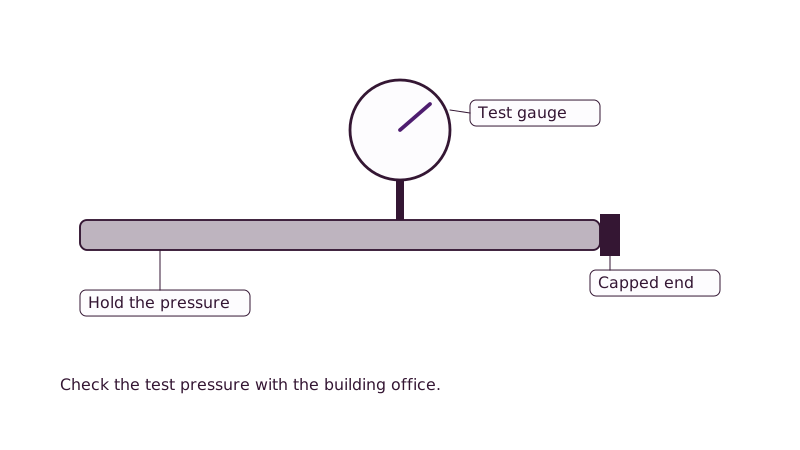
Ask the building division what test pressure and duration it requires, since the code sets these and the office can tell you. Do not test with gas, and do not use soap bubbles as the only check on a line that has not been pressure tested. Once the final inspection is passed the appliance can be lit, and the plumber examines every joint for leaks.
What about flexible gas connectors and CSST?
Appliance connectors are flexible and short, made for the final stretch from the shutoff to the appliance. Running them through walls, floors or cabinets is not allowed. Corrugated stainless steel tubing, CSST, is used for whole-house runs in some homes, with manufacturer rules for fittings, support and bonding, and the inspector checks that those are followed.
CSST needs correct bonding, and installers use the manufacturer's training and instructions. Ask whether the existing system has CSST and whether it was bonded, if you are adding to it. Old black iron or galvanized lines can corrode, and a leak test is wise before adding appliances.
What gas safety steps apply right now?
On smelling gas, get out of the building, phone SoCalGas on 1-800-427-2200 from a spot outside, and dial 911 if there is danger. Avoid flipping switches, using a phone indoors or relighting appliances. Plumbers do not repair a suspected leak while gas is present, and SoCalGas can shut off and check service.
Find your gas shutoff and, if the utility advises it, keep a wrench close by. After an earthquake, shutting that valve can lower the risk, as the earthquake shutoff valve page explains. A carbon monoxide alarm near sleeping areas is a sound precaution in homes with gas appliances.
How do I start a gas piping job?
Decide what you need: a new line, a move, a larger line for a tankless heater, or repair. Phone the building division to confirm the permit steps, then request from a local plumbing business a written quote itemizing the permit, pipe, sizing, test and inspection. The gas line cost guide shows sourced national ranges.
Submit the quote form to start, and a local plumbing business will view the layout before pricing the work. For a ground-up overview of services, open the page on gas line plumbing. Ask what is due and when, since California limits home improvement deposits.
Common questions
May I connect a barbecue or fire pit to gas on my own?
Does the code require a shutoff valve at every gas appliance?
How often should gas lines be inspected?
Should I be home during gas piping work?
This guide is one of many on Rubidoux Ridge Plumbing plumber.
Sources used
Page updated