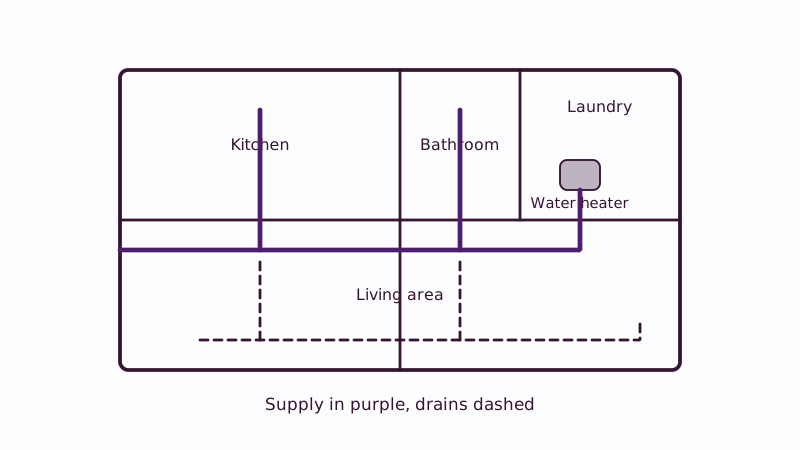
Plumbing a new house means installing every pipe from scratch, in stages, and the price scales with the floor area and the number of fixtures. This Old House's plumbing guide, updated 06/06/2026, puts whole-house plumbing at $10,000 to $20,000 and new-construction rough-in at about $4.50 per square foot of interior space. These come from a national guide, so they are not Riverside rates. The Rubidoux Ridge Plumbing home page lists the plumbing work we arrange, and a quote for your own plans comes from the quote request.
Ahead: what the number covers, the build stages, the costs that land outside the plumber's price, and how to line up bids.
What should I budget to plumb a new home?
On This Old House's numbers, a house of 2,000 square feet comes to roughly $9,000 for rough-in, or $10,000 to $12,000 with fixtures connected, inside the guide's $10,000 to $20,000 span for whole-house plumbing. Treat them as national guide figures: they are neither Riverside rates nor quotes from any plumber we arrange.
The written quote sets the price. Floor area is only a yardstick, since bathrooms, kitchens and laundry rooms hold most of the pipe. A compact home with three baths may run higher than a larger open-plan one with two. Hillside lots, a long run from the meter and an upstairs laundry all add pipe and hours.
What the range omits matters equally. Often the fixtures, water heater, gas piping, irrigation and the trench from the street come as separate lines, so have each bidder itemize inclusions and exclusions.
What are the stages of plumbing a new house?
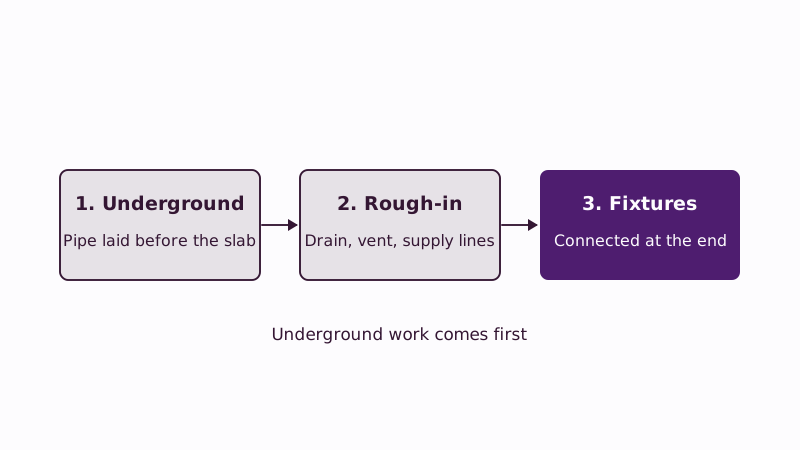
There are three stages. Underground work comes first on a slab, with pipe laid before concrete is poured. Rough-in then threads drain, vent and supply lines through the framing before walls close. Finish plumbing sets toilets, sinks, faucets, tubs and the heater once drywall and cabinets are up.
Inspections follow each stage, and the plumber coordinates timing with the builder. Water supply material, such as PEX or copper, and the drain material are chosen with the builder and checked against the code in force. The City of Moreno Valley's submittal bulletin says the 2025 California codes became effective January 1, 2026, which means a project submitted around now follows them.
An older house goes through a similar sequence during a repipe, described in how a repipe is done, though open walls make new construction simpler.
At what point do I contact a plumbing business?
Reach out once plans are in hand and the builder is taking bids, which is earlier than most people expect, because underground work precedes the slab. Waiting until framing is done leaves little room to compare quotes, and a plumber who sees the plans early can flag fixture placements that add cost.
Who hires the plumber and pulls the permit?
The general contractor normally hires a plumbing subcontractor, and that sub takes out the permit and schedules inspections, although an owner-builder can hire directly. State rules require a contractor license from $1,000 in labor and materials or whenever a permit is needed, and the CSLB website lets you look up a license by its number.
Ask the builder how the plumbing allowance is set and what it covers, so confirm what the allowance covers. Collect two written bids priced from the same plan set so the scopes match.
Which costs fall outside the plumber's bid?
Permits, utility connections and meters. This Old House says permit fees typically run around $75, yet a new house goes through the full building permit process, and fees depend on the city. Water and sewer connection charges come from the utility separately. We found no fee schedule we could verify, so ask each agency directly.
Check who serves the lot. Riverside Public Utilities is the water utility for most of the City of Riverside, but Western Municipal Water District appears to serve some neighborhoods such as Orangecrest, and EMWD serves most of Moreno Valley with Box Springs Mutual Water Company in a small western area. Loma Linda runs its own water and sewer. Confirm the supplier for your address before you budget. SoCalGas serves the cities of Riverside, Moreno Valley and Loma Linda, and gas service is arranged with it.
Permit desks: City of Riverside Building and Safety at (951) 826-5800, City of Moreno Valley Building and Safety at (951) 413-3350, Loma Linda Building and Safety at (909) 799-2836 for permit questions, and County of Riverside Building and Safety at (951) 955-1800 for unincorporated addresses.
What affects a new-construction plumbing bid?
Floor area, bathroom count, kitchen and laundry placement, slab or raised foundation, pipe material, fixture count, heater type and trench length. This Old House observes that labor is most of any plumbing bill and that metal pipe costs more than plastic.
Local water plays a role. In the 2025 report from Riverside Public Utilities, average hardness is 197 mg/L, close to 12 grains per gallon, so some owners plan a softener loop from the start rather than retrofit one: see softener installation. Specify gas lines for range, dryer, heater and any outdoor kitchen up front, as gas line work explains.
A remodel is a different job, better matched by bathroom remodel plumbing and updating an old house.
What should I do next?
Gather the plans, a fixture list and the lot location. Then use the quote request form and a local plumbing business will be asked to review it. Include the city, square footage, bathroom count and foundation type. Expect the plumber to want the plan set before pricing.
No response time is promised. On a custom build, ask how the price shifts when plans change, and request fixture alternates. An itemized quote lets you swap choices without a shock.
Common questions
What is the timeline for plumbing a new house?
Which questions go to a plumber bidding on a new build?
Do I have to be on site?
Sources used
Page updated