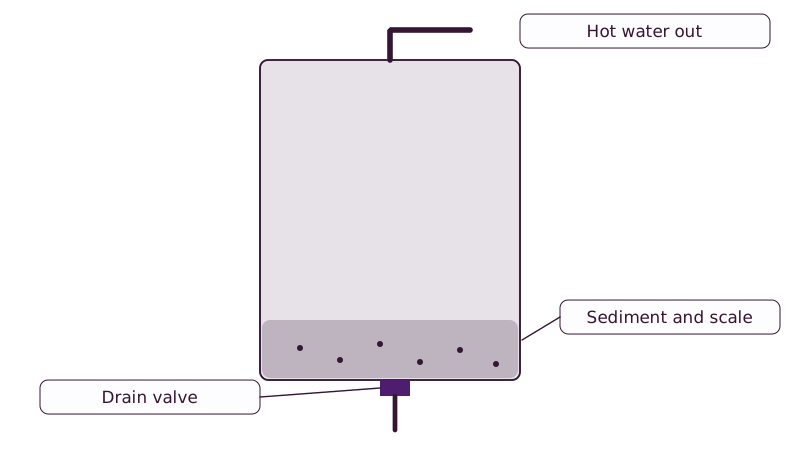
Hard water scale is the chalky crust on faucets, showerheads and inside water heaters. It forms because the water carries dissolved calcium and magnesium, and heating or evaporation leaves them behind as solid deposits. You can reduce it by knowing your hardness number and choosing a fix. Whole-house options sit under water softener installation.
What causes hard water scale in the first place?
Hardness comes from calcium and magnesium compounds picked up as water passes through rock and soil. The USGS says hard water heated in a home water heater can leave solid calcium carbonate deposits that shorten equipment life and raise heating costs. Scale is what is left when the water leaves.
So scale is usually caused by heat plus minerals plus time. The deposits build fastest where water is hottest or evaporates: the water heater, the kettle, the showerhead holes, the edge of a faucet, and glass that dries with spots. Inside pipes the buildup is slow and invisible, which is why a house can lose flow for years before anyone notices. To see what buildup looks like, open up a showerhead or an aerator and inspect the inside.
The trouble is mostly the equipment: reduced hot water output, noisy water heaters, clogged aerators and spotty dishes. Cleaning, once the deposits exist, is covered in removing hard water scale.
How is hard water measured?
Hardness is reported in milligrams per liter, which equals parts per million, or in grains per gallon. A grain per gallon works out to 17.1 mg/L. On the USGS scale, above 180 mg/L is very hard, 121 to 180 is hard, 61 to 120 is moderately hard, and up to 60 mg/L is soft. That gives you a rating scale for any report.
The measurement scale is simple to apply. Take the number on your utility's report, convert grains to ppm by multiplying by 17.1 if needed, and place it on the rating. Notice that pH is something else. The pH scale describes acidity, not hardness, so a neutral pH can still come with very hard water.
What are hardness levels around Riverside?
Local utility reports show a spread. Riverside Public Utilities' 2025 report lists hardness averaging 197 mg/L, about 12 grains per gallon, range 180 to 210, which falls in the very hard band on the USGS scale. Western Water's 2025 report gives local groundwater averaging 155 mg/L and Metropolitan surface water averaging 88 mg/L. EMWD's 2025 table lists Mills-area hardness averaging 5.1 to 7.5 grains per gallon, about 87 to 128 ppm.
Loma Linda's latest readable report is from 2015, listing hardness averaging 93.4 ppm with a range from 6.3 to 220, so ask the city for current numbers. These are district-wide figures and not a reading at your tap. Check which agency sends your bill, since Riverside, Western Water, EMWD, Box Springs Mutual and Loma Linda all serve different addresses. We did not find hardness figures for Box Springs Mutual.
How do I prevent scale in practice?
Four options are worth comparing. Flushing the water heater helps with sediment. A whole-house softener removes the minerals. A salt-free conditioner claims to change how scale sticks. Point-of-use filters help only where they sit. Match the tool to the damage: when the water heater suffers most, treating the whole house makes sense, whereas a spotty shower door is cheaper to wipe.
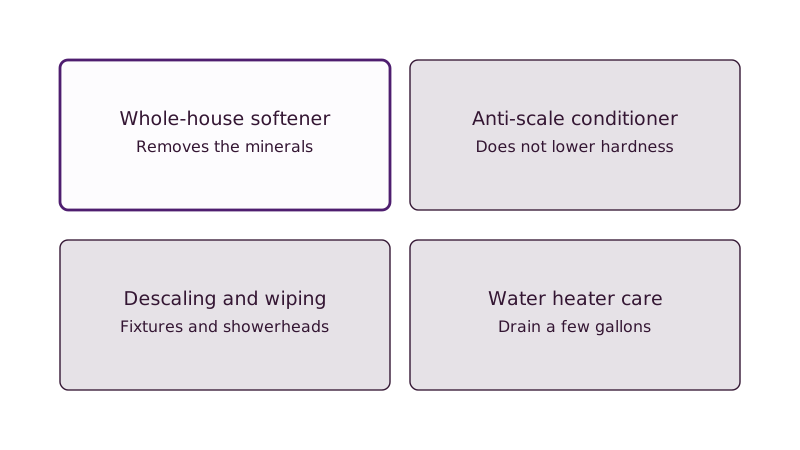
In plain terms, the four compare like this:
- Whole-house softener. Trades calcium and magnesium for sodium or potassium, which removes the cause. It costs the most, uses salt, and needs a drain and power. See softener costs.
- Anti-scale conditioner. Marketed as a way to keep minerals from sticking. Claims vary, and independent test results are not always shown, so ask for the data. It does not lower the hardness number.
- Descaling and wiping. White vinegar on fixtures works on faucets and showerheads, though it can harm natural stone and some finishes, so read the manufacturer's care sheet.
- Water heater care. Letting a few gallons out of the tank now and then helps with sediment. Go by the maker's instructions, and phone a plumber when the drain valve sticks.
Can scale rescue products fix a bad case?
Descaling acids can dissolve mineral crust on fixtures, kettles and showerheads, but they are not a cure for the source. Use them with ventilation and gloves, follow the label, and avoid mixing products. Do not pour strong descaler into a water heater or onto gas appliances unless the maker says to. A heavy crust inside the tank usually means replacement soon.
Rinse well afterward, since leftover acid can harm seals. If scale has choked a pipe, the repair is plumbing work, and replacement of piping behind a wall needs a permit in Riverside according to the city's handout. Confirm the rule with Building and Safety at (951) 826-5800.
Common questions
What is the time frame for preventing scale?
Which questions should I put to a prospective plumber?
Is it necessary for someone to be home?
Does soft water feel different?
This guide is one of many on plumber in Riverside.
Sources used
Page updated