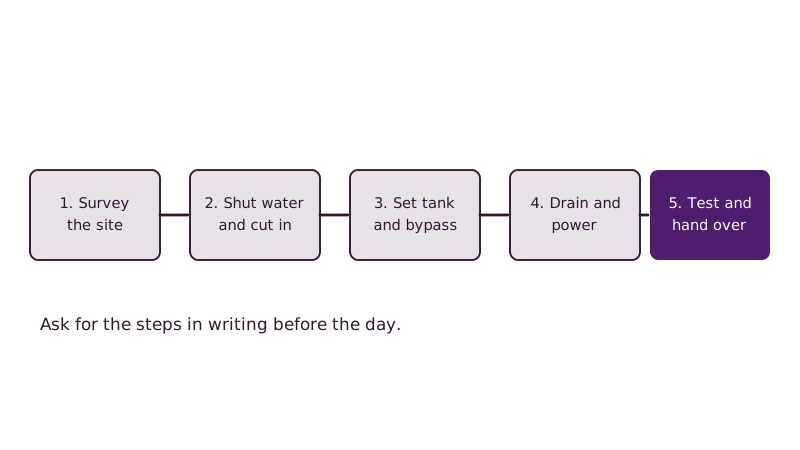
A softener install service does one practical thing: it puts a treatment tank into your water line and a drain line next to it, and then makes sure nothing leaks. You can hire a plumber or a softener dealer for that. This page helps you choose, and the softener plumber overview covers the basic job.
What is covered by a water softener installer's service?
A complete service covers the unit's placement, a bypass valve, the inlet and outlet plumbing, a drain line with an air gap, an outlet check, salt loading, and programming the head to match your hardness. It ends with a flush, a leak check, and a short walk-through of the controls.
Ask for the parts to be named. If the quote reads "install softener" and nothing else, you cannot tell whether it includes a new bypass, copper or flexible connectors, a drain extension or a power outlet. Those details make the difference between a clean job and a callback.
The plumber's trade matters here. A softener ties into the water supply and the sewer drain, both plumbing systems. An electrician is only needed if a new outlet is required, and that is a separate item. A plumber who sets up your softener should be able to handle the drain and the supply together.
Plumber, dealer or DIY: who should install it?
A plumber suits you if the install needs pipe work, a longer drain or a permit. A dealer or retailer may bundle the unit with installation at a set price, which is simpler when the layout is easy. DIY is realistic only if you can solder or use push fittings and are comfortable shutting off the whole house.
When you compare a softener installation company to an independent plumber, ask the same questions of both. Who does the physical work, an employee or a subcontractor? What does the quote include? Is there a contractor license number? California's Contractors State License Board says jobs reaching $1,000 in labor and materials need a license.
If you decide on DIY, understand what you are taking on. A mistake at the main valve or on the drain can flood a garage. A plumber also tests for leaks under full pressure and can fix a fitting the same day.
How should I work from the manual for my softener?
The manual is the authority for your unit. Find the printed manual that shipped in the box, or search the maker's support page using the model number shown on the label. For popular brands such as Whirlpool, Rheem or Aquasure, the manual gives the required inlet pressure, the distance between the bypass and the drain, and the salt setting.
A video can help you picture the job, but the manual carries the numbers. Whatever the brand, pay attention to three limits: the maximum water pressure, the maximum temperature at the unit, and the type of drain connection allowed. Keep the unit off any hot water line.
If you hire a plumber, hand them the manual and the model number before they arrive. It saves time, and a plumber who has installed that brand can check the setup against the printed instruction.
What should a whole-home softener installation look like?
A whole-home install treats everything inside the house. Place the softener downstream of the main shutoff and the pressure regulator, upstream of the water heater and the cold water branches. You can isolate the unit with a bypass valve. Outdoor taps are often teed off earlier so landscape watering uses untreated water.
Check the final layout against a few points. The brine tank has clearance and is level. The drain hose runs into a standpipe or floor drain, leaving an air gap. Pipe supports hold the weight of the valve. The power cord is plugged in at an outlet that is not switched off by a wall switch.
Sizing depends on household size and hardness. In Riverside Public Utilities' 2025 report hardness averages 197 mg/L, about 12 grains per gallon. In Moreno Valley, the EMWD report lists Mills-area hardness of about 5.1 to 7.5 grains per gallon depending on source. A hardness reading of your own tap is worth more than any average, so test it.
Does well water change the install?
Yes. Well water often brings iron, sulfur or sediment on top of hardness, and a softener alone will not handle all of that. A water test tells you which pieces you need, such as a sediment filter before the softener, or an iron treatment stage. Homes in the Riverside, Moreno Valley and Loma Linda areas are generally served by a public water supplier, so this applies mostly to rural parcels.
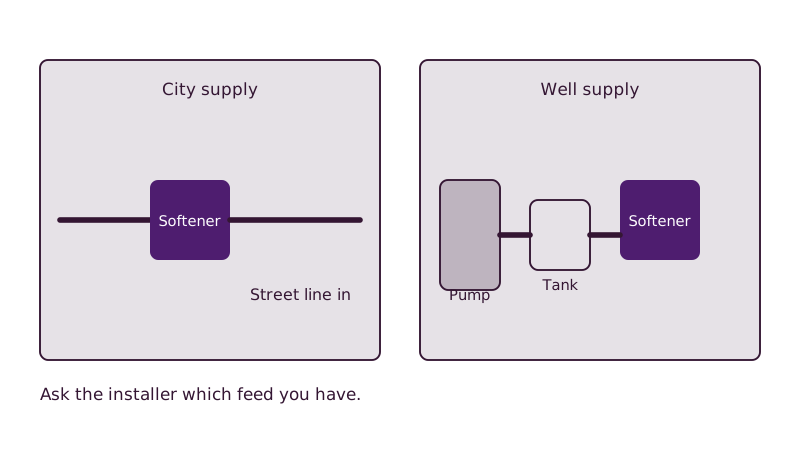
If you are in a rural pocket such as parts of Highgrove or Mead Valley, confirm your water source on your bill. Some addresses are on a district system and some are not; the Mead Valley page and the Highgrove page explain what we know.
A plumber will want the test results before quoting, because the design depends on them. Ask whether the system includes a bypass and a way to take a sample after treatment.
What to do next
Write down your address, the approximate number of people in the home, a recent hardness reading if you have one, and the location you have in mind for the unit. Take a photo of the main shutoff and the area around it. With that, a plumber can quote without guessing.
Then send a request and we will forward it to a local plumbing business. You can compare the price against national guide figures on the softener installation cost page. See the home page for all the other jobs we cover.
When does DIY give way to calling a plumbing business?
Bring in a plumber to cut into copper or galvanized pipe, extend a drain, add a power outlet, work within a cramped crawl space, or if the home is older and its main shutoff fails to close all the way. A valve stuck open can turn a small project into a flood.
Reach out as well when you cannot tell whether a permit applies. In Riverside, City Building and Safety can be reached at (951) 826-5800; in Moreno Valley at (951) 413-3350. A plumber who handles permits saves you a trip.
Common questions
How many hours does a softener installation take?
Which questions suit an installation company?
Does anyone have to be home during installation?
May I put in a softener myself and ask a plumber to review it?
Sources used
Page updated