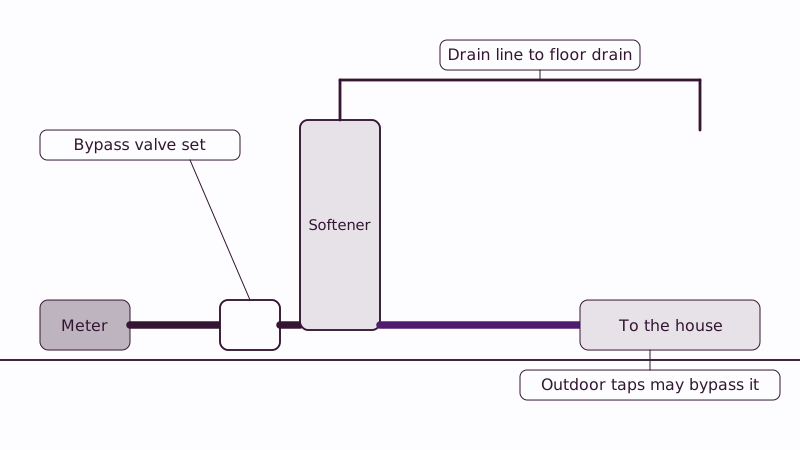
A whole home softener is not an appliance you plug in at the sink. It is installed on the main water line, usually in a garage, side yard or utility closet, and it treats everything that flows into the house, including the water heater. That changes what the installation costs. This article belongs with our overview of water softener installation and focuses on the scope of a full-house job and the price that follows.
What should I expect to pay to install a softener for the whole house?
Fixr's Water Softener Installation Cost guide, updated January 31, 2025, lists $1,100 to $3,000 for the system and installation, with an average of $2,500 and labor of $150 to $1,000. Bob Vila's guide, updated April 22, 2024, gives $200 to $6,000 installed and an average of $1,500. These are national guide figures, not local rates or what we charge.
Think of the number as three layers: the softener, the labor to connect it and the extras your house needs. Fixr's labor range already shows how wide the middle layer can be. The low end is a straight hookup next to a main line with a drain and outlet close by, and the top is a retrofit needing new piping, a drain run and an outlet.
The written quote sets the price. For the broader numbers and the brand questions, see our water softener installation cost page, which covers calculators and by-brand pricing.
What does a whole-house installation actually include?
A full job usually covers placing the tank, cutting into the main line, adding a bypass valve set so you can isolate the unit, running a line to drain the regeneration water, connecting power for the control head, loading salt, setting the hardness level and testing for leaks. Each step either exists in your quote or becomes an extra later.
Walk through it with the plumber before signing. Where will the unit sit, and is there room to reach the salt tank? How far is the drain? Is there already a hookup waiting? A house that already has capped connections near the main can save labor, so mention it. Older homes in Downtown Riverside, the Wood Streets and the Eastside may have galvanized or corroded lines at the main, and a section may have to be replaced by the plumber before connecting.
An important point for homes with outdoor taps: ask whether those lines will be treated or bypassed, since irrigation does not need softened water, and sending it all through the unit means more salt and more regeneration. Some plumbers plumb a separate untreated line for the yard.
How do I size a system for my home?
Sizing is based on household size, daily water use and your hardness number, because the unit has a capacity measured in grains, and it regenerates when that capacity is used up. A bigger family in harder water needs more capacity, otherwise the unit regenerates constantly and wastes salt and water.
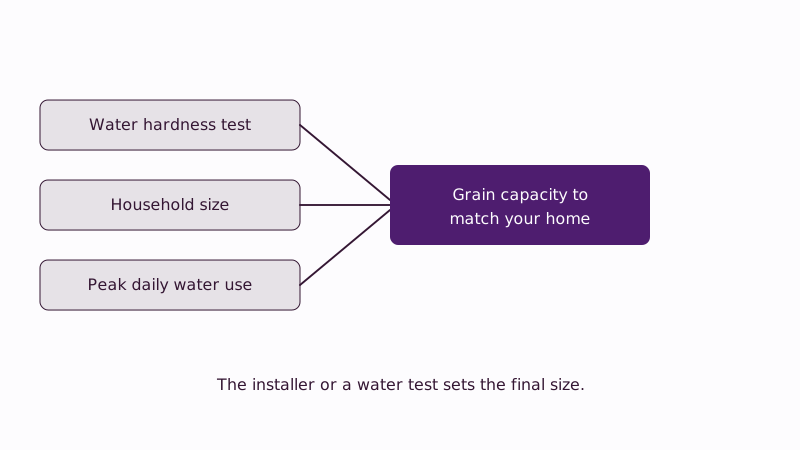
Get the hardness number from your utility's report, not a guess. Riverside Public Utilities' 2025 report lists hardness averaging 197 mg/L, about 12 grains per gallon. Western Water's 2025 report lists local groundwater averaging 155 mg/L. Your bill shows which agency serves you. A plumber or dealer should ask for the number, count the bathrooms and the people, and recommend a capacity, and the model should appear by name on the quote.
An oversized unit costs more upfront and an undersized one costs more over time, so ask the plumber why the chosen capacity fits your house.
What extras can push the bill higher?
Extra costs come from work that is not the softener: a new drain line, a power outlet, replacing old pipe near the main, a pressure regulator if pressure is high, relocating the water heater feed, a sediment filter ahead of the unit and any permit or inspection. Each is a line item you can ask about.
When pipe inside a wall face or under the floor has to be replaced, a permit is required according to the City of Riverside's handout, so ask who pulls it. Riverside Building and Safety is at (951) 826-5800 and Moreno Valley Building and Safety is at (951) 413-3350. We did not find a Loma Linda statement for this specific job, so call (909) 799-2836 to ask.
Operating costs also count over time. Salt, the water used for regeneration and an occasional service all add to the cost of ownership, and can a softener raise your water bill covers the water side.
Common questions
How long does a whole house install take?
What should I ask before I hire someone?
Do I need to be home for the installation?
Is a softener worth it where the water is hard?
The rest of our guides start from the plumber guide for Riverside.
Sources used
Page updated