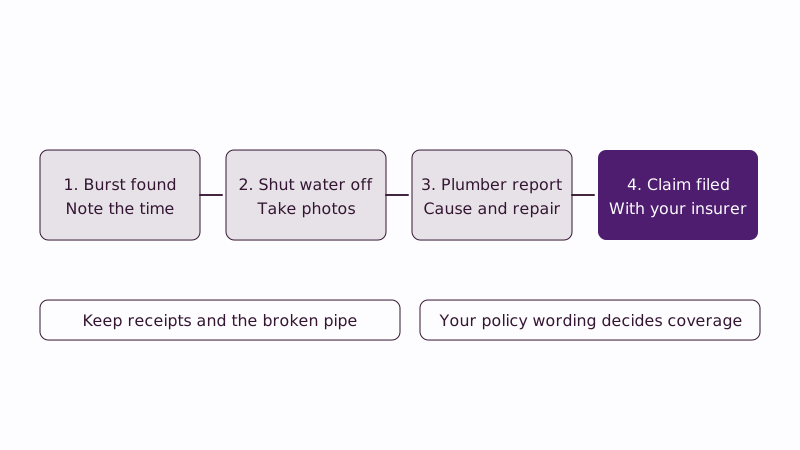
A sudden, accidental burst is covered under many homeowners policies, while slow leaks, wear and poor maintenance are excluded by many. Whether your policy covers a given loss depends on its wording, so the real answer sits in your own documents and with your insurer. We are not an insurance agent, and nothing here is a coverage decision. What we can offer is the order of steps to take and the questions worth raising. For the plumbing side, see leaks and burst pipes.
Does house insurance cover a pipe leak?
A sudden and accidental leak, such as a pipe that bursts, is often covered, and one that dragged on for weeks or months often is not. Insurers commonly separate the two. The distinction between a burst and a seep is often the heart of a dispute, so documentation matters.
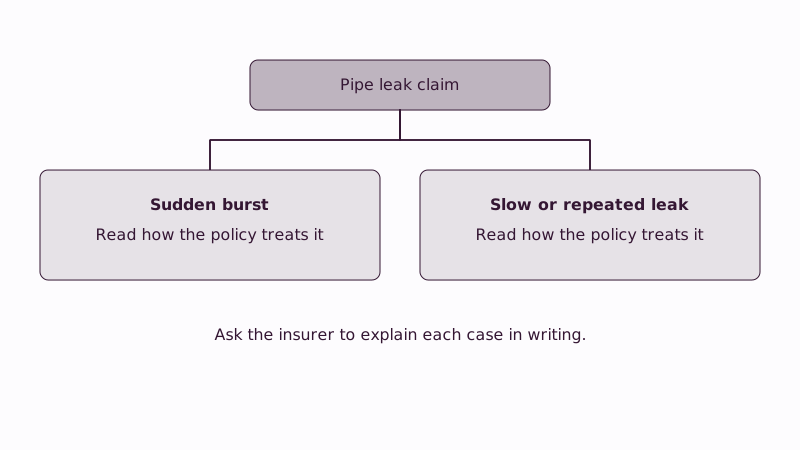
Three questions decide most claims:
- Was it sudden? A split pipe that floods a room is a different loss from a pinhole that stained a wall for a year.
- What does the policy say about water? Some policies add limits, higher deductibles or conditions for water losses.
- What is being claimed? Damage to the home, damage to belongings, and the cost of finding and fixing the leak itself may be treated separately. Some policies refuse to fund repair of the failed pipe yet may reimburse the harm the water did.
Flood and groundwater are usually a different coverage. Sewer backup may need an endorsement. We cannot say which applies to you, so read the policy and ask the insurer in writing.
What are the first steps after a pipe bursts?
Your three jobs are halting the water, shielding the property and recording the loss. Close the main shutoff, cut power to wet areas where that is safe, and carry belongings out of the way. Photograph and film everything before cleaning up. Have a plumber stop the leak, then contact your insurer. Many policies expect reasonable steps to limit further damage.
Keep records:
- Pictures and footage showing the damage, the pipe and the surrounding area.
- The damaged section of pipe if the plumber removes it.
- Receipts for emergency repairs, drying equipment and temporary housing.
- The plumber's invoice, including a description of the cause and the repair.
- A list of damaged items with age and value.
The steps for the water emergency itself are in our emergency burst pipe guide and burst water pipe guide.
How does a plumber's report help a claim?
An invoice that names where the pipe failed, what type of pipe it was and what was done is evidence of what happened. If the plumber can say the pipe split suddenly, in a way consistent with a burst, that helps. Plumbers do not decide coverage, and they should not promise a claim outcome, but a clear written description is useful.
The plumber can record where the failure was, the material, how nearby pipe looks and whether age, pressure, a joint or an outside force seems to be the cause, which is plain description and not a coverage opinion. A contractor license is required in California for jobs where labor plus materials reach $1,000, and insurers may ask about it; you can verify a license number on the CSLB site, cslb.ca.gov.
Will my insurer pay for the repair or only the damage?
That varies by policy. A few policies pay for the water damage that results but not for fixing the pipe. Some also pay for opening up and replacing materials to reach a leak. Others do not. Ask your insurer which of the plumbing repair, access work, drying, and rebuild are covered and what the deductible is.
The cost of the plumbing is separate from the cost of drywall, flooring and paint. For a sense of plumbing prices, see leak repair guidance and leak detection costs. The written quote sets the plumber's price, whatever the claim does.
What might an insurer deny, and why?
Common reasons include a leak that was long-running and not sudden, damage from lack of maintenance, wear and corrosion, delay in reporting, failure to limit damage after discovery, and damage from sources the policy excludes. Water damage that reaches the claim long after the burst can raise questions about whether mold and rot came from the burst or from older moisture.
You can lower that risk by acting fast, documenting well, reporting promptly and keeping repair records. When a claim is denied, request the written reason and the policy provision behind it. You can ask for a review and talk with the California Department of Insurance about the process.
Older homes in Downtown Riverside, the Wood Streets, Arlington and Eastside can have aging galvanized or copper lines, and insurers may ask about the age of the plumbing. Homes in La Sierra and Moreno Valley from the 1970s to 1990s may be at a similar age. Learn what you have: galvanized pipe replacement and damage that water does after a pipe bursts.
How can I prevent a claim denial or a second burst?
Maintain the plumbing, fix leaks promptly, know where your shutoff is, and replace aging pipes before they fail. A burst can pour out gallons quickly, and the EPA reports that the average household loses over 9,300 gallons a year to leaks. Regular checks cost less than a claim.
Practical steps: exercise the main shutoff yearly, check the water pressure (the California Plumbing Code caps it at 80 psi), inspect the spaces beneath sinks and near the water heater, and keep an eye on the meter whenever no water should be running. See burst pipe prevention. If a pipe keeps failing, a repipe may be the lasting fix.
Common questions
How long will an insurance claim take?
What should I ask my insurer after a burst pipe?
Should I be there when the adjuster visits?
Can I get the plumber to say it was sudden?
Should I keep the broken pipe?
The rest of our guides start from Riverside plumber.
Sources used
Page updated