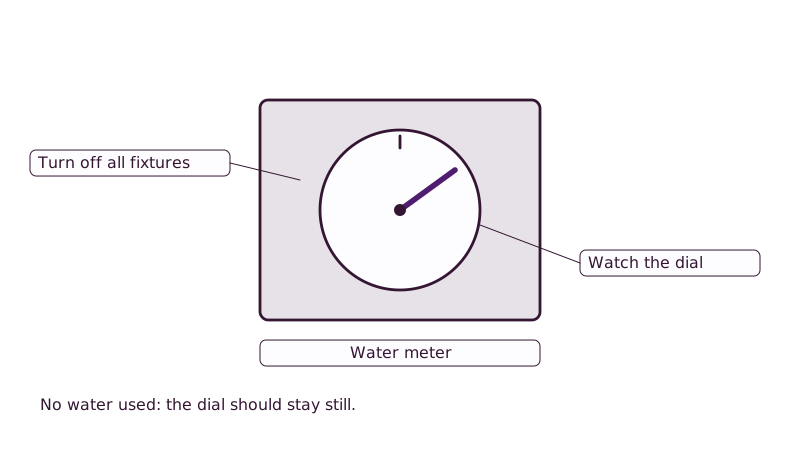
A bill that climbs while nothing looks wet usually means water is escaping out of sight: a toilet that leaks slowly into the bowl, an irrigation valve stuck open, a line under the slab or in a wall. The quickest check is the water meter. The repair side is covered on leaks and burst pipes; here we start with locating the leak.
How does the water meter reveal a hidden leak?
Turn off every tap and appliance, then look at the meter. If the small leak indicator spins, or the numbers move over ten or fifteen minutes with no water in use, water is escaping at some point past the meter on your property. Write down the reading, wait, and check again to confirm.
Locate the meter at the curb or the side of the house, under a lid that lifts with a screwdriver. Watch for spiders and wear gloves. Many meters have a flow triangle or a small dial that turns with any flow. If that dial moves at all with everything off, you have a leak.
Then narrow it. Shut the main valve at the house, then read the meter once more. A meter that stops means the leak is inside the house. A meter that keeps moving means the leak is on the stretch of pipe from the meter to the house, often a buried pipe. This one step saves a plumber a lot of time and you a lot of money.
What to do next
Do the meter test and write down the numbers. Do the toilet dye test. Check the sprinklers. Then call the water supplier to ask for a usage history and whether they have a leak adjustment policy; ask what proof they require. A plumber's invoice may count.
When the meter keeps moving and the source stays hidden, send a request and we pass it to a local plumber who visits. The home page shows the other services we cover.
Is it the sprinklers or the yard?
Irrigation is a common suspect for homes with a lawn or planting beds. A valve stuck open, a broken head or a cracked pipe can run for days. Walk the yard when the system is off and look for soggy spots, green patches, or a hissing sound.
Run each zone for a minute and watch for geysers or pooling. Set the controller to off, then look at the meter again. If the dial stops, the controller or a valve was the cause. Riverside Public Utilities lists rebates for weather-based irrigation controllers, up to $200 per controller, though funds are limited and you should confirm before you buy.
Seasonal use can also raise a bill without any leak. Hot weather, a new lawn, a filled pool or a visiting family can raise water use. Compare the same month a year ago before you conclude there is a leak.
When to call a plumber business
Call when the meter still moves after all water is off and the house is shut off, when you hear water in the walls, when a floor feels warm, when a wet spot appears in the yard, or when the bill keeps climbing after you fixed a toilet or a sprinkler. Do not dig up the yard yourself.
A California contractor license is needed once a job reaches $1,000 in labor and materials or requires a permit, which covers most pipe repairs beyond a simple fixture fix. Before any digging or wall work, get the license number and a written quote.
Might a water heater or softener also push the bill up?
Yes. A dripping relief valve on the water heater, a heater cycling water out through its drain line, a regenerating softener with a stuck valve, or a recirculating pump can all add use. A failed pressure regulator may also increase flow in the house. Each is checked in a few minutes.
Listen to the garage or utility closet. A hiss, a trickle or a constant gurgle is a clue. Look for a steady drip from the pipe on the relief valve, usually along the tank's side. For softeners, see whether a water softener raises the bill. If the bill is high and nothing above fits, why a water bill is so high lists other causes.
What happens when the leak lies beneath the slab or in the yard line?
A leak below a slab or in the buried line from the meter is hard to see, because the water drains into the soil. Clues include a floor that feels warm in one spot, running water heard with everything off, a damp yard patch that never dries, and cracked paving. To confirm it, a plumber uses a camera or listening equipment.
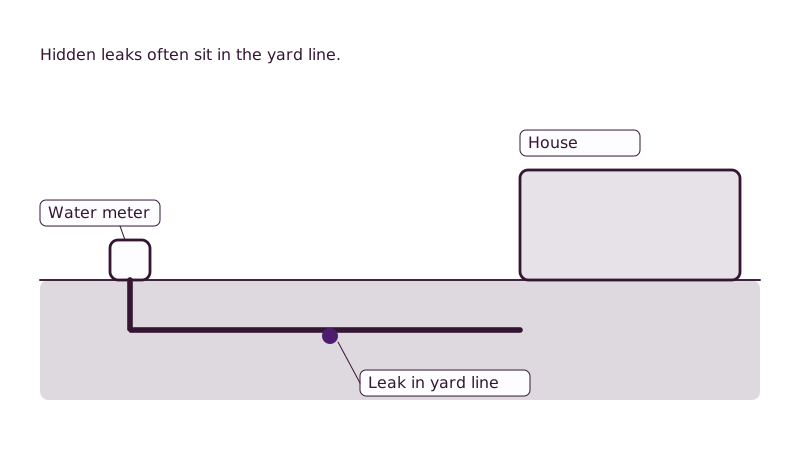
Leak detection is a visit on its own; see leak detection cost for guide figures and slab leak detection and repair for what happens next. Older neighborhoods such as the Wood Streets and Arlington may have old galvanized or copper service lines that corrode, and newer areas such as Orangecrest and east Moreno Valley use newer materials.
The water meter belongs to your supplier. Riverside Public Utilities can be reached at (951) 782-0330, Monday to Friday, 7:00 am to 6:00 pm. If your bill comes from another agency, such as Western Water or EMWD, check the number on your bill.
Could it be a toilet leak I cannot see?
Yes, a silent toilet leak is the most common cause, and it can waste a lot of water without a sound. The flapper leaks slowly into the bowl, so there is no puddle. Put food coloring in the tank, leave it fifteen minutes without flushing, and see whether the bowl water takes on color.
The EPA says the average household's leaks waste more than 9,300 gallons of water a year, and toilets are among the usual culprits. A flapper replacement is cheap and quick. Read about fixing a running toilet if the dye test shows color. Check each toilet in the house, even a guest bath that sees little use.
Faucets matter too. A steady drip adds up over a billing period; see whether a leaky faucet raises the water bill.
Common questions
How long does it take to find a hidden leak?
Which questions should I ask before choosing someone to find a leak?
Does an adult need to be home for leak detection?
Will my water bill be reduced after I fix the leak?
Sources used
Page updated