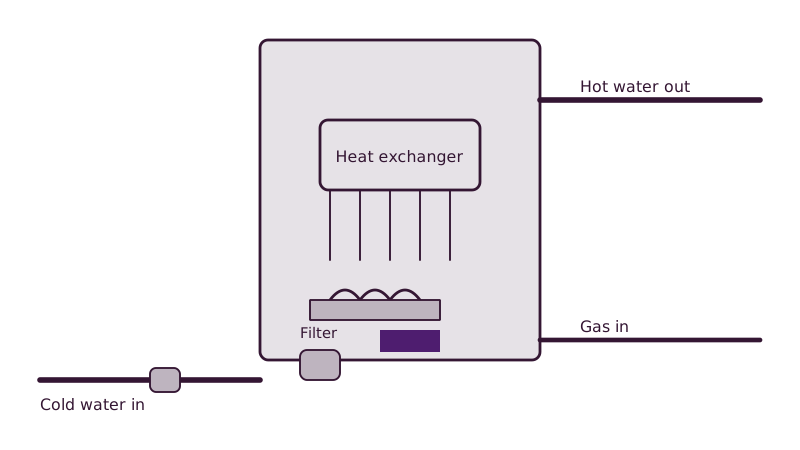
When a tankless heater turns out lukewarm water, cuts off partway through a shower or flashes an error code, the usual causes are a blockage, scale, or too little flow or fuel. Hard-water scale is a frequent culprit here. Safe first steps are flushing the unit, cleaning the inlet filter and confirming the gas or power supply is on. Gas, venting and the heat exchanger belong to a plumber. Tank units are also covered on the broader water heater repair page.
What stops my tankless water heater from heating?
Four problems keep a tankless unit from heating: missing gas or power, a flow too low to fire the burner, a fault that locks the unit out, or a scaled heat exchanger. Confirm the gas valve is open, the breaker is on, the display is lit and a hot tap is wide open. Some low-flow faucets pass less than the minimum needed for ignition.
A code on the display should be found in your model's manual, and you should note it before resetting. One reset after a lockout is fine, but repeated resets can mask a vent or gas problem. Never bypass safety switches. Electric tankless units have separate weak points, like heating elements and thermal fuses, which fall to a plumber or electrician.
In what way does hard water harm a tankless water heater?
Calcium and magnesium bake onto the heat exchanger and narrow its passages, so the unit overheats, loses output and eventually fails. The Riverside Public Utilities 2025 report gives average hardness of 197 mg/L, near 12 grains per gallon, within a 180 to 210 range, which makes scale a real risk for tankless owners here, and other suppliers in the area publish their own figures.
Descaling is routine work, usually a flush of descaling solution or white vinegar pumped through the unit via the service valves. The manual states the interval and procedure, and many units need it yearly where water is hard. Skipping it is a common reason a heater with a good record begins throwing temperature codes. A water softener cuts the problem at its source.
Is flushing a tankless water heater a do-it-yourself job?
Often it is, provided your unit has isolation valves and you can follow the manual. Cut power or gas, close the water valves, connect hoses to the service ports, circulate descaler from a bucket with a pump for the stated time, then rinse and clean the inlet filter. A unit without service valves can have them added by a plumber.
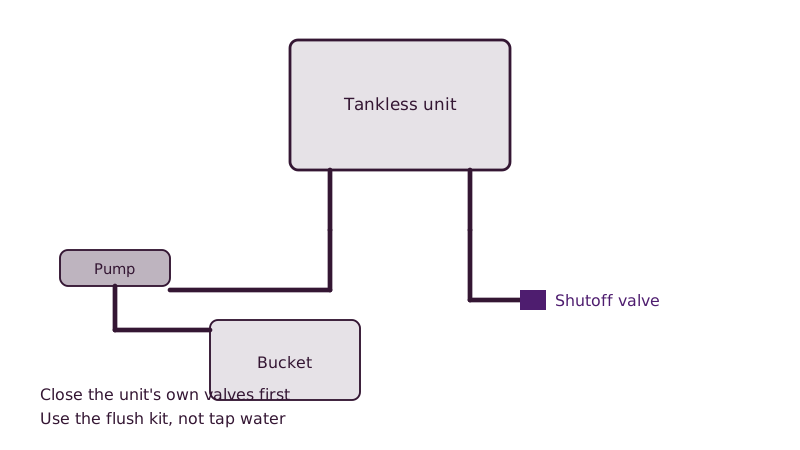
Avoid these errors: firing the unit with valves closed, mixing chemicals, and turning gas back on before water returns. Gas-fired units also contain combustion parts and vent connections that should stay untouched. When unsure, hire it out, since a bad reassembly can leak water or gas.
Which gas and venting rules apply in Riverside?
Gas piping and vent work are regulated. In California any job requiring a permit needs a contractor license, and the City of Riverside's exempt-work handout leaves water heater replacement off its exempt list. Confirm permit needs with Building and Safety at (951) 826-5800. SoCalGas provides service in Riverside, Moreno Valley and Loma Linda.
A gas smell means getting out of the building, phoning SoCalGas at 1-800-427-2200 from outside, and dialing 911 if there is danger. Do not relight or reset the unit. A gas leak, a yellow or sooty flame, or any exhaust inside the house is a reason to stop and call. Gas work is covered on the gas line plumber page.
Why does my tankless heater switch from hot to cold?
In the cold sandwich effect, water left in the pipes from earlier use cools, giving a burst of cold between hot streams. It is a design trait rather than always a fault. A unit that turns cold midway through one long shower, though, may have a flow sensor problem, scale or a clogged inlet screen.
Inspect the inlet filter and the temperature setting. An installed mixing valve or recirculation pump can bring problems of its own. If two fixtures run together and the unit cannot keep pace, output drops. The remedies are a larger unit, a second unit or lower-flow fixtures, and the tank vs tankless comparison explains the tradeoffs.
How do I read an error code on a tankless heater?
Codes differ by maker and model, but most sort into groups: ignition failure, flame loss, exhaust or intake blockage, overheating, flow sensor trouble and water temperature sensor faults. Each code is listed with its cause in the manual. A code that disappears after a restart can still be a warning, so record the number and when it showed up.
Ignition and flame codes often trace to the gas supply, a dirty burner, a worn igniter or a blocked flue. Exhaust codes suggest a blocked vent, a bird nest, or wind hitting a side-wall termination. Overheat codes may reflect scale. A unit throwing repeated codes needs inspection, not a daily reset.
When does repair make sense over replacement?
Repair fits when one part, such as a sensor, igniter, fan or filter, has failed on a unit in decent shape. Replacement deserves a price when the heat exchanger has failed, faults keep recurring, or parts are scarce. A written quote can set both side by side. Sourced national ranges are in the water heater replacement cost guide.
Ask the plumber what is wrong, which part is failing, what the repair involves and whether the manufacturer gives a parts warranty. A written quote starts from the quote form, and urgent leaks are handled on the emergency water heater repair page.
Common questions
How frequently should a tankless heater be flushed?
Can a tankless heater run out of hot water?
Is a tankless water heater repair covered by the warranty?
Which questions should I ask when hiring for a tankless repair?
The rest of our guides start from Rubidoux Ridge Plumbing.
Sources used
Page updated