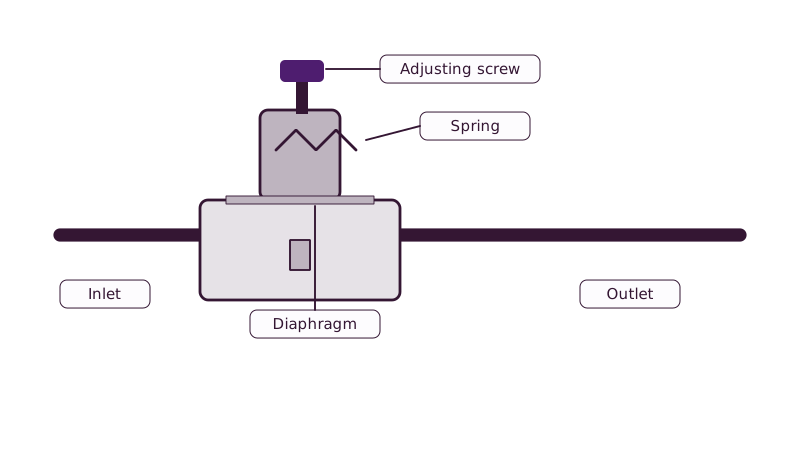
People searching often imagine a regulator mounted beside the water heater. A typical house has just one, a valve on the cold line right after the supply enters, protecting every fixture and the heater downstream. Section 608.2 of California's plumbing code caps pressure at 80 psi. The sections below cover that layout, the signs of a failing valve and where an expansion tank fits. Other heater faults are sorted in the water heater repair hub.
Weak hot water with normal cold water rarely points at the regulator, as the next section shows.
Does hot water have its own pressure regulator?
Normally no. One pressure-reducing valve on the main supply governs hot and cold alike, because the heater draws from the cold side. A second valve on the hot side is unusual. When people ask, they sometimes mean a mixing valve, a temperature and pressure relief valve or an expansion tank, which are separate parts.
When only the hot side sags, suspect the heater and its piping: a half-closed valve, sediment, a blocked shower head or aerator, or a failing dip tube. Low hot water pressure ranks the causes.
Weakness on both sides makes the regulator, a partly closed main valve or the supply the better bet, and low pressure throughout the house handles that.
How do I locate the regulator?
Start at the point where the supply line enters the house: next to the main shutoff, near a garage water heater, or in a yard box. The valve has a bell-shaped brass body with an adjusting screw or bolt on top. Detail is in locating the regulator.
Some houses have none. They depend on street pressure, so a high street reading reaches every fixture. A home lower on a slope can see higher pressure than one above it, purely from elevation. A plumber confirms with a gauge whether a given address needs a regulator.
Measuring takes little effort. Screw a pressure gauge onto an outdoor hose bib, shut every fixture and read the static pressure. Plumbers carry gauges, and hardware stores sell them.
How does the 80 psi limit affect the water heater?
The California Plumbing Code puts the ceiling at 80 psi in section 608.2. Beyond that, fittings, hoses, relief valves and appliances wear faster and leaks become likelier. A failed regulator lets street pressure flood in, and you hear banging pipes and find drips.
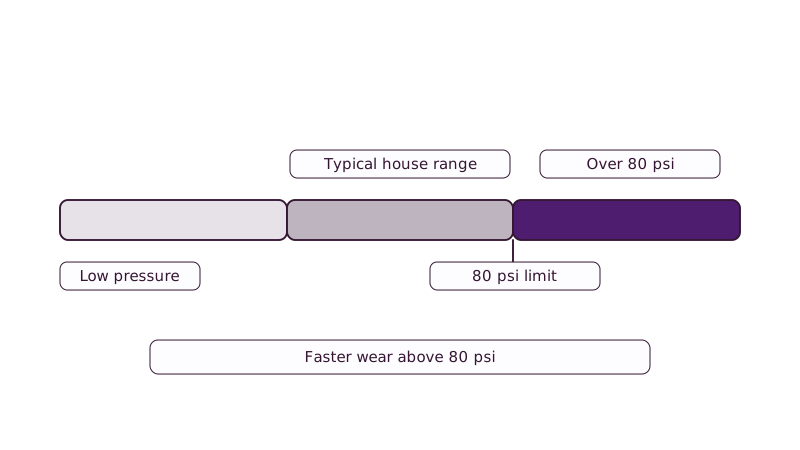
The heater takes the greatest exposure. Heating makes water expand, and a sealed system gives it nowhere to go, so pressure climbs. An expansion tank absorbs the surplus. One is often needed after a regulator or check valve closes the system, although that differs from a code mandate. How it works is shown in expansion tank service.
A relief valve that drips regularly may be answering expansion pressure. It is a safety device, so replace it and never cap it; relief valve replacement explains the process.
What are the signs of a failing regulator?
Hammering pipes, a dripping relief valve, a hissing toilet, blasting fixtures, and pressure that swings from morning to evening all point to it. A regulator stuck closed starves every fixture of flow, and one stuck open passes full street pressure straight into the house.
Regulators wear, and scale works its way inside. With average hardness of 197 mg/L (near 12 grains per gallon) in the 2025 Riverside Public Utilities report, scale on valve seats is plausible. Settings can be tuned, as regulator adjustment describes, but a unit that cannot hold a setting needs replacing, covered in regulator replacement.
Guide figures for the money side are in pressure regulator installation cost.
What can an owner safely handle alone?
Many owners with a gauge and wrench can manage tuning: loosen the lock nut, turn the screw in small steps and recheck the reading. Replacement involves closing the main, cutting or unthreading pipe, and perhaps soldering, and one slip on the main line floods a house.
Use care near the heater. Never cap a relief valve, and do not raise the temperature to compensate for weak pressure, because high settings scald. A heater replacement generally needs a Riverside permit, which Building and Safety at (951) 826-5800 can confirm, and a regulator on the main might interest an inspector too.
When should a plumber take this on?
A gauge reading above 80 psi, a dripping relief valve, hammering pipes, doubt about which part is failing, or a seized regulator all say yes. The plumber measures pressure, tests the regulator and expansion tank, and replaces whatever has worn out.
We do not do the work ourselves. Ask for a written quote and a local plumbing business is lined up to visit. Say what you noticed, along with the gauge reading if you took one. The Rubidoux Ridge Plumbing home page lists the other jobs we handle.
Gas piping, gas heaters and electrical changes are separate regulated trades, and a plumber will say which parts of the job need a permit.
Common questions
What is the usual time to swap a regulator?
Which questions go to a plumber about a pressure regulator?
Do I have to be at home?
Sources used
- California Plumbing Code section 608.2, water pressure limit of 80 psi
- Riverside Public Utilities 2025 Water Quality Report
Page updated