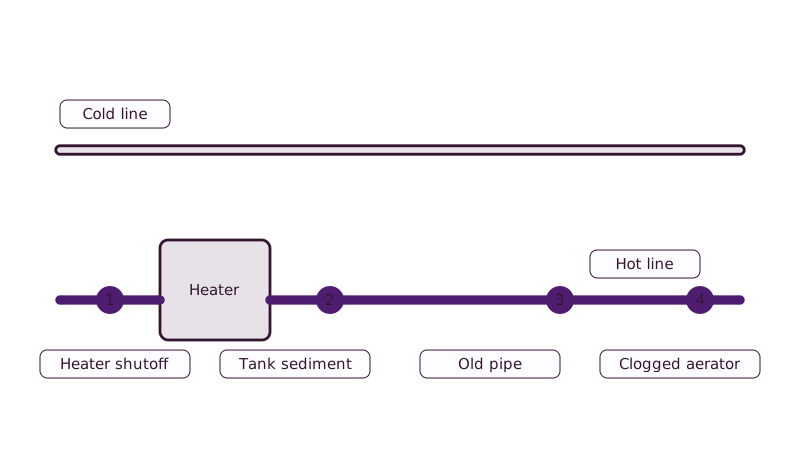
When the cold tap runs normally and just the hot one is feeble, the trouble nearly always lies in the hot water system itself: sediment or scale in the heater, a valve that is partly shut, a clogged aerator, or corroded hot-side pipe. Weak flow at both taps suggests a different problem. The water heater page lists related services, and the home page shows everything else we connect you with.
What makes only the hot side weak while cold flows normally?
The two sides take different routes. Cold water runs directly from the main to the tap. Hot water must first go through the water heater and then along its own pipes. A restriction anywhere in that second path, such as a mostly closed heater valve, a scaled-up tank outlet, or a narrowed galvanized hot line, cuts the flow without touching the cold side.
Start with the simplest suspects. See if every hot tap is weak or just a single one. A lone weak tap usually has an aerator or cartridge problem, while weakness everywhere sends you to the heater and its valve.
Might sediment be choking the water heater?
Yes. Over time, minerals in the water collect on the floor of the tank, and flakes can break loose and block the outlet or a fixture screen. Riverside Public Utilities' 2025 report lists hardness averaging 197 mg/L, about 12 grains per gallon. Eastern Municipal Water District's 2025 Mills-area table lists averages of 5.1 to 7.5 grains per gallon.
Signs include popping or rumbling from the tank, rusty or gritty hot water, and flow that dwindles over months. Flushing the tank and testing the anode rod and dip tube are jobs a plumber can do. Tankless units have a different version of this problem, scale on the heat exchanger, which restricts flow and often triggers an error code. The longer picture is in removing hard water scale together with preventing scale.
Is the heater's shutoff valve open all the way?
Check it first, because it costs nothing. The cold supply valve over the heater must be fully open, with the handle in line with the pipe on a ball valve or turned all the way counterclockwise on a gate valve. A valve that someone nudged during a repair can restrict flow without a visible sign.
The same goes for any isolation valves on a tankless unit and for a mixing or thermostatic valve. If the valve will not move or leaks at the stem, call a plumber to replace it. Never close or cap the pressure relief valve on the heater to stop a drip, because that valve exists to vent dangerous pressure.
Is a blocked aerator or worn cartridge to blame?
Yes, if a single faucet is weak and the others are fine. Unscrew the aerator, the tiny screen on the end of the spout, and rinse away grit and mineral flakes. In a single-handle shower or sink faucet, a worn or scaled cartridge can restrict only one side. Shower arms with old flow restrictors also pinch the stream.
Leave a clogged aerator in white vinegar for about an hour, then rinse it and put it back. If the problem is in a shower, read why your shower pressure is low. If only the kitchen is weak, read about a kitchen sink with low pressure.
Can aging pipes cause it?
Yes. Rust forms inside galvanized steel, and the buildup narrows the pipe until little water gets through. Hot lines can age faster than cold ones, since heat tends to speed corrosion. This is typical in older homes in Downtown Riverside, the Wood Streets, Arlington and the Eastside, where original steel may still be in the walls.
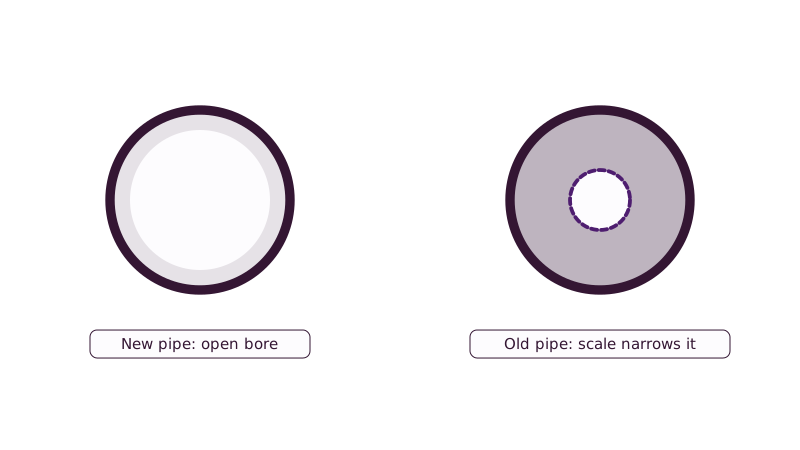
If the pressure has declined over years, and the water shows rust at first use, ask the plumber to identify the pipe material. Replacing only the hot side is sometimes an option, and sometimes a repipe is a better long-term answer. See galvanized pipe replacement for what that involves.
Does the pressure regulator play a part?
Weakness on hot and cold alike makes a failing pressure regulator or a partly closed main valve likely, and a plumber can check with a gauge. Under the California Plumbing Code, building supply pressure tops out at 80 psi, and a regulator holds a house below it. The regulator can also fail in a way that gives low flow.
The part is covered on the hot water pressure regulator page, and the whole-house version is in causes of low water pressure. For sudden changes read sudden low water pressure. A gauge reading is the quickest way to tell a house problem from a utility one.
At what point should I phone a plumber?
Make the call if flushing and the aerator check do nothing, the tank leaks, gas is in the air near the heater, or pressure has fallen throughout the house. For gas, exit the building and ring SoCalGas on 1-800-427-2200 from outdoors, using 911 if anyone is in danger. Never relight a pilot where gas can be smelled.
The plumbing business that takes your request will provide its own timing and a written quote for repairs. Whole-house pressure is covered on the leaks, lines and low-pressure page. Should the heater itself be leaking, start with the water heater leak page.
Common questions
What is the repair time for weak hot water flow?
Which questions go to a plumber about weak hot water flow?
Must I be there while the plumber checks hot water flow?
Does weak hot water flow pose a danger?
Sources used
- Riverside Public Utilities, 2025 Water Quality Report
- Eastern Municipal Water District, 2025 Consumer Confidence Report
- California Plumbing Code, section 608.2 (80 psi limit)
Page updated