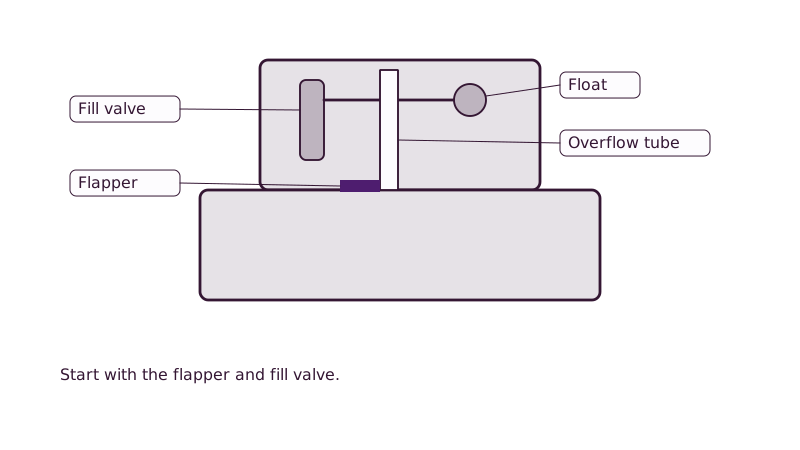
Lift the lid and look inside the tank. Four parts cause nearly every complaint: the flapper at the bottom, the fill valve on the left, the float that tells the valve when to stop, and the overflow tube in the middle. Many repairs cost little and use hand tools. For everything else, including full replacement, see the toilet repair page.
What is inside a toilet tank, and which part fails?
A rubber flapper seals the tank bottom, a fill valve refills it, a float tells the valve when to stop, a chain links the handle to the flapper, and an overflow tube carries excess water to the bowl. Constant contact with water means the fill valve and the flapper wear out first.
Here is how failures show up. A toilet that keeps running by itself has a flapper that is not sealing, a tight chain, or an over-high float. Slow or noisy filling means an aging fill valve. Poor flushing means the flapper shuts too soon or the handle is loose.
The parts are inexpensive and sold as universal kits. Before you buy, note the brand on the tank lid or under it, and photograph the parts so the store can match them. On a very old toilet the tank may take unusual parts, and replacing the whole toilet can be simpler.
Can I fix the bowl, or does it need replacing?
Chips and hairline cracks in the bowl glaze are cosmetic, but a crack through the porcelain that leaks means replacement. A bowl that rocks needs the closet bolts tightened or the wax ring replaced. A bowl that clogs often is a drain or trap problem, not a bowl defect.
Check the shutoff valve and the supply line when you work on a toilet, because they age too. A valve that fails to shut fully, or a crusty line, is worth changing at the same time; see toilet shutoff valve repair. If the toilet is more than a couple of decades old, a replacement can use less water per flush and may cost about the same as repeated repairs. For the budget, see replacing a toilet: cost.
What if the toilet tank is cracked or leaking at the bolts?
A crack in the porcelain tank cannot be repaired lastingly. Sealants and epoxies may slow a hairline seep for a while, but the tank can fail and flood the floor. Replace the tank, or the whole toilet if the model is old. Shut off the supply if you see water seeping from a crack.
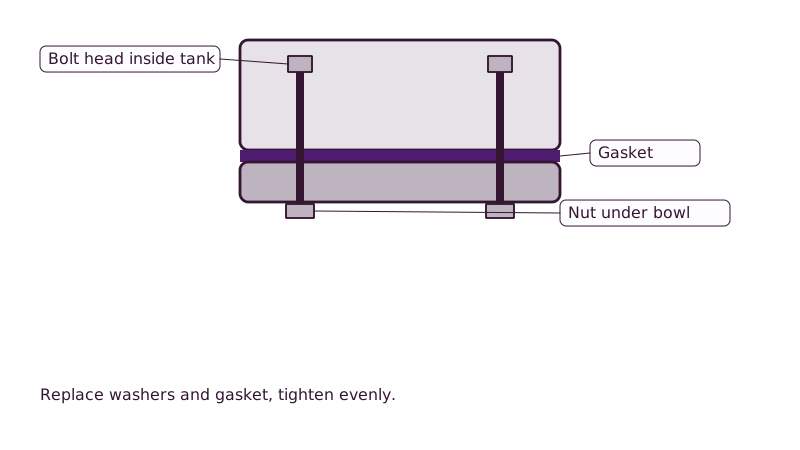
Leaks at the tank bolts are different and fixable. Each of the two bolts securing the tank to the bowl carries a rubber washer. Once it hardens, water runs down the outside of the bowl or onto the floor. Turn off the water, empty the tank, swap the washers and the large gasket sealing tank to bowl, and tighten the nuts in small, even turns. Overtightening cracks porcelain.
Look at the floor around the base too. A puddle there is a wax ring or supply-line problem, not a tank problem; see toilet leaks for that.
When to call a plumber business
Call if the tank is cracked, the shutoff refuses to turn, water appears around the base, the toilet rocks, the same repair fails twice, or you see water damage on the floor or ceiling below. A leak under a floor can rot the subfloor, and a replacement is easier before that happens.
A contractor license is required in California for jobs of $1,000 or more in labor and materials and for any job that needs a permit. Repairing a toilet or swapping it for the same kind is small work, and the City of Riverside lists faucet and toilet repair or replacement as exempt from a building permit. Moving the toilet or changing pipes behind the wall is different.
How do I fix a toilet tank that keeps running?
Shut the valve at the wall behind the toilet, flush until the tank is empty, and examine the flapper. Replace it when it is warped, sticky or gritty. The chain should have about half an inch of slack. Then drop the float so the water stops roughly an inch under the overflow tube.
Food coloring confirms a leaking flapper: put a few drops in the tank, leave it ten minutes with no flushing, then look at the bowl. If the bowl turns colored, water is getting past the seal. Such silent leaks can be costly, since the EPA reports that household leaks waste over 9,300 gallons of water a year, with toilets a common source.
For step-by-step help read fixing a toilet that keeps running, the flapper repair page and the page on replacing a fill valve.
What to do next
Begin with the cheap checks: lift the lid, find the fill valve and the flapper, and try the dye test. Replace the flapper first, since it is the most likely culprit. Photograph any part you cannot identify. If the home is older, the shutoff valve may be corroded, so be careful turning it.
When a repair does not hold, or plumbing work makes you uneasy, send a request and a local plumber will be arranged to visit. Other services are listed on the home page.
Why is my toilet tank sweating?
Cold water in the tank meets warm, humid bathroom air, and moisture condenses on the outside of the porcelain, much like a glass of ice water. It resembles a leak, though it is just moisture. A drip tray, a tank liner, or a mixing valve that sends a little warm water to the tank can reduce it.
Try this quick test: towel the tank's exterior dry, give it ten minutes, and note where fresh water forms. A leak shows up at joints and bolts. Condensation shows up across the whole surface. A steamy shower makes it worse.
Common questions
How long does a toilet tank repair take?
Which questions go to a plumber before a toilet repair?
Does someone have to be home for a toilet repair?
Is it worth fixing an old toilet?
Sources used
Page updated