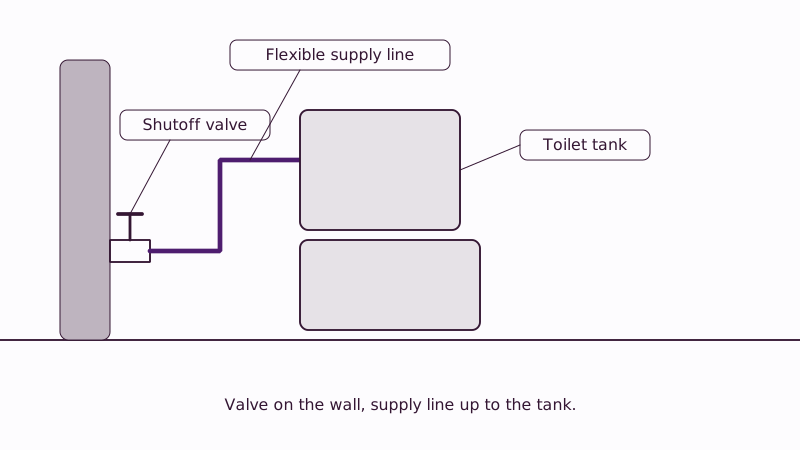
A small valve sits on every toilet's supply line, usually low at the wall or emerging from it. Plumbers call it an angle stop. You reach for it when the tank will not stop filling, when you change a fill valve, or when a leak begins. A valve that sticks or drips makes the whole toilet repair process harder, so this page treats the valve by itself.
What is the purpose of the toilet shutoff valve?
It isolates a single toilet so the remainder of the house keeps its water. Turn the handle clockwise until it stops and the tank stops refilling. Almost every toilet has one: a compact chrome or brass body with an oval or round handle, placed between the wall or floor and the flexible line rising to the tank.
Close it ahead of any tank job: a new flapper, a fill valve, a supply line or the toilet itself. Even better, test it beforehand. Close it, flush once, and watch whether the tank refills. Water that keeps arriving means the valve does not seal, so you would need the main house shutoff for the repair, which is reason enough to replace it.
What makes a toilet shutoff valve drip?
A leak on an angle stop comes from one of three places: the packing around the stem under the handle, the nut securing the supply line, or the joint where the body meets the wall pipe. Dry it off, hold a strip of tissue to each joint, and see which turns damp first. That spot is where water escapes.
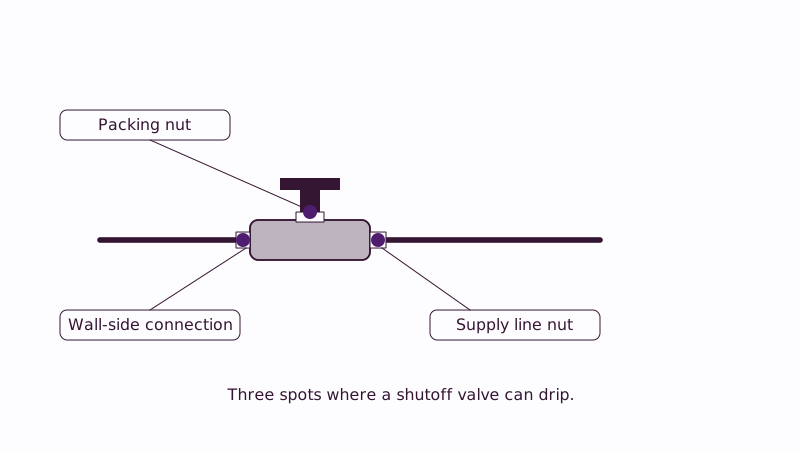
A stem weep sometimes stops once the packing nut is snugged a quarter turn. A drip from the supply nut suggests a slack nut or a tired washer. Water at the point where the body meets the wall suggests a failing valve or corroded joint. Local water is hard, with the 2025 Riverside Public Utilities report giving average hardness near 197 mg/L, and crusty deposits around a joint often mark where a slow leak has been running. For perspective, EPA puts leaks in an average household at more than 9,300 gallons yearly.
Why won't the valve turn or close all the way?
Age is the common reason: scale grips the stem or the inner washer hardens. A handle spinning with no resistance has a stripped or broken stem, and one that turns while water still flows has a worn washer or seat. Do not force a stuck handle with a wrench, since a snapped stem lets water pour out.
Rock it gently back and forth to break up scale, and cycle it open and closed once or twice. A valve that moves but will not seal needs replacing. One that has never moved tends to fail exactly when you need it, so exercise each toilet and sink valve gently once a year. A toilet that keeps running even with the valve open is the topic of the running toilet page.
What is involved in swapping the valve?
Close the house main, flush the tank empty and soak up what is left with a sponge. Loosen the supply line with a wrench, back off the compression nut at the valve and slide the old body off the pipe, or unscrew it when threaded. Set the new valve, snug its nut by hand, add a quarter turn with the wrench, reconnect the line and check for drips.
Corroded copper, a pipe that wobbles in the wall or old galvanized fittings make it harder. Choose the type carefully: a quarter-turn ball style shuts off crisply and is a common modern pick, though multi-turn stops are still used. If the pipe shifts or the sleeve will not release, stop and bring in a plumber, since damage inside the wall is a bigger repair. A fill valve swap fits into the same visit.
When is it better to have a plumber replace it?
Hand it off when the valve is soldered on, the pipe turns or feels loose, water seeps from inside the wall, the house main will not close, or the pipe itself is corroded. The city's handout on permit-exempt work in Riverside names faucet or toilet repair or replacement as exempt, yet replacing piping behind the wall face or under the floor does need a permit.
Opening a wall calls for a phone call to Building and Safety, (951) 826-5800. California's contractor rules start at $1,000 in labor plus materials, or for permit work. Valves in older Downtown Riverside, Wood Streets and Arlington houses may not have moved in decades, with galvanized supply pipe behind them, so a simple swap can turn into pipe work. Use the quote form to book a visit with a written price, and read about toilet leaks if water shows on the floor.
Common questions
How can I tell the valve has failed?
Will tightening stop the leak?
What size is a toilet shutoff valve?
How much time does replacing a toilet shutoff valve need?
Should I replace the supply line at the same time?
For the wider picture, start with Rubidoux Ridge Plumbing.
Sources used
Page updated