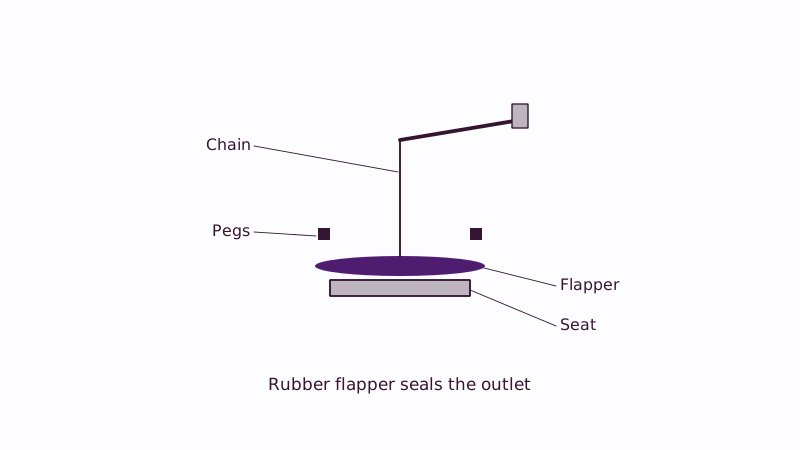
When a toilet runs by itself, check the flapper first. This rubber or silicone seal rises as you flush, then falls back to close the tank drain. Once it warps, cracks or turns slimy, water seeps into the bowl while the fill valve keeps refilling the tank. Other toilet faults belong to our section on toilet repair in Riverside, and you can ask for a plumber visit through the quote page.
How do I know the flapper is the problem?
Add some food coloring to the tank, leave it 15 minutes with no flushing, then check the bowl. Colored water there means the flapper is leaking, since dye reaches the bowl only by passing the seal. A toilet that refills every few minutes or hisses between flushes shows the same fault.
Other signs include a handle you must hold down, a flush that stops short and a tank that never fully fills. Lift the lid and watch: if the water level creeps down and the fill valve starts again with no one touching the toilet, the leak is at the flapper or its seat.
Mineral deposits, along with chlorine tablets left in the tank, wear rubber faster, which is why a flapper that looks fine can still fail. The same problem, from a wider angle, appears in fixing a toilet that keeps running, which also covers float and valve causes.
What do I need to replace a flapper?
You need a replacement flapper of the right size and style, and nothing else in most cases. Close the supply valve, flush the tank empty and take the worn flapper along to the store for comparison. Many toilets use a 2-inch or 3-inch flapper, and the wrong size will not seal.
Measure the flush valve opening. A 2-inch drain has a smaller opening, while a 3-inch drain is wider. Universal flappers fit many models, but brand-specific parts fit better. Some flappers attach to two pegs on the overflow tube, others by a ring around it. Check which you have.
A pair of gloves and a rag for the tank bottom are useful. If the flapper seat, the rim it presses on, is rough or pitted, a little cleaning with a nonscratch pad helps, though a damaged seat may need a bigger repair.
What are the steps to swap the flapper?
Turn off the supply valve behind the toilet, flush to empty the tank, disconnect the chain where it meets the handle arm and lift the old flapper from its pegs or ring. Snap the new one on, reattach the chain leaving a little slack, open the valve and test flush. Look for a clean seal and a full refill.
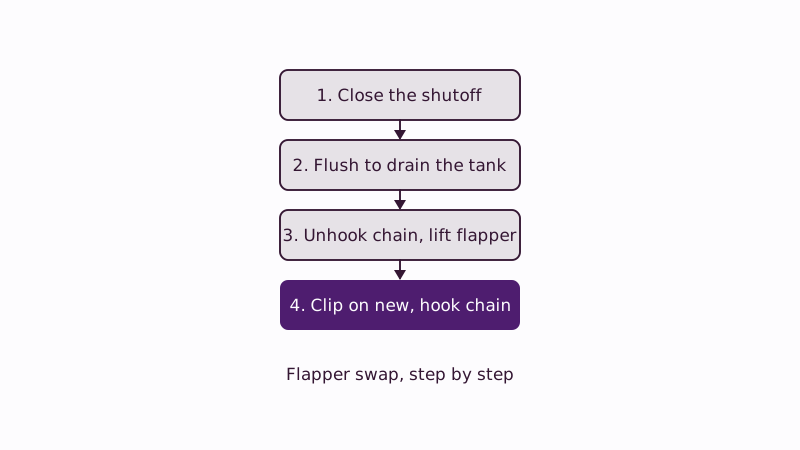
Chain slack matters. Too tight and the flapper cannot seat. Too loose and it can get caught under the flapper. A little slack, around half an inch, is a common guide; the maker's instructions give the exact figure. Trim extra chain so it does not tangle.
Before the new flapper goes on, wipe down the seat using a damp rag. Restore the water slowly, then repeat the dye test after 15 minutes. If color still shows in the bowl, the seat is worn or the flapper is the wrong shape.
What if the toilet still runs after a new flapper?
Usually it is the chain, the seat or the water level. A chain that runs too short keeps the flapper propped open, a rough seat stops it sealing and a water level above the overflow tube drains into it. The fill valve can also leak or the flapper can be the wrong size.
Start with the chain, then trace a finger around the seat to feel for pitting or crust. Look at the water mark, which should rest beneath the overflow tube's rim. If it does not, the fill valve needs adjusting, which our page on repairing a toilet fill valve walks through. A cracked overflow tube is another cause, and the page on repairing the overflow tube covers it.
An old toilet with a cracked tank or a worn flush valve may not be worth the effort, and a new toilet might be money better spent.
How much water can a worn flapper waste?
A lot, because the leak runs day and night. EPA data estimates household leaks at over 9,300 gallons annually, with toilet leaks among the common sources. A silent leak shows up only in the bill, so a high bill and a dye-test result together point to the flapper.
Fixing it early needs an inexpensive part and a few minutes. The cost of ignoring it shows in the water bill and wear on the fill valve. If your bill jumped, reasons a water bill runs high covers the other likely causes.
Riverside Public Utilities lists a rebate that starts at $140 for premium high-efficiency toilets, with funds limited, so check current terms at socalwatersmart.com before buying a toilet in order to stop a chronic leak.
When is a plumber the better call?
Bring in a plumber if the toilet leaks at the base, the tank has cracked, the shutoff valve refuses to close, the flush valve is corroded, or trouble persists after both a new flapper and a new fill valve. A rocking toilet and a wet floor mean the seal at the base is failing, which is a different job.
A plumber can replace the whole flush valve, reset the toilet and check the supply line in a single visit. Water on the floor with no obvious source needs fast attention, because it can ruin the floor and subfloor. A toilet in an older Downtown Riverside or Eastside bathroom, with old valves nearby, can also turn up a stuck shutoff.
Common questions
How often should a toilet flapper be replaced?
Does a universal flapper work?
Do chlorine tablets hurt the flapper?
Is it safe to fix a toilet myself?
Sources used
Page updated