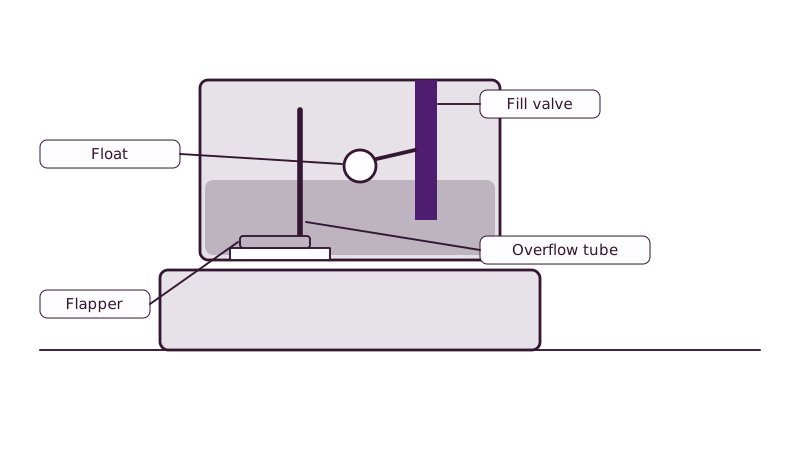
The fill valve is the tall part standing on the left side of the tank, and it fills the tank again after every flush. When it fails, you hear hissing or trickling, the toilet runs on, or the tank never fills. You can adjust or replace it yourself with a pair of pliers and a new valve. The services around this one are covered on the toilet repair page, and the rest are on the home page.
What shows that the fill valve is at fault?
Remove the tank lid and flush. Water that keeps flowing in after the float rises, or a steady hiss, means the fill valve is failing to shut off. If the water level sits above the overflow tube and spills into it, that confirms it. When the level is fine but the bowl refills itself every few minutes, the leaking part is the flapper.
Check the simple things first. A float set too high will keep the valve open until water reaches the overflow tube. Lower the float or turn the adjustment screw, flush, and watch. Debris under the valve seal can also hold it open, and a brief flush with the valve cap off sometimes clears it.
What are the steps to replace a toilet fill valve?
Shut the water at the wall valve under the tank by turning it clockwise, flush the tank empty, and sponge out what remains. Detach the supply line underneath the tank, unscrew the locknut that holds the valve from below, take the old valve out, set the new one in at the manufacturer's height, tighten the nut as the maker directs, and reconnect.
Set the water level at the fill line printed on the valve or inside the tank, then clip the small refill tube onto the overflow pipe, not inside it. Open the wall valve slowly, check the connection for drips, flush twice, and watch for leaks for ten minutes. Avoid overtightening plastic fittings, since porcelain tanks crack. Faucet or toilet repair or replacement is exempt from permits in the City of Riverside, per its handout.
Can a running toilet make your water bill high?
Yes, a lot. According to EPA, a worn flapper can cause a toilet to flush by itself or to leak thousands of gallons a year without a sound, and average household leaks can waste over 9,300 gallons a year. A running toilet is often the biggest single leak in a house. A quiet leak may not make any noise at all.
To check, put food coloring in the tank and leave it ten minutes unflushed. EPA says color in the bowl means a leak; flush promptly to keep the tank from staining. Also compare your bill with last year's. If it has crept up with no change in use, read why a water bill climbs so high and a high bill without a visible leak.
What does the toilet flapper gasket do, and how often should it be replaced?
Down at the base of the tank, the flapper is a rubber seal that rises on a flush and falls back to hold the water. It wears, warps and gathers mineral film. EPA advises checking flappers from time to time and replacing them every five years at minimum, and taking the old part or a photo to the store to match size and float.
If the bowl refills by itself, or the handle has to be jiggled to stop the water, the flapper is the first suspect. Turn off the water, unhook the flapper chain and the side ears, press the new one on, and set the chain with slight slack. Hard water wears seals faster. Riverside Public Utilities' 2025 report lists hardness averaging 197 mg/L, about 12 grains per gallon.
Is it possible for a toilet to burst a pipe?
The toilet itself cannot, but its supply line can fail. The flexible braided line that connects the wall valve to the fill valve can split or burst at its fittings as it ages, and the result can flood a bathroom in minutes. Inspect the line and replace it when it is frayed, rusty, bulging or simply old.
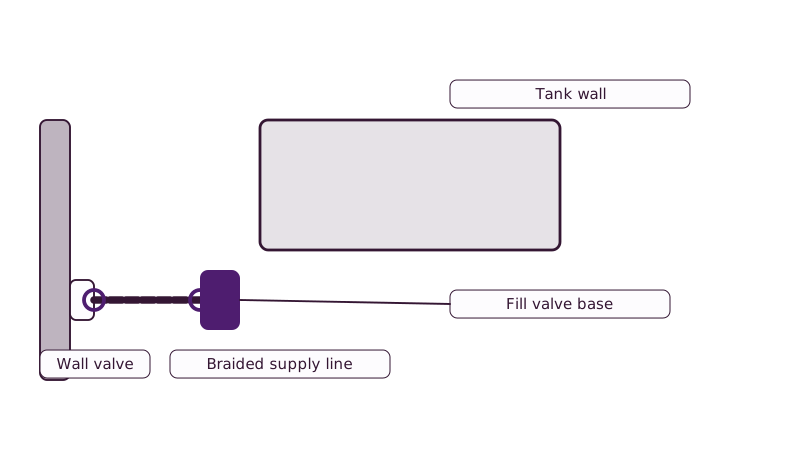
Close the wall valve if you are going away for several days. If a supply line has already burst, close the main valve and go to our emergency plumber page. The wall shutoff itself can fail or drip. For that part, see toilet shutoff valve repair.
At what point should a plumber handle a toilet fill valve?
Call if the shutoff valve does not close, if the base or the supply line leaks, if the tank is cracked, if the new valve still runs, or if the job is not one you want to take on. A plumber business that takes your request can replace a fill valve, a flapper or the whole toilet and will quote in writing.
If a toilet runs on even with a new flapper and fill valve, the flush valve seat may be worn or the overflow tube cracked. Those are plumber jobs, and sometimes replacement is the better value. Other running-toilet fixes are in why a toilet keeps running, toilet flapper repair and a toilet that won't stop running. For an old, inefficient toilet, Riverside Public Utilities lists a rebate starting at $140 per eligible model on its residential page, subject to available funds.
Common questions
How long does it take to repair a toilet fill valve?
Which questions go to a plumber fixing a running toilet?
Does someone need to be home for a toilet repair?
Should I replace the fill valve and the flapper together?
Sources used
Page updated