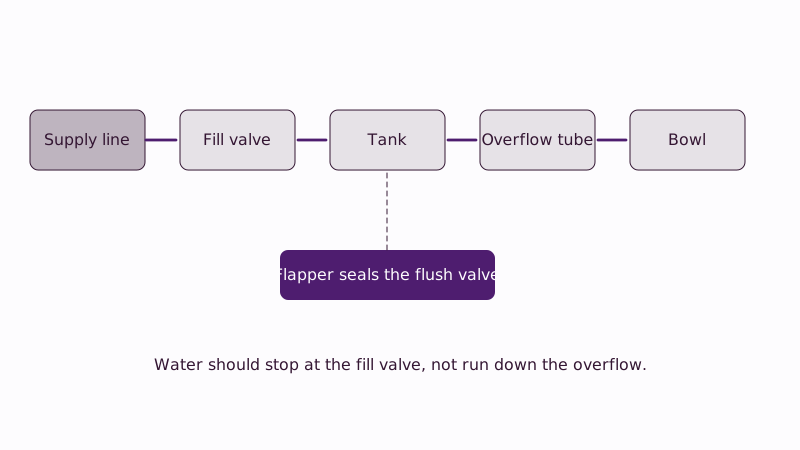
Listen late at night. A hiss that comes back now and then, or a tank that quietly refills itself, means water is slipping past a seal. The culprit almost always lives inside the tank, and finding it takes five minutes and no tools. This entry in the toilet repair series covers causes, quick tests and the effect on your water bill.
Why won't my toilet stop running?
Running means the tank either cannot hold its water or cannot sense that it is full. Suspects: a flapper leaking into the bowl, a float adjusted so high that the overflow pipe takes the extra, or a fill valve that has worn past the point of closing. Take off the lid and look for a trickle past the flapper or a steady stream into the pipe.
Go in sequence. Wiggle the handle; if running stops, blame the chain or handle. Press the flapper down; if water stops, it was not sealing. Check the level; water reaching the top edge of the overflow pipe means the float must come down. A normal level with a hissing fill valve means the valve is done. The running toilet causes page goes case by case.
Is the flapper or chain the problem?
Most often. The flapper is a rubber cap over the drain opening, lifted by the chain. Too short a chain props it open, and too long a chain can wedge beneath it. Rubber that has warped, hardened or crusted over stops sealing, and hard water can speed that along; the city's 2025 utility report gives average hardness as 197 mg/L, near 12 grains per gallon.
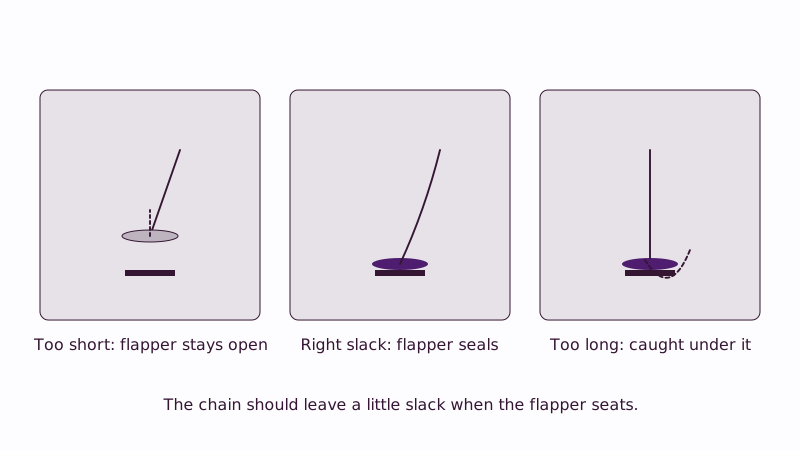
Wipe the seat beneath the flapper with a cloth, make sure the chain has some give, and flush. Still running? Install a flapper made for your model. Close the supply valve, empty the tank by flushing and photograph the old flapper to match it at the store. The flapper repair page covers the swap, and the fill valve page covers the next suspect.
What if the flush handle is not working?
A handle that wobbles, sticks or does nothing usually means a dropped chain, a loose lever arm or a nut that backed off. Pop the lid and look. Attach the chain to the lever hole that leaves a little slack, and tighten the mounting nut. A few handle nuts have reverse threads, so check the direction before forcing anything.
Handle moves, flapper stays put? The chain may be snapped or the lever rusted through, and a new handle kit fixes it. A handle that works yet leaves the toilet running afterward points back at the flapper or float. For a weak or short flush, see flush repair.
Does a running toilet push up the water bill?
It can, and quietly. The EPA reports that a typical household leak wastes upward of 9,300 gallons a year, with toilets a common source. Current Riverside water rates are not something we verified, so no dollar amount appears, but gallons accumulate on every bill.
To test the toilet, add food coloring to the tank and wait a quarter hour without flushing; if the bowl turns tinted, the flapper leaks. Then try the meter: shut every fixture, look at the leak dial and see whether it creeps. A jump with no clear cause is covered in why water bills climb and in the page on a bill that rises with no leak in sight.
Is a leaking toilet different from a running one?
Yes, though both show up on the bill. A running toilet refills over and over, often audibly. A leaking one may seep from the base, the supply connection or the tank bolts onto the floor, or slip silently into the bowl. Floor leaks can damage the subfloor, which matters beyond the water charge. Look for damp spots, rocking and stains near the base.
Water on the floor? Close the supply valve and stay off the toilet. Cracked porcelain cannot be mended with confidence, so replace it. The toilet leak page traces the sources, and replacement pricing shows guide figures. If the supply valve itself will not close, see the shutoff valve guide.
Could air, a float or a worn fill valve be the cause?
Yes. A fill valve that sputters or chatters may have trapped air or grit in the supply line. Lift its cap, let a little water rinse through, and reseat it. A float set high feeds water into the overflow pipe, and a sticking float never tells the valve to close. A valve nearing the end of its service is better replaced than adjusted.
Following the fill valve's instructions, set the float so refilling stops under the top of the overflow pipe. A whistle, or a tank still refilling long after a flush, points to a worn valve, and replacing it is a common fix. The overflow tube page shows how to tell when the tube itself has cracked.
Which situations call for a plumber?
Reach out if the tank or bowl has a crack, water seeps around the base, the supply valve will not close, replacement parts fail to stop the running, or the bill keeps climbing with no source. A plumber can also hunt for leaks elsewhere in the house that a running toilet may mask.
The city's list of permit-exempt work includes toilet repair or replacement, while pipe replacement within a wall or beneath a floor needs a permit; Building and Safety is at (951) 826-5800. Billing questions go to Riverside Public Utilities, (951) 782-0330. For a visit with a written price, fill in the quote form.
Common questions
What is the fastest way to stop it for now?
Why does it still run after a new flapper?
Is a leaking toilet a reason for a bigger bill?
How long does fixing a running toilet take?
Should I buy a new toilet if mine keeps running?
This guide is one of many on Rubidoux Ridge Plumbing plumber.
Sources used
Page updated