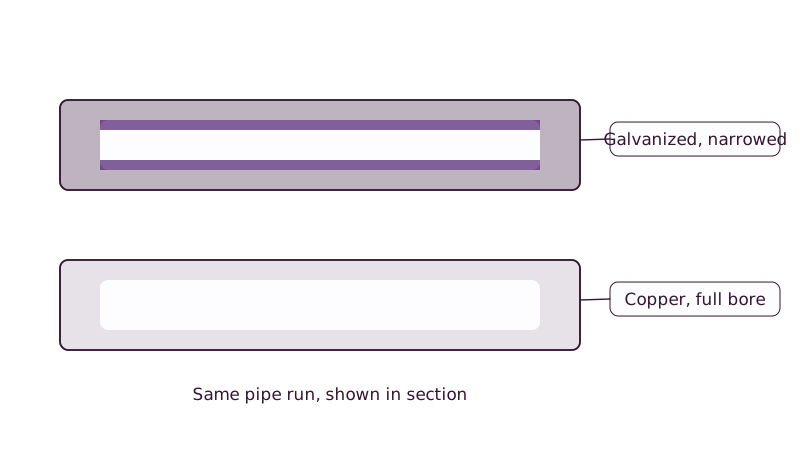
For decades, houses were plumbed with galvanized pipe: ordinary steel coated in zinc. Over time the coating thins, the steel corrodes from within, and rust plus mineral scale pinch the bore down to a sliver. You end up with flimsy pressure, brown water and leaks at the threaded joints. This page belongs with our broader repiping guide and looks at replacing galvanized lines specifically.
How do I know my house has galvanized pipe?
Look at the exposed runs in the garage, below sinks and next to the water heater. Galvanized pipe appears matte gray, joined by threaded fittings, and often rough or streaked with rust. A magnet clings to it, unlike copper. Scrape a small spot: silvery gray metal is galvanized, reddish metal is copper, and anything non-metal is plastic.
Age is a hint. Galvanized pipe is most probable in older houses, which in Riverside could mean older districts like Downtown, the Wood Streets, Arlington and Eastside, though we have no year-built counts to confirm it. Houses with partial repairs may have galvanized mixed with copper or plastic. A house built or fully repiped in the 1970s through 1990s may have copper or other pipe. When in doubt, send us a photo with a request and the plumber can identify it.
What problems does galvanized pipe cause?
Typical signs: pressure that collapses when two fixtures run, rusty water once the house has been sitting unused, tinted hot water, and leaks that show up as pinholes or at threads. Pressure that is fine at the street but weak in the house points to a narrowed line. See low pressure for a gauge test.
Leaks inside walls matter most. A seep inside a wall can saturate drywall and framing for months, and damp materials invite mold. The true danger of leaving old pipe alone is that hidden water, more than the rust. Local water compounds it: the city utility's 2025 report gives 197 mg/L as the average hardness (around 12 grains per gallon), so scale piles on top of the rust. If you want the broader picture of when whole-house work makes sense, read how often to repipe.
What are my options for replacing galvanized pipe?
You can replace the whole system, which is a full repipe, or replace sections. Most whole-house repipes use PEX or copper. PEX is bendable plastic tubing that can be fished through walls via small openings; copper is rigid metal with a long track record. Partial replacement works when only one run is bad, but the remaining galvanized will keep aging.
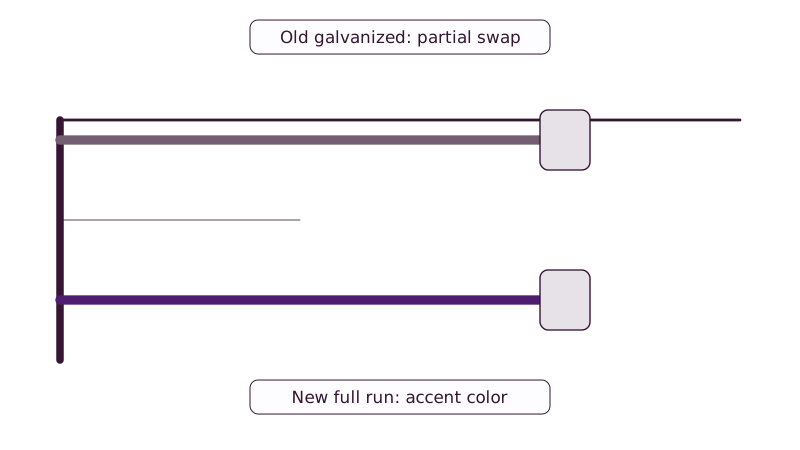
Compare the two in PEX vs. copper, and see the sequence in how a repipe proceeds. A plumber will usually reroute lines rather than follow the old paths, set new shutoffs and fix drywall openings or leave them for a finish contractor. Ask what the quote includes for wall repair, because it is a common gap between quotes.
What does a galvanized replacement cost?
Take a two-bath, 1,500-square-foot house. Bob Vila's PEX versus copper comparison (updated July 23, 2025) lands near $4,000 to $6,000 with PEX and $8,000 to $10,000 with copper. Its older repipe guide, dated April 24, 2023, shows a whole-house span of $1,500 to $15,000, averaging $7,500. Those figures are national, so they are neither local rates nor our charges.
The written quote sets the price. House size and layout weigh most, followed by material, fixture count, wall access, drywall patching, permit fees and whether any pipe runs under a slab. The 2023 guide is older and weaker, so read it as background. More on numbers: PEX repipe pricing and whole-house repipe pricing.
What is the time frame for repiping a house?
No verified duration is available to quote, since it swings with house size, access and crew. Expect a repipe to run several days, with the water off for a portion of each, and patching and paint adding time afterward. Ask for a schedule listing the shutoff windows and the inspection date.
Plan around the water shutoff: showering and cooking may have to happen elsewhere during the job, and closets and sink cabinets in the work zone must be emptied. Some plumbers phase the job to keep one bathroom usable, so mention that when you write in. The repipe sequence explains the order of work.
Does repiping call for a permit?
In Riverside, the city's work-exempt-from-permits handout says replacement of piping behind the wall face or below the floor requires a permit, so a repipe generally does. Confirm with Building and Safety at (951) 826-5800. Moreno Valley's building division is at (951) 413-3350, and Loma Linda's permit line is (909) 799-2836. We did not verify their written rules, so call.
A repipe also crosses California's contractor-license threshold, set at $1,000 in labor and materials or for any permitted job. Normally the plumber obtains the permit, and an inspector examines the work ahead of wall closing. Hold on to that permit record for a future sale, since it documents the new plumbing.
Is a polybutylene replacement program available?
No active program turned up that we could verify, so we do not describe one. Polybutylene was a gray plastic pipe installed in some houses in past decades, and its weak point is said to be the fittings. Owners usually move to PEX or copper. See polybutylene replacement for signs and options.
Look through your insurance policy and the seller's records, since past claims or notices sometimes exist. A plumber can identify the pipe at a glance. Mention a suspected polybutylene line when you write in, which lets the plumber weigh repair against replacement.
Common questions
Does aging galvanized pipe pose a risk?
How long does galvanized pipe last?
Is a partial swap an option?
What should a repipe quote spell out?
Is PEX allowed here?
This guide is one of many on the plumber guide for Riverside.
Sources used
Page updated