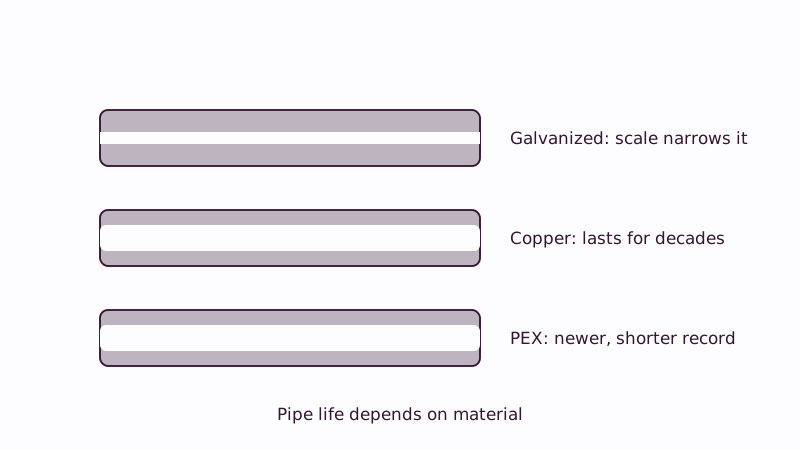
A house is repiped once, when its pipes approach the end of their service life, and some homes never need it. What matters is the material and the record of failures, not the number of years. Our main page on whole-house repiping in Riverside covers the job itself. This page answers when. If you suspect your home is due, pass the details along on the quote page.
Is there a set number of years before a house needs repiping?
No fixed interval exists. Pipe material sets the clock, and local water and installation quality move it. Galvanized steel is commonly said to last several decades before corrosion chokes it, copper often lasts longer, and plastic types vary by product. A repipe is recommended by the leak history, not by a birthday.
The numbers circulating online are ranges, and a home in the same street can differ because of one bad batch or one flooded winter. Treat any single figure as a rough guide. What should push you toward repiping is a pattern: repeated pinhole leaks, falling pressure, rusty water and walls opened more than once for repairs.
The old rule that works: one leak is a repair, several in a year is a message. Our companion piece on the reasons for repiping a house gives the reasoning behind it.
How long does each pipe type usually last?
Each material has a rough working life that installers quote, and every figure carries a wide spread. Galvanized steel tends to fail first, copper lasts for decades, PEX is newer with a shorter track record and ABS and PVC drain pipes can outlast the house if kept dry and unstressed. Hard water and chemistry nudge each number.
A quick view of how the main materials behave:
| Pipe material | What tends to go wrong | Typical story |
|---|---|---|
| Galvanized steel | Rust inside, narrowing, flaking | Low pressure and brown water, then leaks at threads |
| Copper | Pinholes, pitting, thin walls | A first pinhole, then more within months |
| Polybutylene (gray plastic) | Fittings crack, brittle with age | Widely replaced, and commonly reported as installed between the late 1970s and the 1990s |
| PEX | UV damage, fitting failures | Few failures if installed to code and shielded from sun |
| CPVC | Brittleness over time | Cracks at joints in older runs |
Water chemistry matters. Riverside Public Utilities' 2025 report lists hardness averaging 197 mg/L, about 12 grains per gallon; mineral scale narrows pipes, though the effect on any one house differs. See our notes on galvanized pipe replacement and polybutylene pipe replacement for the two materials that most often justify a repipe.
What are the signs your house is overdue?
Repeated leaks in different spots, rust-brown or yellow water from the tap, weak flow from several fixtures at once, a pipe that shows green or white crust, ceiling stains with no roof cause and a meter that runs with all fixtures off all point toward failing supply pipes. One sign alone could be a local fault, while two or more suggest the system.
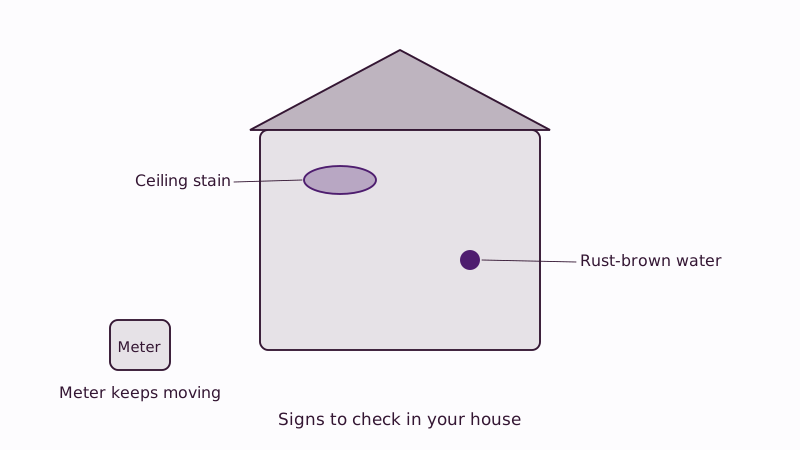
Check the visible runs in the garage, under sinks and at the water heater. Pitted green copper, rusty threads and flaking steel are easy to see. Gray plastic with a PB stamp tells you the material. A plumber can scope the pipes, check pressure and quote a partial or full job.
Ask whether the leaks are at fittings, which can be repaired, or along the pipe body, which means the wall is going.
How do homes in Riverside, Moreno Valley and Loma Linda compare?
Older orange-grove-era and mid-century homes in Downtown Riverside, the Wood Streets, Arlington and the Eastside may still have galvanized or early copper. Tract homes built between the 1970s and the 1990s in Moreno Valley and La Sierra may include copper, and some polybutylene. Newer communities such as Orangecrest more often have PEX.
Housing era is a guide, not a diagnosis, since many older homes were repiped in part during remodels. Ask a plumber what is actually in your walls. Unincorporated areas such as Highgrove and Mead Valley follow county rules, so permits may come from Riverside County and not the city.
Pipe replaced inside walls or under floors is outside Riverside's permit-exempt list, and a whole-house repipe is exactly that, so build the permit office into the plan: (951) 826-5800 in Riverside.
Can I save money by repiping part of the house?
Sometimes. A partial repipe swaps out only the worst section, for example a failing galvanized run or one bathroom group, and leaves sound pipe in place. It costs less up front but may leave older pipe that fails later, so have the plumber identify which sections are healthy and which are not.
Repiping while walls are already open, during a remodel or after water damage, can save on drywall patching and make the project cheaper overall. The full cost picture is on repipe cost and the comparison of materials is on PEX versus copper.
Think about the project as a whole: patching a leak that is not isolated can cost as much as the repipe once wall repair is added to the water damage that comes after. Request written quotes covering both a repair and a repipe, then compare.
What risks come with putting it off?
Waiting raises the chance of a hidden leak behind a wall, which means ruined drywall, flooring and in time mold. Poor flow and discolored water add daily annoyance. Insurance may deny a claim when the damage comes from long-term leaking and not a sudden break, and conditions differ by policy.
A planned repipe is calmer than an emergency one. You choose the schedule, the material and the quote, while an emergency forces fast decisions. Water in the walls is a bigger cost than the pipe.
A plumber who checks the house can tell you whether a repipe is near or whether monitoring will do. In the meantime, locate the main shutoff and test it, because a stuck valve turns a small leak into a flood.
Common questions
How many years do copper pipes last?
Does repiping hurt resale value?
Is polybutylene a reason to repipe now?
Do I need a contractor for a repipe?
Sources used
Page updated