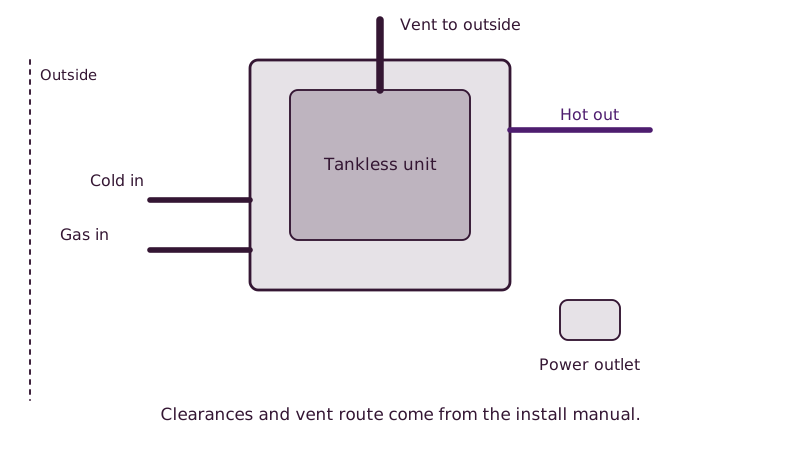
Installing a Rinnai tankless heater means checking four things before the old tank comes out: whether the gas line can feed the unit, how it will vent, where the condensate and relief water will drain, and whether the water supply and electrical outlet are ready. A permit is generally needed. The step-by-step belongs to the manufacturer's installation manual, which the plumber follows. For the wider service, see the water heater repair page.
What does a Rinnai tankless installation involve?
The job replaces the tank with a wall-mounted unit and adds what it needs: a gas connection sized for the unit's input, venting to the outside, water supply and hot outlet with isolation valves, a drain for condensate and the pressure relief, and a power connection for the electronics. The old tank, gas line and venting are removed or modified.
Models differ. Some are condensing and need somewhere to drain acidic condensate, some are non-condensing and use different venting, and some are made for outdoor mounting. Rinnai publishes the clearances, vent lengths, gas input and pipe sizes for each model, so the plumber should say which model is being quoted and show where it will sit.
Does my gas line need to be upsized?
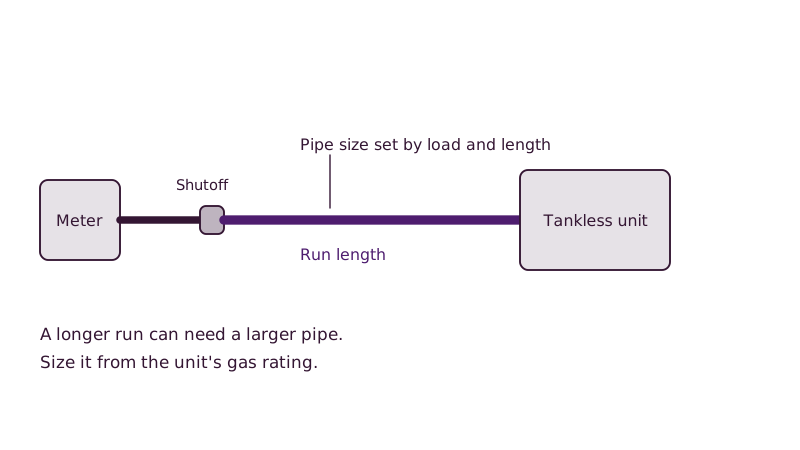
Often, yes. A tankless heater can draw more gas when it fires than a tank unit does, so pipe that was sized for a tank unit may be too small, and flow can drop when other gas appliances run. The plumber sizes the line from the total demand and how long the run is, using the manual and the code, and may replace some of the pipe.
Gas work is regulated: a California contractor license is required for any job needing a permit, and changes to gas piping usually need one. SoCalGas serves Riverside, Moreno Valley and Loma Linda, and the plumber may ask SoCalGas whether your meter is big enough. Smelling gas means leaving the building, phoning SoCalGas on 1-800-427-2200 from outdoors, and dialing 911 if anyone is at risk. The page on gas line work has more.
What venting and clearances does a tankless unit need?
Venting is not optional or flexible. The manual gives approved materials, maximum lengths and elbows, and distances from windows, doors, vents and property lines. Condensing and non-condensing models call for different vent materials, and the manual names the approved type for each. Exhaust must never enter the house.
A garage heater tucked into a corner may have to move to reach an exterior wall. Existing tank flues often cannot be reused. A home with any gas appliance is better off with carbon monoxide detectors. The permit inspection generally includes the vent, and work that does not match the manual may have to be redone.
How does hard water affect a Rinnai unit in Riverside?
Scale accumulates on the heat exchanger and cuts its life short. Riverside Public Utilities' 2025 report lists hardness averaging 197 mg/L, about 12 grains per gallon, range 180 to 210, so scale control matters. Plumbers often fit isolation valves to allow flushing the unit, and some homeowners add a softener or scale filter.
Plan on regular descaling, as the manual describes. The tankless repair article explains symptoms of scale, and treatment is covered on the softener installation page. Ask the plumber whether service valves and a filter are included in the quote, because they matter later.
How much does a tankless installation run?
Guide figures are national, not local. This Old House's 2026 guide, updated 06/17/2026, lists tankless at $2,100 to $4,000 installed. Fixr's guide, updated January 31, 2025, gives a typical range of $2,500 to $4,500, with an average of $2,811. Gas line upsizing, new venting and a new circuit can push a job toward the high end.
The written quote sets the price. The difference from a plain gas tank swap comes mostly from extra gas piping, venting and labor. The guide to water heater replacement costs compares the types side by side, and the tank vs tankless page helps you decide whether the cost is worth it.
Is a permit with an inspection required?
Generally yes. The City of Riverside's exempt-work handout does not list water heaters as exempt, and Building and Safety, at (951) 826-5800, can confirm for your address. Moreno Valley and Loma Linda have their own divisions, and we did not find their water heater rules stated on a page, so call them. Unincorporated addresses use County of Riverside Building and Safety.
The contractor usually obtains the permit, and the inspection typically covers the gas connection, venting, drainage, strapping and the final connections. Earthquake strapping is a state requirement, and a wall-mounted tankless unit needs solid mounting. Be wary of a quote that omits the permit.
Which questions come first before I accept the quote?
Ask for the make and model, the gas input, whether the gas line is being resized, the venting route, the condensate and relief drainage, isolation valves, the permit, wall repair and haul-away. Ask whether the business installs this brand regularly. California limits home improvement deposits, so ask what is due before the work starts.
Use the quote form to start a written quote; a local plumbing business looks at the location before pricing it. If the old tank is leaking now, go to the urgent water heater repair page.
Common questions
Can a Rinnai tankless heater replace my tank in the same spot?
How long does a tankless installation take?
Do tankless heaters need a recirculation pump?
Will a tankless heater work during a power outage?
For the wider picture, start with Rubidoux Ridge Plumbing.
Sources used
Page updated