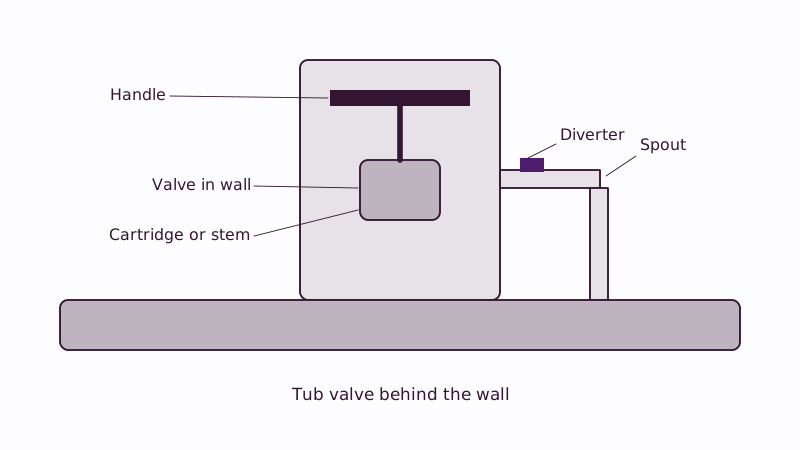
A dripping tub spout means the valve behind the handle no longer shuts fully, and the usual cure is a new cartridge or new washers and seats. Unlike a sink faucet, a tub valve lives in the wall, often with no shutoff of its own. Kitchen and bathroom sink fixtures, plus the disposal under the counter, are covered in our section on fixtures and garbage disposal repair. To book a visit, go to the quote page.
Where is the water dripping from: spout, handle or shower head?
The location of the water points to the part. A drip from the tub spout after shutoff suggests the valve cartridge, stem or seat. Water around the handle suggests stem packing or an O-ring. A shower head that drips while the tub fills means a failed diverter, or the same worn valve letting water through.
Note whether the drip is hot, cold or warm. A drip that is warm means the valve mixes both sides and the cartridge is worn. A single-handle fixture has one cartridge. A two-handle or three-handle tub has a stem for each. Hard water scale on the seats causes a slow drip that gets worse with time. Our shorter guide on fixing a leaky bathtub faucet covers the same ground for beginners.
How do I reach the valve behind a tub faucet?
Lever off the handle cap, take out the screw, then pull away the handle and trim plate to expose the stem or cartridge in the wall. Some baths have an access panel facing the tub from a closet or hallway. Shut off the water first, at the nearest shutoff or the main valve.
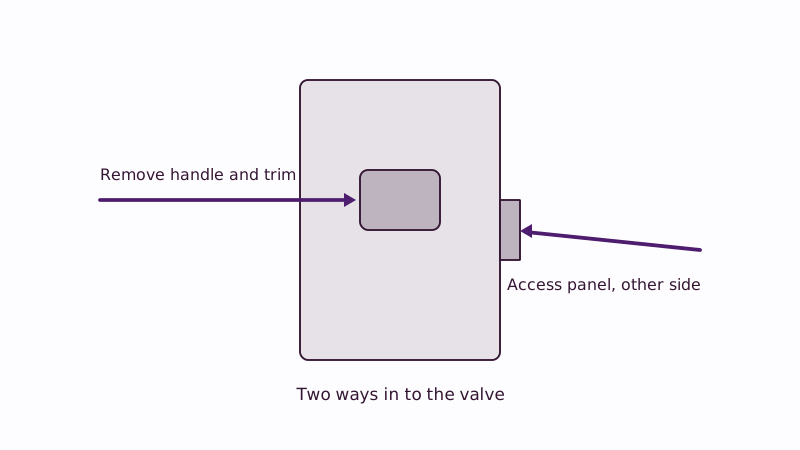
Take photos as you go so you can rebuild in the right order. A tub with no local shutoff needs the main valve off, then the tap opened to drain the line. A stem nut may need a deep socket, and plastic sleeves protect against scratching. Lay a rag across the drain to catch screws and washers.
If the cartridge has a clip, retaining nut or locking collar, note how it fits. Pulling a stuck cartridge takes a cartridge puller, a tool sold at hardware stores for specific brands.
What do I replace inside a tub valve?
On a single-handle tub, you replace the whole cartridge, matching brand and model. On a two-handle tub, replace the washer and the seat of the leaking side, or the whole stem. Replace O-rings at the same time, and grease the new parts with plumber's grease. Rebuild and test with the water back on, slowly.
For a Delta, Moen, Kohler or other brand using a model-specific cartridge, look for the number stamped on the cartridge or old part and match it. The Delta-specific steps appear in the guide to a Delta shower faucet leak. Seats that are pitted call for a seat wrench, a reseating tool, or a whole new valve body.
What if the drip is from the spout diverter?
A diverter is the pull-up knob or lever that sends water to the shower. If the shower leaks while the tub is on, the diverter's seal is worn or the spout is faulty. Replacing the spout, a screw-on or slip-fit part, is often a quick fix, with no work inside the wall.
Check how the spout is held: a set screw under the spout means slip-on, and a threaded connection means unscrew it by turning counterclockwise, using a pipe wrench with a cloth to protect the finish. Wrap fresh plumber's tape around the threads and caulk the gap at the wall afterward. If the spout leaks where it meets the wall, the nipple pipe behind it is corroded or loose, and that belongs to a plumber.
For leaks at the shower itself, the page on a dripping shower faucet helps, and the one on shower leak plumbers explains when a professional should take over.
When must the wall be cut open for a tub leak?
Cut into the wall if the valve body itself is cracked, the wall pipe leaks, no access panel exists, or the handle repair fails to end the drip. That means opening tile or drywall, replacing the valve and restoring the finish. It is a plumber and a tile job, and often a permit one.
Riverside's handout puts pipe replaced inside a wall under the permit rule, so ask Building and Safety, (951) 826-5800, before any cutting. Moreno Valley and Loma Linda have their own offices, and unincorporated addresses answer to the county.
Water staining on the ceiling below a second-floor bathroom, a soft tub surround or a musty smell all suggest the leak sits behind the wall. Take them seriously.
How much water is lost to a dripping tub faucet?
A steady drip adds up through the day and night. The EPA estimates a typical household leak at over 9,300 gallons a year, and a tub drip counts toward that tally. It also stains the tub, builds scale and signals that the valve is wearing out, so fix it early.
A drip that stops when you tighten the handle hard means a worn washer or cartridge, and hard tightening makes it worse. If your bill has risen, read the page about leaky faucets and water bills.
What about the disposal and other fixtures while I am at it?
If you are replacing plumbing parts, the garbage disposal under the sink, along with the supply lines and shutoff valves, deserve a look the same day. A disposal that hums, leaks from the bottom or smells needs its own attention, and old supply lines are cheap to replace before they fail.
Leaks from a disposal flange, the dishwasher hose or the P-trap often get mistaken for a faucet leak. Run water and look. The fixtures hub linked near the beginning of the page lists those jobs.
Common questions
Do I have to shut off the main water to fix a tub faucet?
Why does the tub faucet drip only when hot?
How long does the repair take?
Can I replace the whole tub valve myself?
Sources used
Page updated