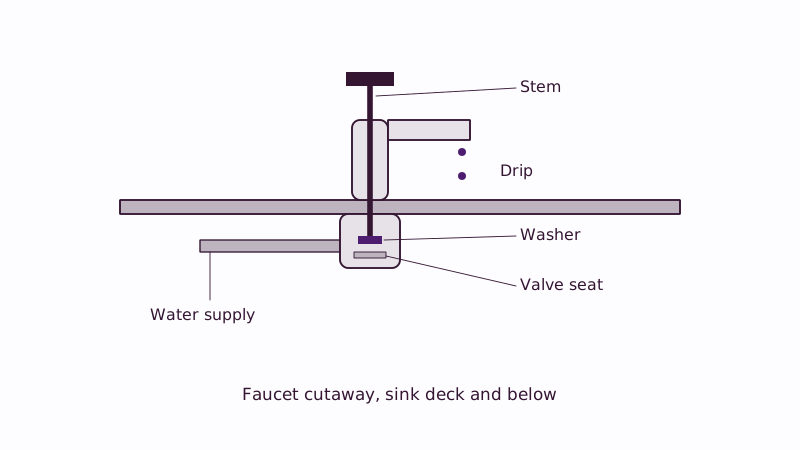
A dripping faucet is leaking through a single worn part, and replacing it stops the drip almost every time. Close the valve beneath the fixture, remove the handle, work out whether you have a washer, cartridge, ball or O-ring, and match it at a hardware store. The same fixture family, including sinks and disposals, is covered in our section on garbage disposal and fixture repair. If the repair is beyond a quick swap, send a request for a visit.
What actually causes a faucet to drip?
A drip comes from a seal that no longer closes: a compression washer worn flat, an O-ring gone hard, a cartridge with a scored face or a valve seat pitted by minerals. Water pushes through the gap one drop at a time. The faucet's design tells you which part, so identify the type before buying anything.
Compression faucets have separate hot and cold handles that screw down against a rubber washer. Cartridge faucets, often single-handle, use a plastic or brass insert. A ball faucet has a rounded cap over a rotating ball fitted with springs and seats. Ceramic-disc models rely on two polished discs in a cylinder. Hard water leaves scale on all of them, and the Riverside Public Utilities 2025 water quality report lists hardness averaging 197 mg/L, about 12 grains per gallon, so mineral build-up is a common reason seals wear early.
What is the repair for a leaking kitchen or bathroom faucet?
Close the two small valves under the sink, run the faucet to release pressure, and block the drain so no screw is lost. Pop off the cap, remove the handle screw and handle, unscrew the retaining nut and draw out the cartridge or stem. Swap in a new washer, O-ring or cartridge, reassemble in reverse order and test.
Bring the old part along to the store for an exact match, since cartridges that look alike differ by spline count and length. Smear a little plumber's grease on the new O-rings. Tighten gently, since over-tightening cracks plastic parts. Open the valves slowly and let the faucet flow for about a minute to clear air and debris.
If the faucet spout leaks from its base instead of the tip, the spout O-rings are the likely cause. A leak from under the handle means the stem packing or cap. The steps differ little between kitchen and bathroom, though a pull-down kitchen faucet adds a hose to check.
What about a Delta or a two-handle faucet with a loose handle?
Depending on the model line, Delta faucets often have either a cartridge that can be replaced or a ball assembly, so the model number matters more than the brand. Find it on the box, a stamped mark on the body or the shop's lookup by photo. Remove the handle, pull the cartridge with the right tool and install the matching one.
For a handle that wobbles or leaks around the stem, tighten the setscrew with the correct hex key first, then check the packing nut underneath. Handles that spin without shutting off have a stripped stem or a stripped screw hole.
Two-handle models are a separate project, and washers and seats are covered in repairing a two-handle faucet that leaks. The step-by-step for bath fixtures, where the valve sits inside the wall, is in repairing a dripping tub faucet.
What should I do about a leaking outdoor or garden faucet?
Outdoor faucets leak at the packing nut behind the handle, at the spout or from a failed washer. Close the water at the main or at an indoor shutoff serving the line, tighten the packing nut by a quarter turn and test. If the leak continues, replace the washer or the stem. A leak at the wall points to the pipe behind it.
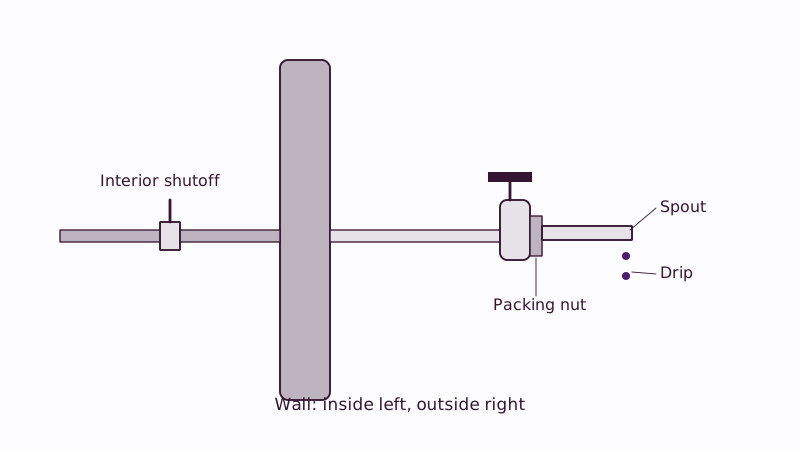
Hose bibs leak most when a hose stays attached through the winter nights, but sun and age also take a toll: brittle rubber, cracked plastic handles and corroded stems. A frost-free bib uses a long stem, and if it drips inside the wall the whole unit must be replaced, as the pipe behind the face of the wall is more than a casual repair. Riverside's permit handout puts pipe replacement inside a wall under the permit rule, so phone Building and Safety at (951) 826-5800 before cutting anything open.
A vacuum breaker cap on the spout can also drip while in use. That is its normal action.
Why does it matter to fix a drip fast?
A drip wastes water and, left alone, grows into worse damage. The EPA estimates household leaks waste over 9,300 gallons annually, and a faucet drip is one of the quiet contributors. Scale also builds on the damaged part and makes the next repair harder. Beyond cost, it stains basins and rots cabinet bases.
The effect shows on your bill, and how a leaking faucet affects a high water bill explains how to tell a drip from a larger leak. If a drip started in an older home with galvanized or aging copper lines, the faucet may not be the only worn thing, and a plumber visit sorts that out.
My Waste King disposal is jammed. How can I fix it?
Switch the disposal off at its wall switch, and either unplug it or cut the breaker before touching anything. Fit the hex wrench supplied with the unit into the socket at the middle of the underside and rock it to and fro until the flywheel spins freely. Pull the object out with tongs, never fingers, and press the red reset button.
Most jams come from a spoon, bone, fruit pit or fibrous peel. When the wrench makes a full turn, switch the power back on, run cold water and try again. A hum with no spin means a jam. A silent unit with a tripped reset means an overload, and a leak underneath means a failed seal and a replacement. For clogs that back up the sink, read clearing a garbage disposal drain.
Common questions
At what point should the faucet be replaced instead of repaired?
Does the main water supply have to be closed?
Is a dripping faucet a plumber job?
Why does the faucet still drip after I replaced the washer?
Sources used
Page updated