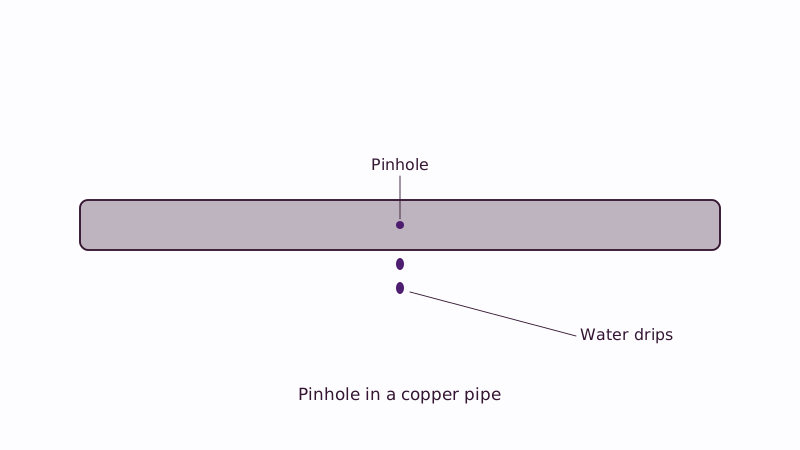
First turn off the water and dry the pipe, then pick a repair. A clamp, or a coupling that pushes on without tools, stops it fast, and cutting out a section and fitting a new one fixes it for good. If the leak hides behind drywall or beneath flooring, a permit and a plumber enter the picture. Leaks elsewhere in the home are covered in our hub on plumbers for leaks in Riverside. For help, use the request form.
Why does copper pipe develop pinholes?
Corrosion working from the inside or the outside thins the wall until a pinhole opens. Fast-moving water, water chemistry, pitting under mineral deposits, leftover soldering flux, contact with other metals and contact with soil or slab can all drive it. One pinhole is a repair, but several in the same house point to a pattern across the system.
Pinholes can show up in copper of any age. The cause often depends on the house and its water, and a plumber who inspects the pipe interior can tell you more than any guess. The leaks usually start small, with damp spots, green crust on the outside, hissing or a patch of discolored paint.
Water that is hard enough to deposit scale can add to pitting, though the link varies, and Riverside Public Utilities' 2025 report lists hardness averaging 197 mg/L, about 12 grains per gallon.
What is a quick way to hold back a pinhole leak?
Shut the valve for that line, or the main, and crack open a faucet to release pressure. Dry the pipe, then wrap it with self-fusing silicone tape, press epoxy putty over the hole or tighten a repair clamp sized for the pipe. Restore water slowly and watch for drips. This buys time and does not replace a proper repair.
A pinhole spraying a jet is under pressure, so shut off first. A rubber patch with a hose clamp is a classic stopgap. Push-fit repair couplings go on without heat after the water is off and the section is cut. Do not expect putty on a wet pipe to hold, because the surface must be dry and clean.
When the pipe runs inside the wall or the ceiling, skip the temporary patch. Close off that branch and get it repaired. For pipes you can reach, see the guide on a leak below the sink, and leaking water pipe repair is the general guide.
What is the permanent fix?
Cut out the damaged section of copper and join in a new piece with soldered, press or push-fit couplings. Use lead-free materials rated for drinking water. A pipe with one pinhole may be fixed with a short section, while a pipe with several holes is better replaced for its full run, since the next hole is likely close by.
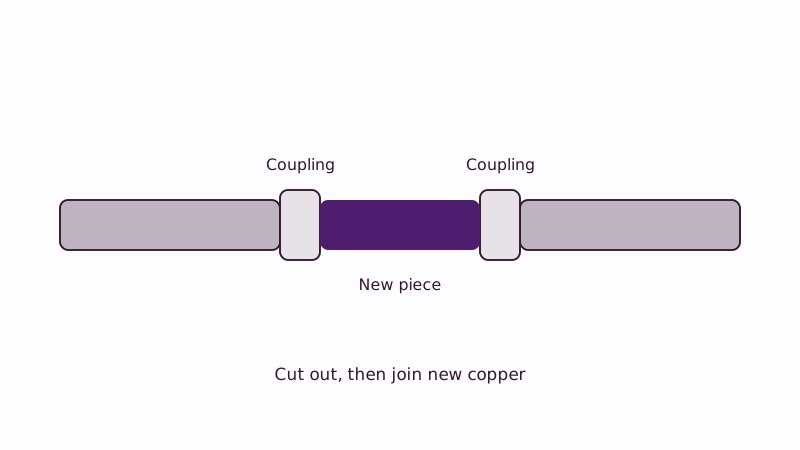
A torch, flux and a dry pipe are required for soldering, so drain the water completely and keep anything flammable away. Never solder near wood framing without a heat shield. Press fittings and push-fit couplings skip the flame but still need a clean, square cut. A pipe inside a wall needs access, so cutting the drywall comes first.
A permit comes into play. Riverside requires a permit when piping is replaced within a wall or beneath a floor, so ring Building and Safety at (951) 826-5800 first. The Contractors State License Board says California requires a contractor license for jobs of $1,000 or more, and for any job that needs a permit.
What are the signs of a pipe bursting inside a wall?
A wall burst shows up as damp or bulging drywall, stained paint, a musty smell, running-water noise when everything is off, a meter that will not stop moving and weaker pressure. A warm spot on a wall can mean a hot line. Close the main, then read the meter before and after to compare.
Feel along the wall with the back of your hand and look for swollen baseboards, bubbling paint and mold-like spotting. A moisture meter, which hardware stores sell, reads dampness behind the surface. Do not open large sections of wall unless you know the line. The guide to spotting a burst pipe walks through the same clues, and a separate page on burst pipe causes explains the reasons.
What is the right way to dry out a ceiling after a leak?
Repair the leak first, then open the wet drywall to admit air, pull out soaked insulation, and run fans plus a dehumidifier until moisture readings match dry areas. Dampness lasting beyond a day or two risks mold, so act fast. Heavily sagging drywall should come down.
Poke a small hole to drain a bulge into a bucket, working carefully because a loaded ceiling can fall. Turn off power to lights in that area if water is in the fixture. Dry for several days, and check the attic if there is one. The page on a leaking ceiling goes deeper on repairs once drying is done.
If the water ran through electrical wiring or the wetness covers a large area, call an electrician and your insurer before using any equipment.
What about a burst pipe outside the house or a leaking PVC joint?
For an outdoor pipe, shut off the water, dig around the break once the underground lines are marked, remove the damaged piece and fit a coupling. For a PVC joint, cut out the section and glue in a new one with primer and cement, or use a repair coupling, after the pipe is dry. A seeping joint rarely seals itself.
Call 811 before digging, since gas, power and communication lines run underground. PVC cement needs dry pipe and time to cure, so keep the water off for the period printed on the can. Sprinkler pipes use the same technique. A leak in the main service line or under the slab is more than a patch job.
Our plastic pipe leak page covers PVC and other plastics in more detail.
When do repeated pinholes mean it is time to repipe?
Two or three pinholes in a year, especially in different rooms, can suggest the whole system is wearing out, and repairing each one may cost more over time than replacing the pipe. A plumber can check the pipe walls, water pressure and chemistry. Our page on whole-house repiping shows the alternative.
According to the EPA, a typical household leak wastes over 9,300 gallons a year, and several small leaks add up. The cost of water damage behind walls often exceeds that of the pipe.
Common questions
Will epoxy putty seal a pinhole leak?
Is a pinhole leak an emergency?
Will my insurance cover it?
Is a permit part of the repair?
Sources used
Page updated