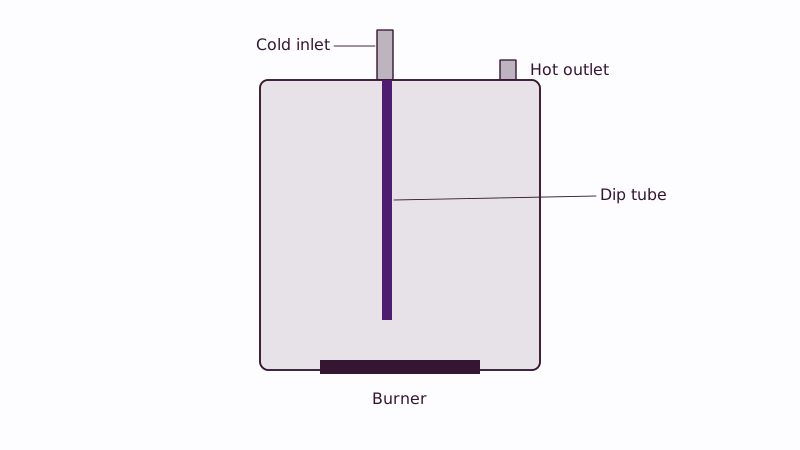
Inside a tank heater, the dip tube moves cold water from the top down to the bottom, leaving the heated water above for your taps. Once it cracks or breaks off, cold water blends with the hot near the top and showers go lukewarm quickly. Other tank faults are covered in the hub on water heater repair in Riverside, or you can submit a request.
What is a dip tube and why does it matter?
It is a plastic tube, a little narrower than a garden hose, fastened to the cold inlet fitting on top of the tank and running nearly to the floor of it. Incoming cold water leaves down low, next to the burner or the lower element, then climbs as it warms. Without the tube, cold water pours in at the top, right where the hot outlet draws.
That design lets a tank heat water at the bottom and hold it ready on top. A broken tube short-circuits it, so you get less usable hot water from a tank that is still heating normally. Tankless heaters do not have one. In an electric tank, the lower element works harder when the tube fails, and in a gas tank the burner runs more often.
What symptoms say the dip tube has failed?
Hot water that fades fast, lukewarm showers from a heater that otherwise runs, tiny white or beige bits of plastic clogging aerators and showerheads, and a sputtering hot tap all point to a damaged tube. Rust-colored water, a leaking base or loud popping suggest other causes, so the symptom list matters.
Look for flakes first. Remove a faucet aerator or a shower head screen and see whether tiny curls or chips of plastic have collected there. The age of the unit is a clue, since plastic tubes can degrade over the years.
If hot water runs out although the thermostat is set properly, the guides on a running heater that gives no hot water and on a kitchen sink without hot water help you work out whether the dip tube or something else is to blame.
How do I tell a dip tube failure from a bad heating element?
Check the temperature at the nearest tap, then the water coming from the hot outlet pipe on the tank. If the outlet is lukewarm, mixing is occurring. A dead element or a pilot problem produces cold water, not warm. A plumber can test a tank by drawing a few gallons and watching the temperature drop.
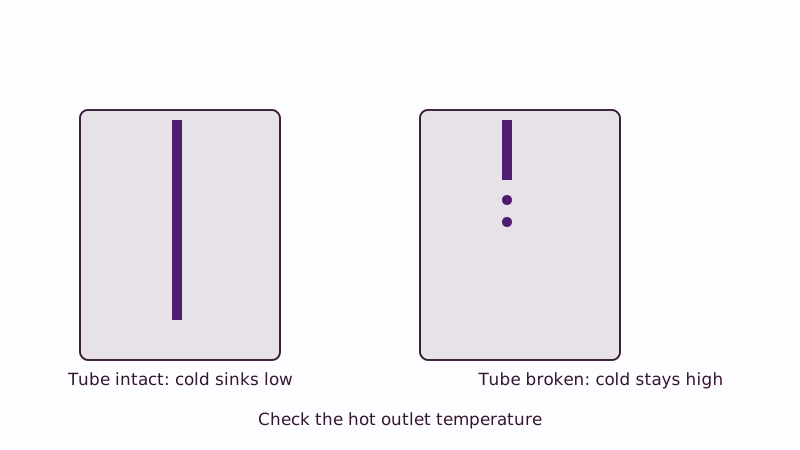
A failed upper element on an electric heater also produces water that turns lukewarm fast, which looks similar. Check the elements with a meter, or let a plumber handle it, before replacing the tube. Gas heaters add the thermocouple and burner as suspects. If the water has plastic flakes, the dip tube is a strong suspect. Flakes also appear in an older heater from corroded fittings, so confirm before buying parts.
The surest test is to turn the water off to the tank, remove the cold inlet fitting and check the tube by eye. It doubles as the first repair step.
What does a dip tube replacement involve?
Turn off the gas or breaker, close the cold supply valve, drain the tank partway, disconnect the cold inlet pipe and unscrew the inlet nipple that holds the tube. Pull the broken tube, slide in the new one, reconnect, refill the tank and restore power. The job is mechanical but fiddly, and nipples often seize.
In practice, the cold inlet nipple is either a plain fitting with the tube pushed in or a heat trap with built-in check ball and tube. Some heaters have a tube integrated in the nipple, so the whole fitting is swapped. Corroded threads can snap, and a snapped fitting means the heater needs replacing. The heater's brand and model number identify the part.
Fill the tank completely before power returns, and keep a hot tap open until the air stops spitting. A leak at the new fitting means the thread sealant needs redoing. The City of Riverside's permit-exempt list does not cover water heaters, so for work beyond a part swap confirm with Building and Safety at (951) 826-5800.
Does a heater needing a new tube justify the repair?
For a young, sound heater, yes, since the tube is a small part. An old heater that is rusty at the base or leaks through the shell is better served by putting the money toward a new unit. A seized nipple can turn a small part swap into a bigger job.
Have the plumber put both options in a written quote. Guide figures for each type appear in water heater replacement costs. When the tank is more than a decade into its life, the repair is a gamble that the rest of the tank will hold. A heater with scale and sediment from years of hard water, which Riverside Public Utilities lists at about 12 grains per gallon on average, could justify replacement instead.
If you decide to replace it, note that SoCalGas serves the area and gas work is regulated, so leave gas piping and venting to the plumber.
Which other faults drain hot water too soon?
An electric unit with a dead upper element or thermostat, a gas unit with a pilot or thermocouple fault, sediment piled at the base, hot and cold crossing over in a mixing valve, and a heater too small for the household all bring the same complaint. The dip tube is one suspect, not the only one.
Sediment shows as rumbling or popping and an unusually long reheat. Crossover may originate in a one-handle faucet, a worn cartridge, or a thermostatic shower valve that lets cold in. If only one fixture is the problem, the heater is not at fault. Look at shower with no hot water when the problem is one bathroom.
Common questions
Do all water heaters have a dip tube?
What is the time for the replacement?
Can the plastic flakes harm me?
Should I drain the whole tank?
The rest of our guides start from plumber riverside.
Sources used
Page updated