Test another hot tap first. If the bathroom or the shower runs hot, the water heater works and the kitchen faucet, its supply line or its shutoff is the problem. When none of the taps gives hot water, the heater is the problem instead, and a better place to start is our water heater page or the guide to what causes a total loss of hot water. Our other services are shown on the home page.
Is the problem the whole house or just the kitchen sink?
Run the hot tap in a bathroom for a minute. If it runs hot there, the heater, the pilot or element and the main hot line are all working, so turn to the kitchen. No hot water anywhere means the heater has lost its pilot, its power, its element or its gas. In that case the sink is a symptom.
Also consider distance. A kitchen sitting at the end of a long pipe run can be slow to deliver hot water, and a slow trickle can look like none. Let the tap run two minutes before you decide. If the water never warms, keep going down the list.
Is the angle stop under the sink fully open?
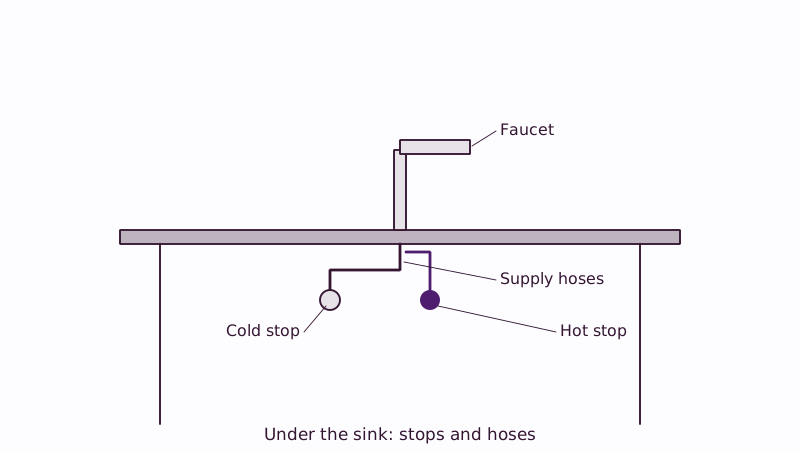
Look under the sink for two small valves, called angle stops, one for hot and one for cold. A hot valve that is closed, or only part way open, gives low or no hot flow. Plumbers or a dishwasher installer sometimes close one and forget. Turn the valve counterclockwise slowly until it stops, then run the tap.
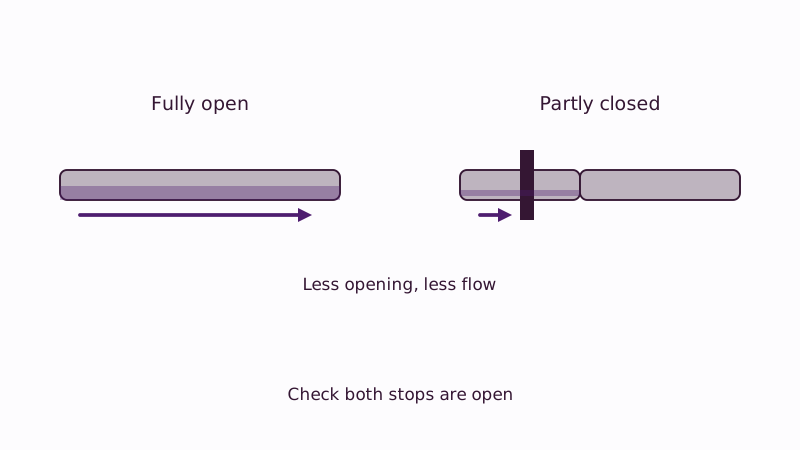
Valves left untouched for years can stick or leak once moved, so go gently and keep a towel nearby. Should the stem drip after opening, give the packing nut a quarter turn. A stubborn valve, or one dripping from the body, needs a plumber, since forcing it can break the pipe behind it.
Could the supply hose or the cartridge be blocked?
Yes. The flexible hose running from the angle stop to the faucet may be kinked in the cabinet or collapsed inside. The faucet cartridge or the hot-side inlet screen can also clog with mineral flakes. With a single-handle faucet, a cartridge that has worn or scaled up can block hot while cold still flows.
Riverside Public Utilities' 2025 report lists hardness averaging 197 mg/L, about 12 grains per gallon, and scale lodges in small passages first. To check the hose, shut both stops, disconnect the hot hose from the faucet over a bucket, then crack the hot stop open. Strong flow shows the hose is fine and the faucet is at fault. Little or none means the stop or line is blocked.
Is the faucet itself to blame?
When the stop and hose are fine, the faucet's cartridge or valve is the likely culprit, and replacing it is a common repair. Mixing the hot and cold in one body means a failed seal can send cold into the hot channel. If you notice that both taps run cold after a faucet swap, the supply lines may have been connected backward.
Check that the hot line, usually on the left, is connected to the hot side of the faucet. For a leaking or worn single-handle faucet, see fixing a leaky single-handle faucet, and when considering a replacement, faucet replacement costs has the numbers.
What if the kitchen sink has hot water but it is only lukewarm?
Lukewarm at one sink usually means a cross-connection or a weak cartridge, or a thermostat turned too low. A water heater turned down to a low setting delivers lukewarm water at every tap, while one sink with the problem points to that faucet. A broken dip tube in the heater can cause lukewarm hot water house-wide.
Check how the other taps behave. Then compare it with the dishwasher, which needs hot water to work well. When the heater is at fault, a dip tube replacement or an element or thermostat fix is the repair. A tank that has no hot water at the sink and at the shower is a different job; see water heater working but no hot water.
Could a tankless heater be why the kitchen has no hot water?
Yes. Tankless heaters need a minimum flow to fire, so a faucet opened just a little may not trigger the burner, and a clogged aerator can push the flow under that threshold. If hot water appears when you open the tap fully and fades when you turn it down, suspect the flow switch or a scaled-up unit.
Descaling is part of owning a tankless unit in hard water. A plumber can flush the heat exchanger and check for error codes. If you see an error code on the unit, write it down before calling. The page on shower no hot water covers the same problem at the other end of the house.
When should I call a plumber?
Call when you have checked the stops, the hose and the aerator and the faucet still gives no hot water, when you see water under the cabinet, when a valve refuses to turn, or when the heater itself seems to have failed. If the heater gives off a gas smell, get out of the building and call SoCalGas at 1-800-427-2200 from outdoors.
A leak under a sink or at a fitting is worth fixing promptly, because small leaks add up, and the EPA reports that the average household wastes over 9,300 gallons a year through leaks. A plumber business that takes your request will quote the repair in writing. Leaks inside the cabinet are covered in fixing a leaking pipe beneath the sink.
Common questions
What is the repair time when the kitchen sink has no hot water?
Which questions should I ask a plumber about a single sink with no hot water?
Should I be home while the plumber works on my kitchen faucet?
Why is hot water slow to reach my kitchen sink?
Sources used
Page updated