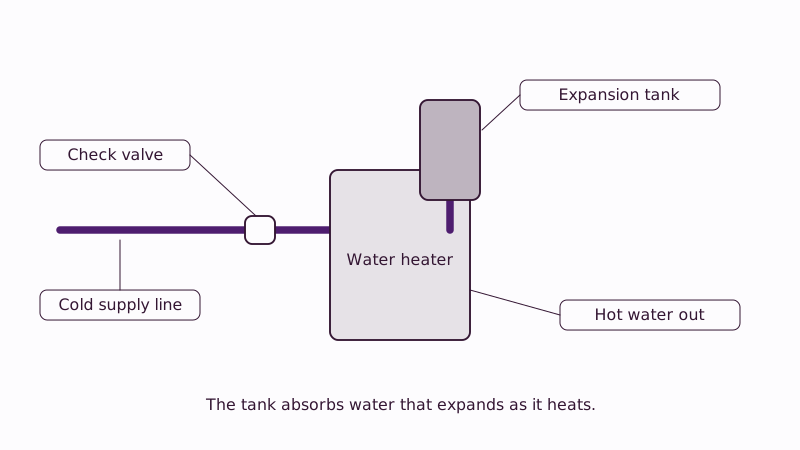
Look near your water heater for a small, squat tank, often blue or gray, hanging from the cold water pipe. That is the thermal expansion tank, and it is a separate item from the heater itself. When it gives out, you may see a dripping relief valve, higher pressure at the faucets or a banging pipe. It sits alongside the other water heater repair topics, and below you will learn the signs of a failed tank and what replacing one involves.
What job does an expansion tank perform?
Water takes up more room when it is hot. In a closed plumbing system, one with a check valve or regulator at the meter, the added volume cannot escape, so pressure climbs every time the heater cycles. The expansion tank holds a cushion of air behind a rubber diaphragm that soaks up that extra volume.
Without the cushion, the pressure spikes land on every joint, fixture and the heater's own relief valve. That is why a stubborn relief valve drip, a noisy pipe and early failure of faucets or the heater are often traced back here. A house on an open system, where expanded water can flow back into the street, may not need one. Whether yours is closed depends on what is installed at the meter, which a plumber can check in a few minutes. Expansion tanks are often needed, and we will not say the code requires one in every home.
How do I know the tank has failed?
Typical signs include water coming out when you press the little valve on top, a tank that feels cold and heavy all over, a relief valve dripping each time the heater runs, and pressure at the taps that jumps. The simple test is to tap the shell: the top should sound hollow and the bottom solid.
Here is the checklist a plumber works through:
- Press the air valve stem, like a tire valve. Air should hiss. Water spitting out means the diaphragm has ruptured.
- Tap the tank from top to bottom. A fully dull sound is a waterlogged tank.
- Use a gauge on a hose bib to read the house pressure. Section 608.2 of the California Plumbing Code sets 80 psi as the limit.
- Look for rust at the base or seams, which means the shell itself is going.
Failed tanks are replaced, not recharged, if the diaphragm has torn. If the tank is merely low on air, the plumber can restore the charge with a pump.
How are expansion tanks sized and set up?
Sizing depends on the heater's capacity and the house water pressure, and the maker's chart gives the right tank. The air charge in the tank should match the incoming water pressure before the tank is connected. A tank charged to the wrong number either fills too early or does not cushion at all.
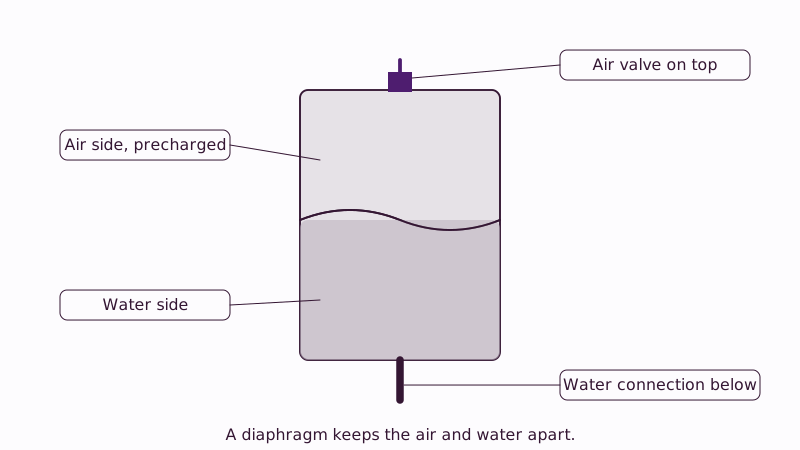
That is why a pressure gauge matters at the start of the job. The plumber reads the house pressure, sets the air side to match, then installs the tank on the cold line near the heater, with a support if it is large. A bracket matters because a tank full of water is heavy, and the connection can strain. The manufacturer's instruction sheet has the exact numbers, and we do not repeat them here.
Hard water adds one more thing to watch. Scale that forms around fittings can make old connections hard to remove, which affects how long the job takes. Riverside Public Utilities' 2025 report lists hardness averaging 197 mg/L, about 12 grains per gallon.
Should I replace it myself?
It looks like an easy swap, but it involves draining part of the system, handling a heavy part and working near a water heater with hot water, gas or electric power. A bad connection can leak for months behind the heater. We recommend a plumber, and the permit question is worth asking.
The City of Riverside's permit-exempt handout does not list water heater work, and says replacing piping behind a wall or below the floor requires a permit. Riverside generally wants a permit for a water heater replacement, so ask Building and Safety at (951) 826-5800 whether adding or changing a tank on the line falls under it. Moreno Valley's office is at (951) 413-3350. We did not find a Moreno Valley or Loma Linda statement on this, so ask them.
Gas odor near the heater means leaving the house and phoning SoCalGas on 1-800-427-2200 once you are out.
What should I budget for a replacement?
No readable published guide prices an expansion tank alone, so we name no figure. The tank is a modest part, and most of the bill is labor plus any additional work discovered during the visit, for example a failing pressure regulator. The written quote sets the price, with parts, labor and permit listed separately.
If your relief valve has been dripping, the cause may be pressure, and the plumber may suggest a regulator or valve work along with the tank. Three of our pages, on a relief valve swap, hot water pressure regulators and replacing the heater, show how these fit together. A heater close to retirement may call for replacing it and adding a new tank in the same visit.
Common questions
How much time does a tank replacement need?
What should I find out before hiring?
Does someone need to be home for this?
Can a bad expansion tank damage other things?
This guide is one of many on Rubidoux Ridge Plumbing.
Sources used
- City of Riverside, work exempt from building permits
- California Plumbing Code section 608.2, water pressure limit of 80 psi
- California Contractors State License Board
Page updated