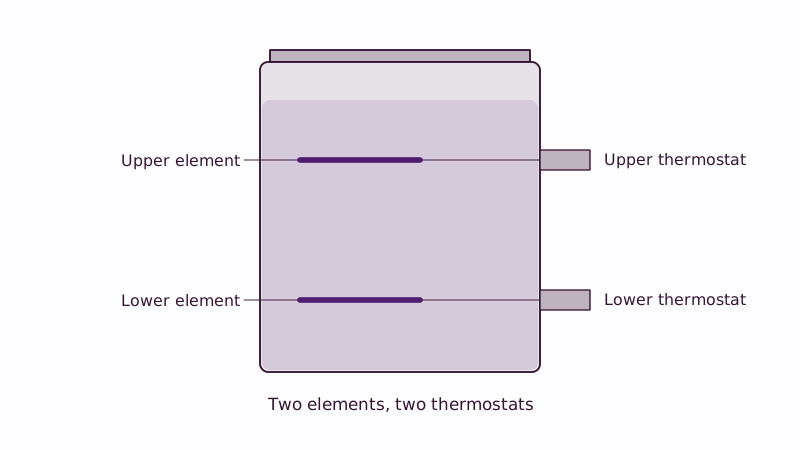
An ordinary electric tank water heater uses two heating elements, one near the top of the tank and one near the bottom. A burned-out element shows up as lukewarm water, hot water that runs out quickly, or none at all. Diagnosis and replacement sit comfortably within plumber territory, and the water heater repair hub puts it in context with the other faults.
Coming up: symptoms, testing, the swap itself, and how that compares with buying a new heater.
How can I tell a heating element has failed?
Two patterns help. Fully cold water implicates the upper element or upper thermostat, since the top element heats first. Hot water that fades quickly usually means the lower element has died, which leaves the tank with less usable hot volume.
Rule out easier explanations first: a tripped breaker, a tripped thermostat reset, or a heater undersized for the household. The sequence of checks, gas models included, appears in the no hot water guide.
With power off, a plumber confirms a failed element by putting a meter on the terminals. Infinite resistance, or a short to the metal shell, means the element is dead. An element shorting to ground can also trip the breaker at once, which is a safety concern rather than a nuisance.
Who should do the swap, and what does the visit involve?
Call a plumber if the cause is unclear, the breaker keeps tripping, the tank weeps, or you would rather avoid working near live circuits. During the visit the plumber cuts the power, tests the elements and thermostats, replaces the dead one, refills the tank and confirms the water heats.
We do not do the work ourselves. Request a written quote and a local plumbing business is lined up to come out. If the heater is also noisy, rusty or very old, ask the plumber to assess the whole unit on site. Rumbling noises are explained in why there is no hot water.
According to the state licensing board, a contractor license is needed once jobs reach $1,000 in labor and materials, or for any job needing a permit, and a plain element swap falls well below that. A new circuit is separate electrical work. Other jobs we handle are listed on the Rubidoux Ridge Plumbing home page.
Is replacing a heating element a job I can do myself?
Many handy owners do it. Electrical and plumbing risks combine here, and the stakes are real. Switch off the breaker and verify the power is dead with a tester, close the cold supply, drain enough water to expose the element, take off the cover and insulation, back out the old element with an element wrench, install the new one with a new gasket, and refill the tank fully before power returns.
Purchase a match for the old element in voltage, wattage and mounting, whether screw-in or bolt-in. A mismatch can overload the circuit or fail to seat. The model is on the heater's rating label.
Pass it to a plumber when you see leaking at the tank, heavy corrosion on the terminals or scorched wiring, or when the heater is a heat pump or has a complicated control board. Swapping an element counts as repair work. Replacing the whole heater generally needs a permit in Riverside, which Building and Safety at (951) 826-5800 can confirm.
Is a new element enough, or should the whole heater go?
A fairly young tank that is dry underneath and has lost just one element usually calls for a new element. An older tank, or one that has already failed twice, may justify replacement instead. A plumber can price both options in the same written quote.
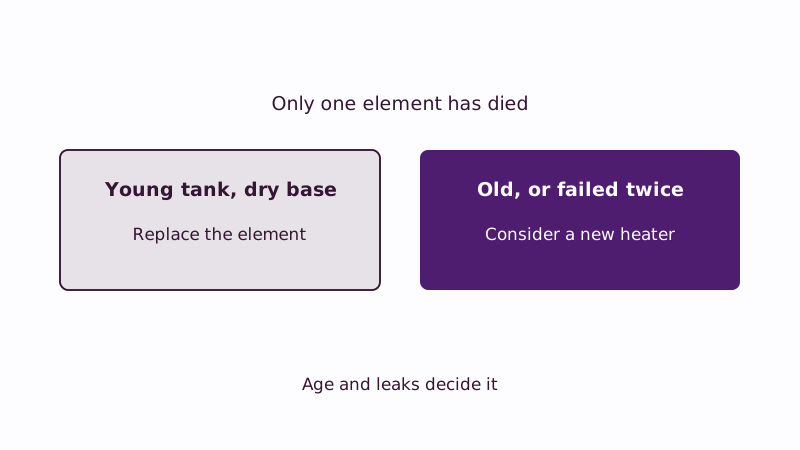
The tank's condition decides it. A rusty, leaking or heavily scaled tank is close to the end. Replacement options, tankless included, appear in tank versus tankless and water heater replacement.
With the tank already open for service, ask about the sacrificial rod too, because anode rod replacement can extend the tank's life. No dollar figures appear here, since the sources we could read gave no reliable range for an element swap. Trust the written quote.
What makes heating elements burn out?
Scale and sediment do most of the damage. Minerals settle on the lower element and insulate it from the water, so it overheats and finally fails. Hard water accelerates the process. Riverside Public Utilities' 2025 report puts average hardness at 197 mg/L, near 12 grains per gallon, which makes scale a plausible factor in many local homes.
Age matters as well. Elements wear out, and a heater that has gone through a few is often near retirement. Water collecting at the bottom of the tank is a different issue entirely, and no element swap cures it. Timing questions are answered in heater replacement intervals.
Dry-firing, which means powering an element while the tank is not full of water, destroys it within moments. A new element can be ruined this way, so leave the breaker off until the tank is full and a hot tap runs water.
Common questions
What is the usual time for an element swap?
Which questions come before an element replacement?
Should someone stay home during the visit?
Sources used
Page updated