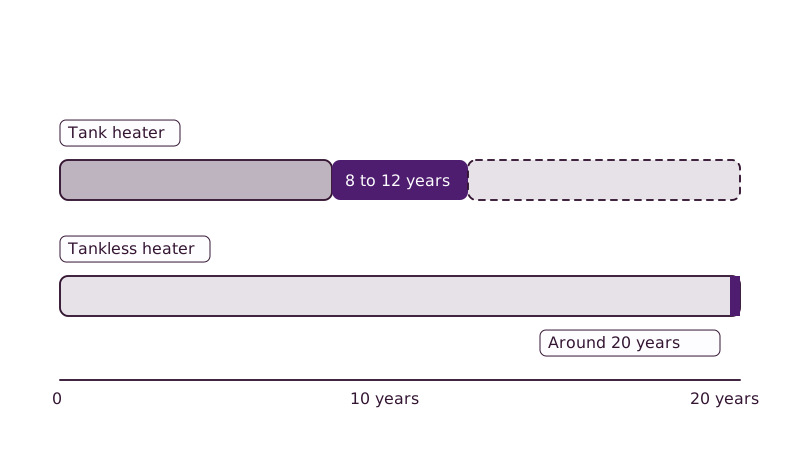
A storage tank water heater is usually replaced somewhere around the ten-year mark. Guides commonly cite 8 to 12 years, while tankless units are often said to last about 20 with regular care. Those are rough figures, not promises, and a unit can fail early or run on for years. This page helps you read the signs, and the water heater repair page explains how a local plumber is arranged to visit you.
When does a water heater reach the end of its life?
Tank heaters typically run 8 to 12 years and tankless ones about 20, though results depend on water quality, maintenance and how hard the unit works. Treat the age as a prompt to inspect, not a deadline. A ten-year-old heater with a clean tank can outlast a six-year-old one in a house with very hard water.
Where you live changes the picture. Water throughout the Inland Empire carries minerals, and the figures are public. Riverside Public Utilities' 2025 report gives average hardness of 197 mg/L (about 12 grains per gallon), ranging from 180 to 210. EMWD's 2025 report gives Mills-area hardness averaging 5.1 to 7.5 grains per gallon, varying by source, and Western Municipal Water District's local groundwater averaged 155 mg/L.
Minerals from hard water settle as sediment and scale on the bottom of a tank and on the heating parts. That makes a burner or element work harder and tends to cut the tank's lifespan. It is the main reason people here get less than the best-case number.
How can I tell the age of my water heater?
Find the rating plate along the tank's side and read the serial number. Many makers encode the month and year it was made in that number, and the brand's website or support line can decode the format. If the plate is unreadable, a plumber can usually identify the age from the model and the build style.
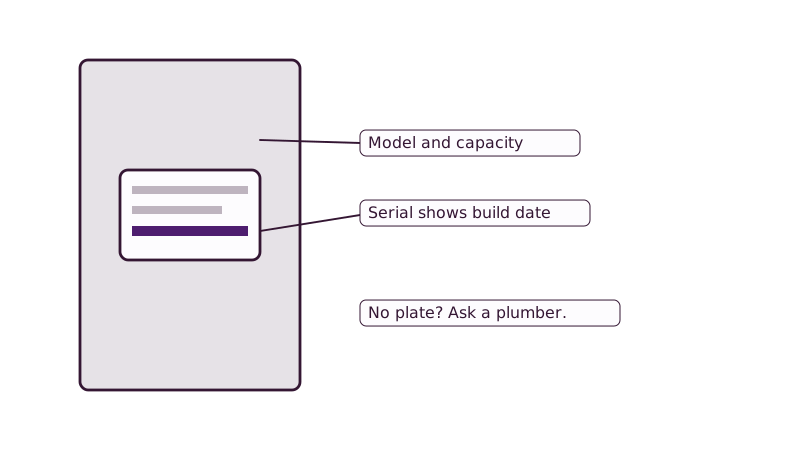
Write down the model number, serial number and capacity from the plate while you are there. They help when you ask about a part, a recall or the warranty period printed on the paperwork. A heater you inherited with a house may have an install date on a sticker or on the permit record.
If you bought the house recently, ask the seller or the city whether the water heater was permitted. A Riverside replacement usually requires a permit, and water heaters do not appear in the city's exempt-work handout. Building and Safety can be reached at (951) 826-5800.
Should I replace the water heater before it fails?
Often yes, if the unit is past ten years and showing signs of wear. A planned replacement lets you pick the type, compare quotes and schedule the work. When a tank fails it can flood a garage or closet, and the choice gets made in a rush. Planned does not mean early at any cost, so weigh age against condition.
If the tank is clean, quiet and dry, an older heater can run on with maintenance. If it is leaking, rusted or already needs a part, replacement usually wins. A plumber who inspects the unit can give you an honest view if you tell them you want options, not a sales pitch.
When you replace, consider what else comes with the job. Earthquake strapping is a California requirement for water heaters, and an expansion tank is often needed in a closed system. These are described in expansion tank replacement. To decide whether to go with a tank or a tankless unit, read the comparison in tank versus tankless, and water heater replacement cost gives guide figures.
Can I make a water heater last longer?
Yes, within limits. Flush sediment from the tank on a schedule, check or replace the anode rod before it is used up, keep the thermostat at a moderate setting and make sure the pressure on the line is not above the 80 psi code limit. A plumber can do all of these, and they cost less than a replacement.
The anode rod is a sacrificial metal rod inside the tank that corrodes first so the tank does not. After that, the tank corrodes next. The rod's role is covered in anode rod replacement, and many plumbers check it during any service visit. Pressure matters too, because high pressure strains the tank and relief valve. See adjusting a water pressure regulator.
Water softeners also reduce scale in the tank, although they bring their own costs and upkeep. Our softener and water bill guide explains how one affects usage.
What are the signs that my water heater needs replacing?
The clearest sign is a puddle around the bottom of the tank, because a leak through the shell means the steel has failed. Other signs include hot water that runs rusty, rumbling or popping sounds, uneven temperature, a unit older than ten years and repairs that keep returning. Several together say replace, not repair.
Here is how to read each sign:
- Water under the tank. Check fittings first, since a loose connector is cheap to fix. When the water seeps from the tank body itself, see how to deal with a water heater leak.
- Rust-colored hot water. Rust appearing only on the hot side implicates the tank, whereas rust on both hot and cold implicates the pipes.
- Popping and rumbling. Sediment on the bottom traps steam bubbles. Flushing can help, but heavy buildup means the tank has been struggling for a while.
- Not enough hot water. A failed element, thermostat or dip tube can cause it. See dip tube replacement and no hot water, heater working.
- Repeated repairs. Two or three visits in a year for a ten-year-old heater suggest a bigger issue underneath.
Does the type of heater change how often I replace it?
It does. Storage tank heaters wear out because the tank corrodes, while tankless units wear in the heat exchanger, valves and controls, and can often be repaired part by part. Heat pump models fall in between and need their own filter and drain upkeep. Fuel matters less than the tank or the heat exchanger.
Descaling on a regular basis is needed for tankless heaters wherever water is hard, and that covers the cities we serve. Descaling guidance comes from the maker, so follow the manual, and see tankless water heater repair for the problems that appear when it is skipped.
We arrange work in Riverside, Moreno Valley and Loma Linda. You can request a quote with the age, brand and symptoms, or browse the other work listed on the home page.
Common questions
Is a ten-year-old water heater too old?
How much does replacement cost?
Do I need a permit to replace a water heater?
Does a water heater warranty matter when I decide?
Sources used
- Riverside Public Utilities, 2025 Water Quality Report
- Eastern Municipal Water District, 2025 Consumer Confidence Report
- Western Municipal Water District, 2025 Water Quality Report
- This Old House, How Much Does Water Heater Installation Cost? (2026), updated 06/17/2026
- Fixr, How Much Does a Gas Water Heater Cost in 2026?, updated January 30, 2026
- Fixr, Electric Water Heater Installation Cost in 2026, updated January 27, 2026
- City of Riverside, Work exempt from building permits handout
Page updated