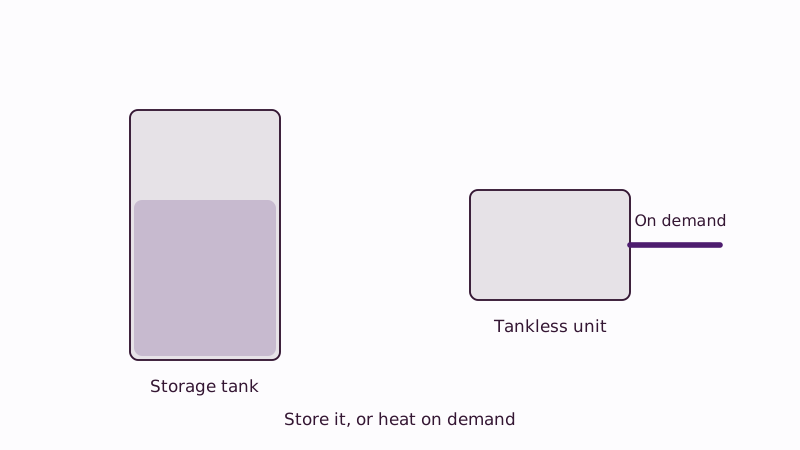
For endless hot water, floor space and, in light-use homes, energy, gas tankless comes out ahead. A gas tank is ahead on up-front price and simple installation. This Old House's 2026 guide puts tank models at $1,200 to $2,300 installed and tankless at $2,100 to $4,000. These are national guide figures. They are neither Riverside rates nor what we charge. Repair and replacement are covered on our water heater page, and our other work is listed on the home page.
What are the pros and cons of tankless vs tank?
A tankless unit warms water solely when a tap is opened, so it never runs out during a long shower, takes a small wall space and tends to last longer. Its cons are a higher installed price, a need for a larger gas line and sealed venting, and scale upkeep. A tank is cheaper and simple but holds a large volume of water that you pay to keep hot.
In a table form: a tank costs less to install, can run out when demand is heavy, wears out sooner, and loses some heat while it sits. A tankless unit costs more up front, gives continuous hot water, needs periodic descaling, and can fall short if several fixtures run at once beyond its flow rating. Neither is the answer for every house.
Does tankless really save energy?
According to the U.S. Department of Energy, demand-type heaters beat storage tanks in efficiency by 24 to 34 percent in homes using 41 gallons or less of hot water daily, and by 8 to 14 percent in homes using about 86 gallons daily. The saving comes from skipping standby heat loss.
So savings shrink as the household gets bigger. A family that runs showers, laundry and the dishwasher all day sees a smaller gain than a couple. Percent savings on an energy bill is also not the whole payback story, since the unit costs more to buy. If you want a rough sense of the break-even, ask the plumber for the efficiency ratings of both models and compare them with your gas bill.
Which extras does a gas tankless unit require beyond what a tank needs?
A larger gas supply, a vent rated for it, and often a drain for condensate. A gas tankless unit can draw several times the gas of a tank burner at full fire, so the line and the meter capacity must support it. Venting for a high-efficiency unit usually runs through a wall or roof in plastic or stainless pipe.
SoCalGas serves Riverside, Moreno Valley and Loma Linda, per its cities list. In many older homes the gas line was sized only for a tank heater plus a furnace, so a swap can involve upsizing pipe. Permits are needed for gas piping, and our pages on gas tankless water heater installation and residential gas piping codes describe the steps. See tankless installation cost for the dollar side.
How does Inland Empire water affect each type?
Hard water scales both, in different ways. In a tank, minerals settle on the bottom and coat elements or burner surfaces. In a tankless unit, scale collects inside the heat exchanger and restricts flow. Riverside Public Utilities' 2025 report lists hardness averaging 197 mg/L, roughly 12 grains per gallon, ranging from 180 to 210.
For a tankless unit, plan on regular descaling, which a plumber can do with a flush kit, and ask whether a scale-reduction filter makes sense. For a tank, flush it and check the anode rod. Read our pages on hard water scale prevention and anode rod replacement for upkeep.
What is the lifespan of each type?
Most demand-type units are expected by the Department of Energy to last more than 20 years, which is longer than a tank. A tank heater commonly lasts about a decade, though that is a rule of thumb that varies with water and care. Parts of a tankless unit can usually be replaced separately, which stretches its life.
Do not buy on lifespan alone. A tank that costs half as much and lasts half as long is not a worse deal on paper, and a repair on an out-of-warranty tankless unit can be pricey. Ask the plumber about the manufacturer's warranty on the heat exchanger, parts and labor, and whether the brand has local parts support. For brand-specific information, see Navien, Rinnai and Rheem repair pages.
Which is right for my house?
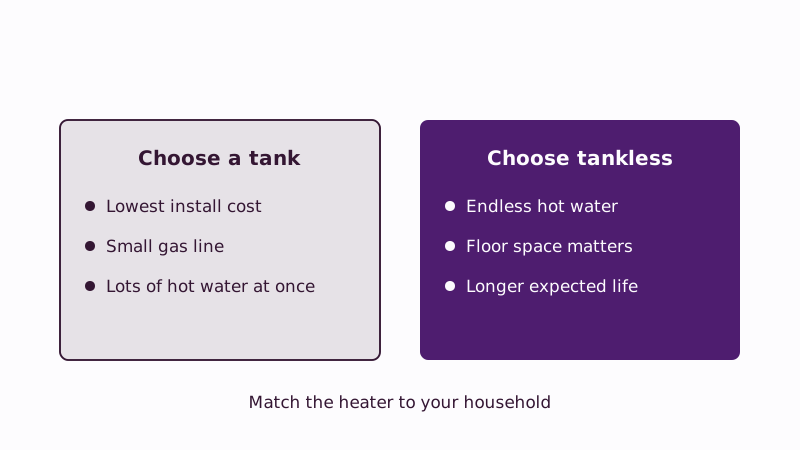
A tank suits you if the lowest install cost matters most, your gas line is small, or the household draws plenty of hot water simultaneously and the tank absorbs the surge. Choose tankless if you value space and endless hot water, can have the venting and gas line upgraded, and use moderate amounts of hot water.
Older homes in Downtown Riverside, Wood Streets and Arlington may need pipe and venting changes that favor a tank. Newer homes in Orangecrest and east Moreno Valley are more likely to have the room and capacity for a tankless install. See our fuller tank versus tankless guide for more detail.
Common questions
How long does it take to install a tankless gas water heater?
What should I ask before I buy a tankless unit?
Do I need to be home when the water heater is swapped?
Will a tankless heater give hot water instantly?
Sources used
Page updated