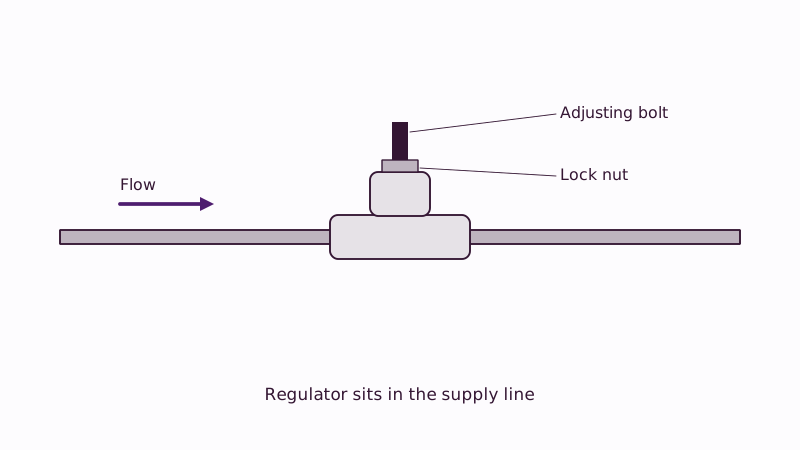
Start at the point where the main supply line comes into the house, whether through a wall or up from the ground. The regulator usually sits a few feet past the main shutoff and looks like a bell-shaped brass valve with an adjustment screw on top. If pressure at the taps feels off, this is the first stop, and the next steps are in our hub on water pressure and valves.
Treat this page as a walking tour covering the likely locations, how to recognize the valve, how a gauge confirms it, and what to do if nothing turns up.
Where do I look for the pressure regulator?
Start where the supply pipe meets the building. Frequent hiding places include an outside wall by the front hose bib, a garage corner near the water heater, a crawlspace, a utility closet, or a lidded box in the yard. Expect it on the pipe just past the main shutoff and ahead of the first branch.
Another approach is to trace the pipe backward from the street. The meter and the utility's shutoff live in a box by the curb, the line runs to the house, and the regulator usually appears on the house side where the pipe first becomes reachable. Slab houses often have the entry on an outside wall or in the garage, and houses with a crawlspace may hold it below the floor.
With a garage heater, follow the nearby cold supply, because the main often enters along the same wall. Photograph the area and run a hand along the pipe.
How do I recognize a pressure regulator?
Imagine a brass dome roughly fist-sized, topped with an adjusting bolt and lock nut. A stamped arrow marks flow direction, two pipe connections hold it in line, and many models also carry a small side port or a threaded plug for a gauge.
Several lookalikes cause confusion. The main shutoff has a wheel or lever. An expansion tank is a small vessel, not a valve, hanging near the heater. The heater's relief valve has a test lever plus a discharge pipe. An irrigation backflow device is a bigger, more complicated assembly.
Replacement units can look different, so the exact shape varies, and a plumber spots it in seconds. For the common residential size, see the three-quarter inch regulator valve.
Can I confirm it without taking anything apart?
Thread a pressure gauge onto an outdoor hose bib or laundry faucet, close every tap and appliance, and read the dial. California Plumbing Code section 608.2 caps pressure at 80 psi. A higher reading means the regulator is missing or failing, while a very low one suggests a valve left partly shut or a supply problem.
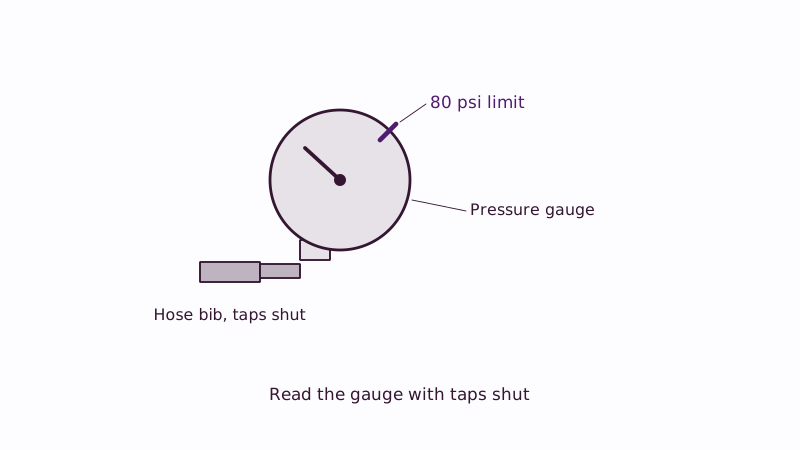
The gauge reads static pressure, which is the pressure when no water moves. Read it at different times of day, since street pressure can change. Hillside homes can see higher pressure than homes above them, simply from elevation, so the surrounding neighborhood matters.
On the utility side, Riverside Public Utilities customer service answers at (951) 782-0330. Other suppliers, such as EMWD, Western Municipal Water District, Box Springs Mutual and the City of Loma Linda, serve other addresses, and your bill names yours.
What does it mean if no regulator turns up?
Many houses have none and simply take street pressure as it arrives. Some lost theirs in a remodel or have it sealed in a wall or box. If the gauge reads under 80 psi and fixtures behave, you may not need one. A high reading is the cue for a plumber to fit a regulator on the main.
Search once more before giving up: behind stored boxes, inside a utility closet, beneath a hose bib or in a lidded in-ground box. A house with a second entry, such as an irrigation line, may carry a device on each line.
A valve found inside a wall or sealed enclosure may need access opened by a plumber. Guide prices for a new one are in regulator installation cost.
Do hot water systems have their own regulator?
Normally not. The same pressure-reducing valve serves hot and cold, since the heater takes its supply from the cold line. A separate part, the heater's temperature and pressure relief valve, protects the tank. The hot water pressure regulator page explains the difference in detail.
Low hot water pressure with normal cold pressure is not a regulator problem. It tends to be a sediment or fixture problem on the hot side. Hot water pressure low covers those causes.
What should I do once I find it?
Photograph it and note its position, then record the gauge reading. Leave the adjusting screw alone until a gauge is attached and you have a plan, because even a small turn can shift pressure. The steps are in adjusting a regulator valve.
A sudden change is worth reading about in sudden low water pressure before you blame the regulator, since a worn one is just one possible cause. Scale shortens valve life, and the 2025 Riverside Public Utilities report puts hardness at an average of 197 mg/L, near 12 grains per gallon. Swapping it out is covered in regulator replacement.
When does a plumber need to get involved?
Phone a plumber when the regulator stays hidden, the gauge passes 80 psi, pressure swings, pipes bang, or the relief valve on the heater starts dripping. The plumber finds and tests it, checks the expansion tank while there, and replaces the regulator if it has failed.
We do not do the work ourselves. Request a written quote and we pass the job to a local plumbing business. Tell us what you saw and whether you took a gauge reading. Our Rubidoux Ridge Plumbing home page lists the other services we arrange.
Work on the main line can involve a permit. A pipe replaced behind the wall face or under the floor needs one, according to Riverside's handout on exempt work, and Building and Safety at (951) 826-5800 can advise.
Common questions
How much time does locating and testing a regulator take?
What questions go to a plumber about a pressure regulator?
Must I be home?
Sources used
- California Plumbing Code section 608.2, water pressure limit of 80 psi
- Riverside Public Utilities contact page
- Riverside Public Utilities 2025 Water Quality Report
Page updated