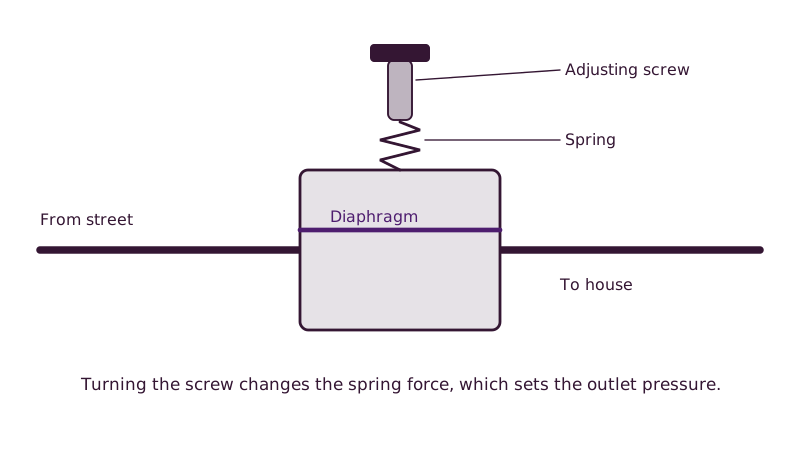
Look for a brass valve shaped like a bell, usually close to the main shutoff or the water meter; this pressure regulator reduces incoming pressure to a steady household level. To adjust it, read the pressure on a gauge, back off the lock nut, then move the adjusting screw a little at a time, checking the gauge after each move. This guide covers each step. If the valve will not hold a setting, our water pressure page describes how we pass your request to a local plumber.
How does a house water pressure regulator work?
Inside the bell is a spring pressing on a diaphragm. Street pressure pushes against the diaphragm from the water side, the spring pushes back, and the balance opens or closes a seat that lets water through. Turning the adjusting screw changes how hard the spring pushes, which moves the pressure the valve holds.
That is why a regulator keeps a steady downstream number even when the street pressure moves up and down through the day. When the diaphragm hardens, the seat wears or debris lodges in the valve, the balance is lost, and the pressure can creep up or drop off.
Section 608.2 of California's plumbing code caps static water pressure at fixtures in a building at 80 psi. A regulator is how a house stays under that line when the street supply runs higher. Many plumbing guides suggest aiming well below the limit, in the range of roughly 50 to 60 psi, but your appliance manuals set the real limits.
How should I measure the pressure before changing anything?
Attach a pressure gauge to an outdoor hose bib or a washing machine faucet, confirm nothing in the house is drawing water, and read the dial. Hardware stores sell inexpensive gauges. Measure at a quiet hour, since pressure sags when neighbors water their lawns.
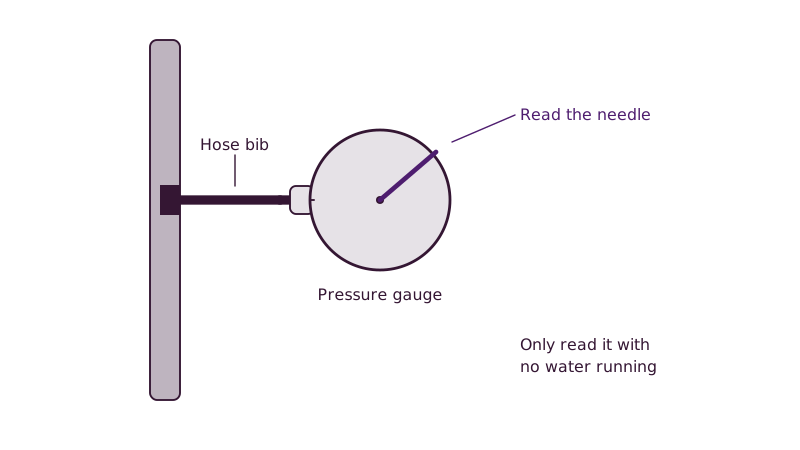
Write down the number. Then run a tap or flush a toilet and watch the needle, since a big drop under flow suggests a restriction, not a mis-set regulator. If the number is above 80 psi when the house is quiet, the regulator is not doing its job, and an adjustment may only be a temporary fix.
A gauge that stays high for hours with everything off also tells you something. Pressure that climbs overnight can mean the valve is failing to hold, and the relief valve on the water heater may begin to drip as a result.
How do I adjust the regulator?
With the gauge attached and the house quiet, back the lock nut off by a turn or two on top of the regulator. Clockwise on the adjusting screw raises the pressure; counterclockwise lowers it. Move it only a quarter turn per step, pause a few seconds, read the gauge, and snug the lock nut once the reading holds.
Different brands differ in detail, so read what is printed on the valve body and follow the maker's sheet if you have it. Most adjustable valves work as above, but some models are factory set and have no screw at all.
Go slowly. Overshooting past 80 psi puts pipes and appliances at risk. If the reading will not change, or drifts back within an hour, the valve is worn out.
Never reach for the adjustment screw on a valve that is leaking from the bell or the side. Leaks mean the diaphragm or body has failed, and the fix is replacement.
How can I tell if my water pressure regulator is bad?
A failing regulator shows itself through a gauge reading over 80 psi, pressure that swings between strong and weak, banging pipes when a tap closes, a dripping relief valve, a toilet that keeps refilling and faucets that spit. Any one of these is a hint, and two or three together point strongly to the valve.
One more sign is water that sounds like it is rushing through the walls. Our guide to water hammer sounds explains the banging. Low flow is a different problem: reasons for low water pressure and sudden low pressure in the house cover that, including whether the culprit is the regulator, a valve left partly shut or a clogged line.
Pressure that is high in the cold lines and weak in the hot lines is another clue the problem is in the water heater, not the regulator. See hot water pressure low.
How long do water pressure regulators typically last?
How long a regulator lasts depends on hard water, debris and street pressure, and we have no authoritative age to quote, so a gauge reading tells you more than the age of the valve. Test an older valve that has never been checked every year or two. Replace it if the reading is above 80 psi or will not hold a setting.
Riverside Public Utilities' 2025 report lists hardness averaging 197 mg/L (about 12 grains per gallon), and EMWD's 2025 report puts hardness in its Mills area between 5.1 and 7.5 grains per gallon, varying with the source. Mineral buildup can foul a seat or a screen.
Is replacing a pressure regulator a do-it-yourself job?
It is possible if you are at ease closing the main, handling threaded or soldered fittings and following local rules. Plenty of homeowners hire a plumber because the valve sits on the main line, a bad joint floods the house and permits may apply. First, phone the building and safety office in your city.
Steps for a straightforward swap:
- Close the main, then drain the line through a tap at the lowest level.
- Note which way the arrow on the old valve points, since water flows one way through it.
- Disconnect the unions or fittings, match the size and connection type, and fit the new valve in the same direction.
- Open the main slowly, check for drips, and set the pressure with a gauge.
Riverside's published exemption list names faucet and toilet replacement as exempt from permits, while pipe replacement inside a wall or beneath a floor needs one. The handout we read does not address regulators, so ask Building and Safety at (951) 826-5800 for a city address. Replacement guidance and the cost page cover what a plumber's visit looks like.
Where is the regulator, and which size do I need?
Check the point where the water line comes into the house: next to the main shutoff inside a garage, on an exterior wall, in a basement or at the meter box. Sizes run by pipe diameter. A common house service size is three quarters of an inch, covered in 3/4 inch pressure regulator valves.
If you cannot find one, there may not be one. Some houses never had a regulator, and some have the regulator tucked inside a meter box. Where a regulator is usually located lists the usual spots, and a plumber can confirm in a visit.
What about hose, shower and pump regulators? A shower head flow restrictor, a garden hose regulator and a well pump pressure switch all manage pressure at one point, not the whole house. They are separate parts and are not substitutes for the main valve. A separate valve for hot water appears in hot water pressure regulators.
Common questions
What pressure should I set my regulator to?
Can adjusting the regulator cure low pressure?
Is it normal for the pressure to change during the day?
Who should I call in Riverside, Moreno Valley or Loma Linda?
Sources used
- California Plumbing Code, section 608.2 (static water pressure limit of 80 psi)
- Riverside Public Utilities 2025 Water Quality Report
- Eastern Municipal Water District 2025 Water Quality Report
- City of Riverside, Work Exempt From Building Permits
Page updated