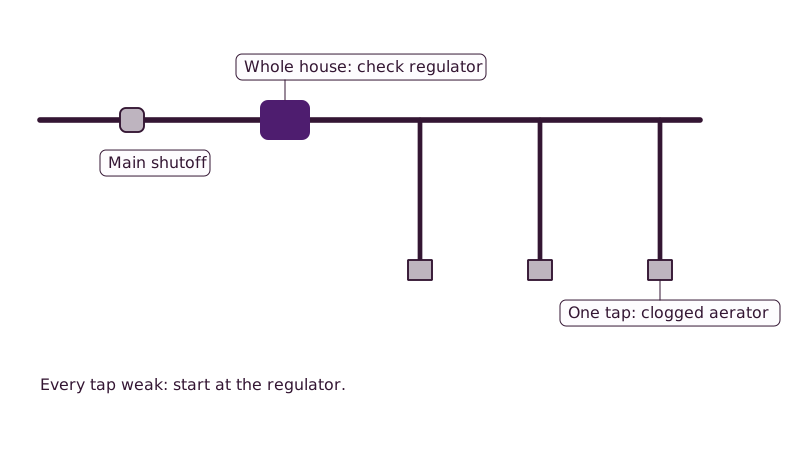
Only a handful of things cause low pressure. One weak faucet usually means a clogged aerator or showerhead, or a supply valve that is partly closed. A weak whole house calls for checking the main shutoff, the pressure regulator, a hidden leak, a clogged or corroded pipe, or trouble on the utility's end. The low water pressure plumbers page describes the service if you need a visit.
What causes low water pressure at just one faucet?
A single weak tap almost always has a local cause: mineral buildup in the aerator or showerhead, a partly closed stop valve beneath the sink, a kinked flexible supply line, or a clogged cartridge. Take off the aerator, rinse away the debris, soak it in vinegar and put it back. Weak hot with fine cold narrows the cause to the hot side.
Hard water leaves scale on fine screens fast. In its 2025 water quality report, Riverside Public Utilities lists average hardness of 197 mg/L, roughly 12 grains per gallon, so scale is a common culprit around here. Check the stop valve handle next. If it is not fully open, turn it counterclockwise. Old multi-turn valves can fail internally, and a plumber can replace them.
Can a hidden leak lower water pressure?
Yes. When a leak sits upstream of your fixtures, water escapes before reaching the tap and pressure falls, sometimes together with a higher bill or a meter still turning while everything is off. Wet spots, a hissing sound or a warm floor can give it away. For the average household, the EPA puts leakage at over 9,300 gallons a year.
Try the meter test: with every tap and appliance off, look at the meter's leak indicator. Any movement means water is escaping. Slab and wall leaks need detection gear. The slab leak detection and repair page and the burst pipe signs guide cover what to look for next.
Could old or clogged pipes be the cause?
Yes, most often in older homes. Galvanized steel lines corrode inside, shrinking the opening until flow drops, and copper can scale or pit. Houses in Downtown Riverside, the Wood Streets, Arlington and the Eastside include many mid-century or earlier builds where this happens, while newer areas such as Orangecrest more often have PEX or newer pipe.
Signs of narrowed pipe are low pressure that grows worse over months, brown water on first use, and pressure that drops further when two fixtures run. An inspection and tests by a plumber will confirm it. If the lines are failing, the repipe options page explains what the job involves.
Why is pressure low throughout the entire house?
When every fixture is weak, check the main shutoff at the house and at the meter. A gate valve that is partly closed or has a broken inner gate cuts flow. Next suspects are a failing pressure regulator, a hidden leak that diverts water, corroded or narrowed supply pipe, or a recent change in the utility supply.
A quick test: open a hose bib near the main and watch the flow. Strong flow there with weak flow indoors suggests narrowed house piping. Weak flow at the bib as well implicates the supply line, the regulator or the main valve. Ask the neighbors if they notice it too, because a main break or flushing work on the street affects whole blocks at once.
Is the problem on the utility side?
Sometimes. Mains get repaired, hydrants get flushed and demand peaks in hot weather, so pressure can dip for hours. Call your water utility with your address. Riverside Public Utilities lists (951) 782-0330 for customer service, weekdays 7:00 am to 6:00 pm. Other parts of the area are served by EMWD, Western Municipal Water District, Box Springs Mutual or the City of Loma Linda, so confirm the supplier on your bill.
If neighbors have normal pressure while you do not, the problem is in your lines or at your meter. If the utility says supply is normal at the meter, the fault is on your side of it, and a plumber can take a reading at a hose bib to confirm.
How does a bad pressure regulator cause low pressure?
Shaped like a bell and sitting close to the point of entry, the pressure regulator brings street pressure down to a safe level. When the internal diaphragm or spring fails, pressure can drop sharply or swing too high. Many homes have one, and they wear out. Fitting a gauge to a hose bib gives the actual reading, and plumbers test it as well.
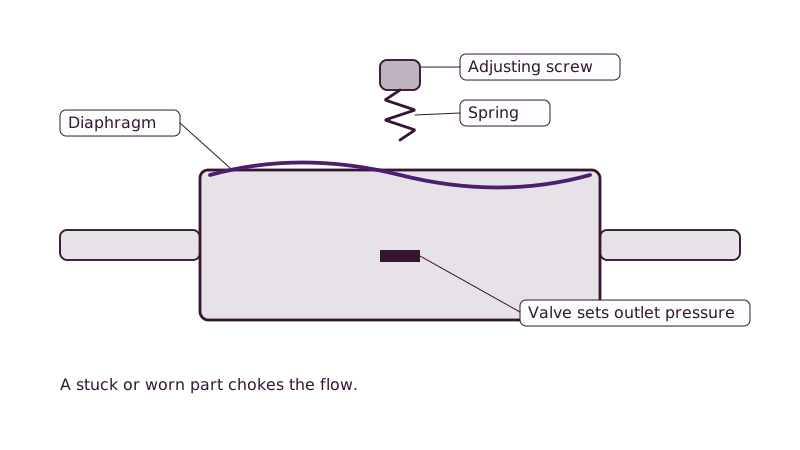
Static pressure is limited to 80 psi by section 608.2 of the California Plumbing Code, so a regulator stuck wide open can endanger fixtures and appliances. One stuck nearly closed causes the opposite problem. In most cases a plumber should do the replacement. The water pressure regulator cost guide shows what the work typically involves.
Is low water pressure dangerous?
Low pressure is rarely dangerous by itself, but it can be a symptom of something that is. A leak can cause water damage and mold, a failed regulator can later spike pressure and burst fixtures, and weak flow can leave a tankless heater or a fire sprinkler unable to work properly. The real risk is ignoring a cause that keeps getting worse.
A sudden drop with no explanation deserves a quick look the same day. Shut off appliances that need full flow if you notice odd behavior, such as a tankless unit that cuts out. For details, the tankless hot water heater repair guide explains flow-related errors.
Common questions
What is the way to measure my home's water pressure?
What explains low pressure in just the shower?
What if only the hot side has weak pressure?
Does a plumber need to be called for low pressure?
For the wider picture, start with Rubidoux Ridge Plumbing plumber.
Sources used
- California Plumbing Code, section 608.2 (80 psi limit)
- Riverside Public Utilities, Contact us
- City of Riverside, work exempt from building permits
- EPA WaterSense, Fix a Leak Week
- Riverside Public Utilities, 2025 Water Quality Report
Page updated